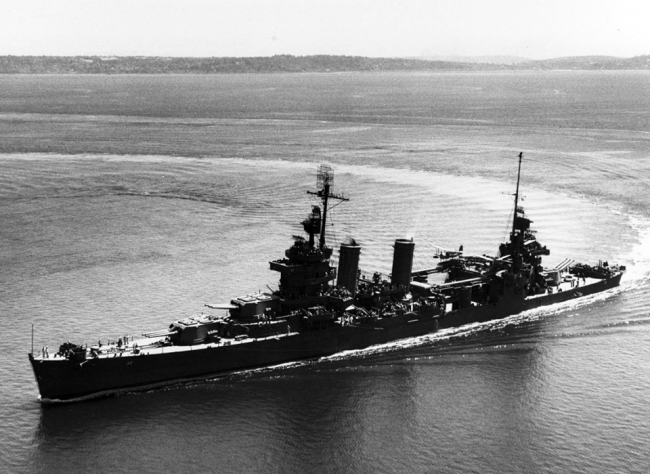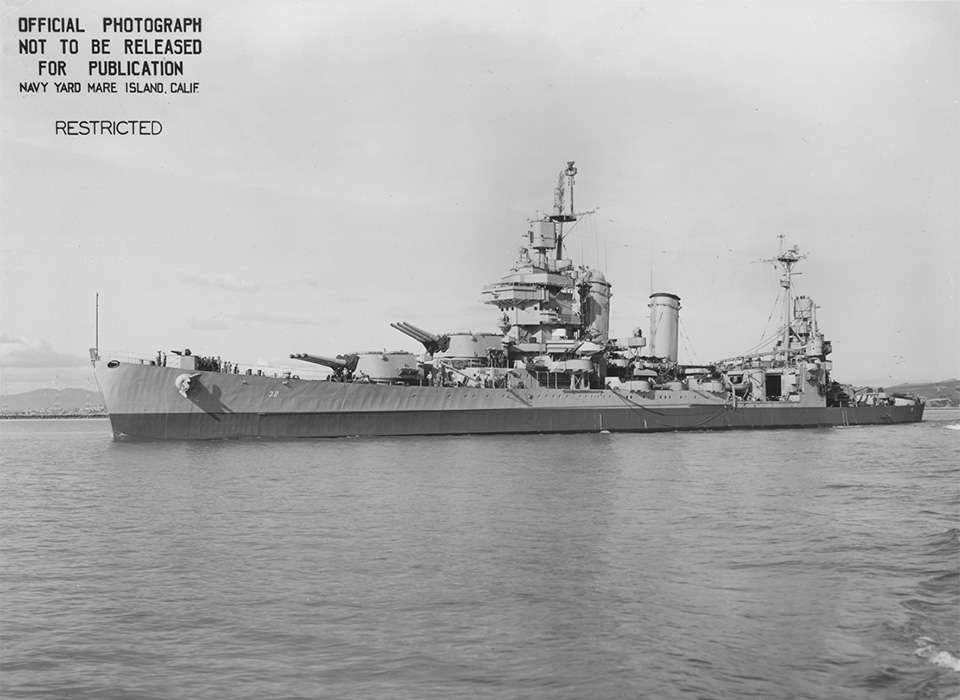
Top Photo: The USS New Orleans, photographed in the San Francisco Bay area in March 1945. Courtesy National Archives
In modern times, all but one US Navy battleship went to sea named after a state within the federal Union. From the 1880s on, each smaller and generally faster cruiser carried the namesake of an American city. Although the USS New Orleans (CA-32) was built in Brooklyn, New York, she represented the “Big Easy” and her people. And now, she is the subject of the newest special exhibit at The National WWII Museum in New Orleans: Come Back Fighting: USS New Orleans at War, now on display in The Joe W. and Dorothy D. Brown Foundation Special Exhibit Gallery.
Before his stint as the Assistant Secretary of the Navy under President Herbert Hoover from 1929 to 1933, New Orleans native Ernest Lee Jahncke was a civil engineer, civic leader, and head of Jahncke Shipbuilding Company. His daughter Cora was the sponsor of the new heavy cruiser, and his son Ernest Jr. was slated to be among the warship’s first group of officers.
Prohibition was still in effect when the USS New Orleans slid into New York’s East River in 1933. News outlets of the era reported that Cora and the elder Jahncke agreed to use Mississippi River water to christen the ship in place of traditional Champagne.
Twice in the 1930s, the new cruiser New Orleans sailed up the Mississippi River to visit her namesake city. There, her crew had the chance to enjoy some Southern charm as well as haunt the bars and shops along Bourbon Street late into the night. But when war came for the United States, the USS New Orleans was gone. Her home port was a far-off naval base called Pearl Harbor.
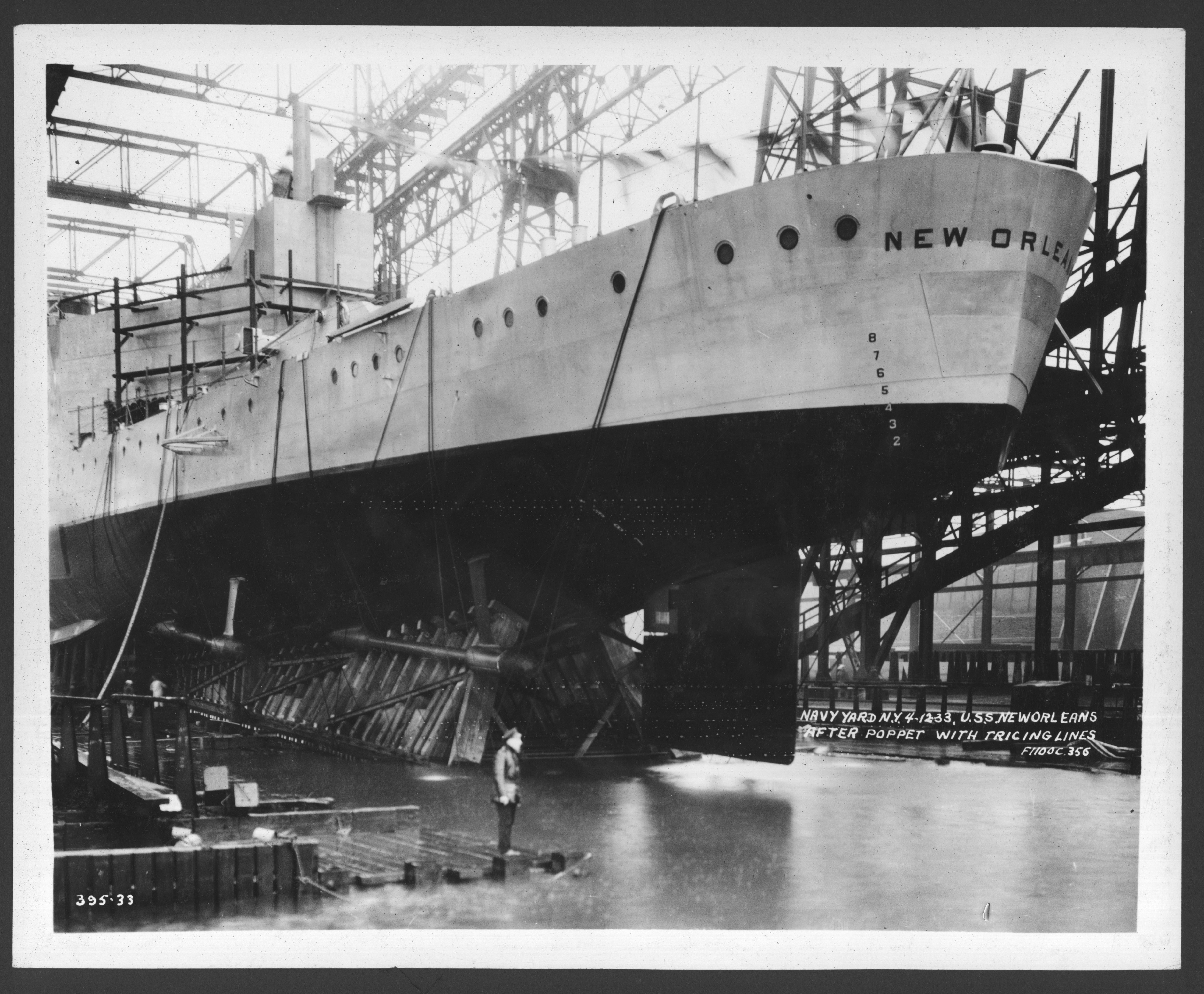
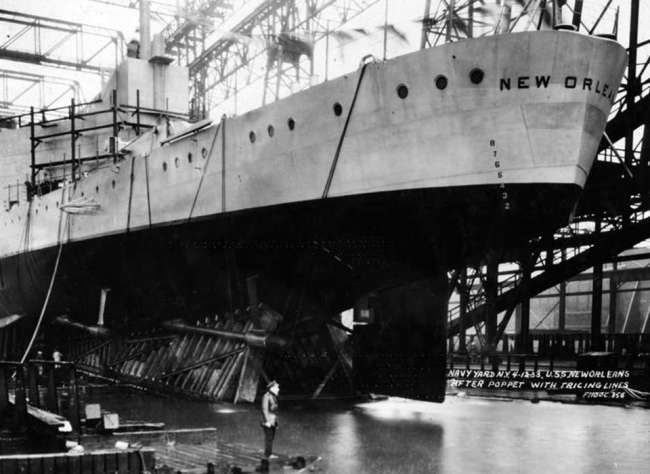
Crews ready the USS New Orleans for launch in 1933 at Brooklyn Navy Yard. Courtesy National Archives
The story of the USS New Orleans in wartime is a perfect conduit for telling the story of the Pacific war at The National WWII Museum. Not only was the vessel a hometown hero, she participated in almost every major campaign against Japan. And, when faced with great tragedy, she always bounced back, similar to how the people of New Orleans fought to recover from disasters such as Hurricane Katrina in 2005.
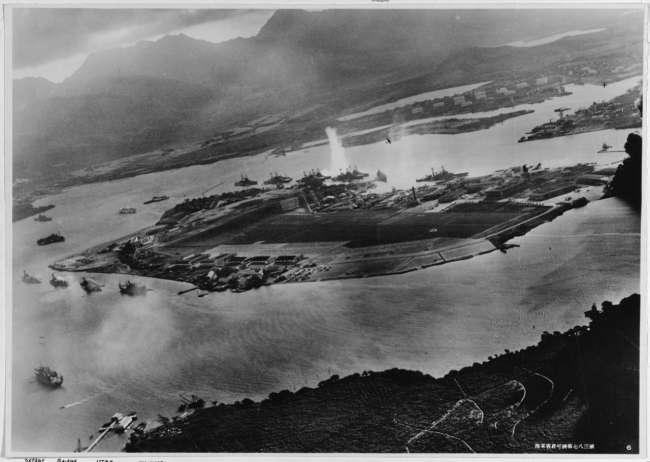
During her 1,365 days at war, there were several setbacks for the ship the sailors lovingly called “NO Boat,” but also many great victories. On December 7, 1941, with her power cut off, sailors of the USS New Orleans hefted ammunition by hand to her 1.1-inch and 5-inch guns to fight attacking Japanese aircraft over Hawaii. Chaplain Howell Forgy encouraged his men as they fought back, shouting, “Praise the Lord and pass the ammunition!” Later made famous by the Frank Loesser-penned song of the same name, the phrase became a rallying cry during the early war years, when the prospect of victory seemed most bleak.1
Come Back Fighting contains sheet music, a production poster, and ephemera that carry the slogan, and the Museum’s own Victory Belles recorded a version of the song to play in the gallery.
The months after Pearl Harbor were filled with missions to the Coral Sea, Midway, and the Solomon Islands. At each turn, the USS New Orleans escorted one of just a handful of aircraft carriers in the Pacific. Her crew witnessed the sinking of the USS Lexington (CV-2) firsthand, participated in the destruction of much of the Japanese carrier fleet at Midway, and protected the USS Saratoga (CV-3) before and after she was torpedoed by a Japanese submarine in the summer of 1942.
That November, the New Orleans was in a line of American vessels tasked with stopping Japanese nighttime supply deliveries to their troops on Guadalcanal. It was dangerous work. When the task force tangled with the Japanese on November 30, 1942, three of the New Orleans’ sister ships—the USS Astoria (CA-34), USS Quincy (CA-39), and USS Vincennes (CA-44)—had already been sunk in the waters off Savo Island, an area sailors were beginning to call “Ironbottom Sound.”
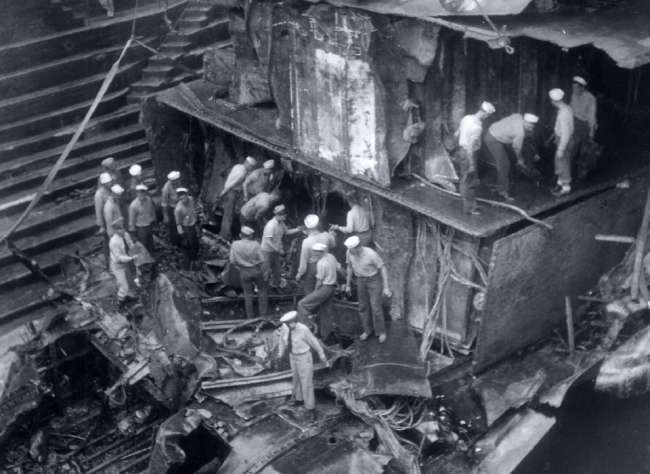
That night, the New Orleans was hit by a Japanese “Long Lance” torpedo that set off the ammunition stored in her forward magazine. The blast severed the mostly unarmored bow, killing more than 180 sailors.
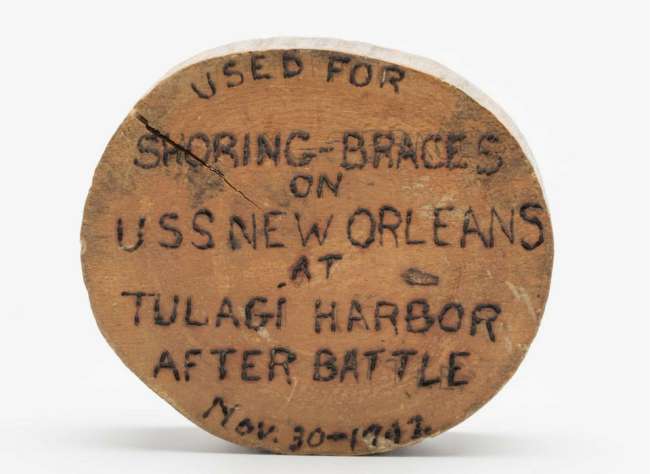
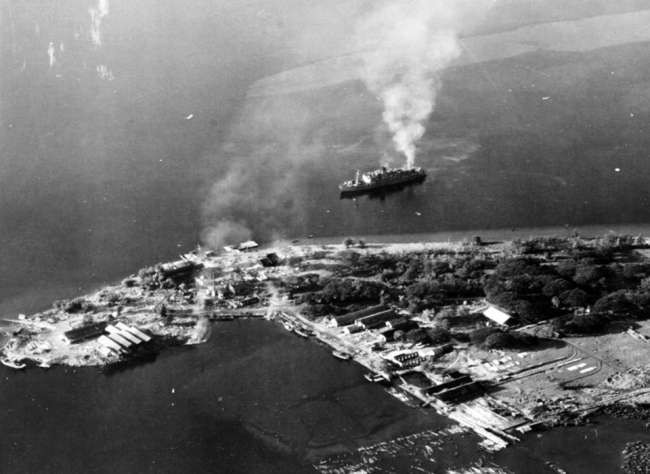
She limped away from the fight to the island of Tulagi, where the survivors camouflaged the ship to keep her hidden from snooping Japanese aircraft. Sailors followed locals into the woods to cut lumber to shore up her severed hull. A souvenir piece of the shoring can be seen in the exhibit, retained by a “NO Boat” sailor as a keepsake.
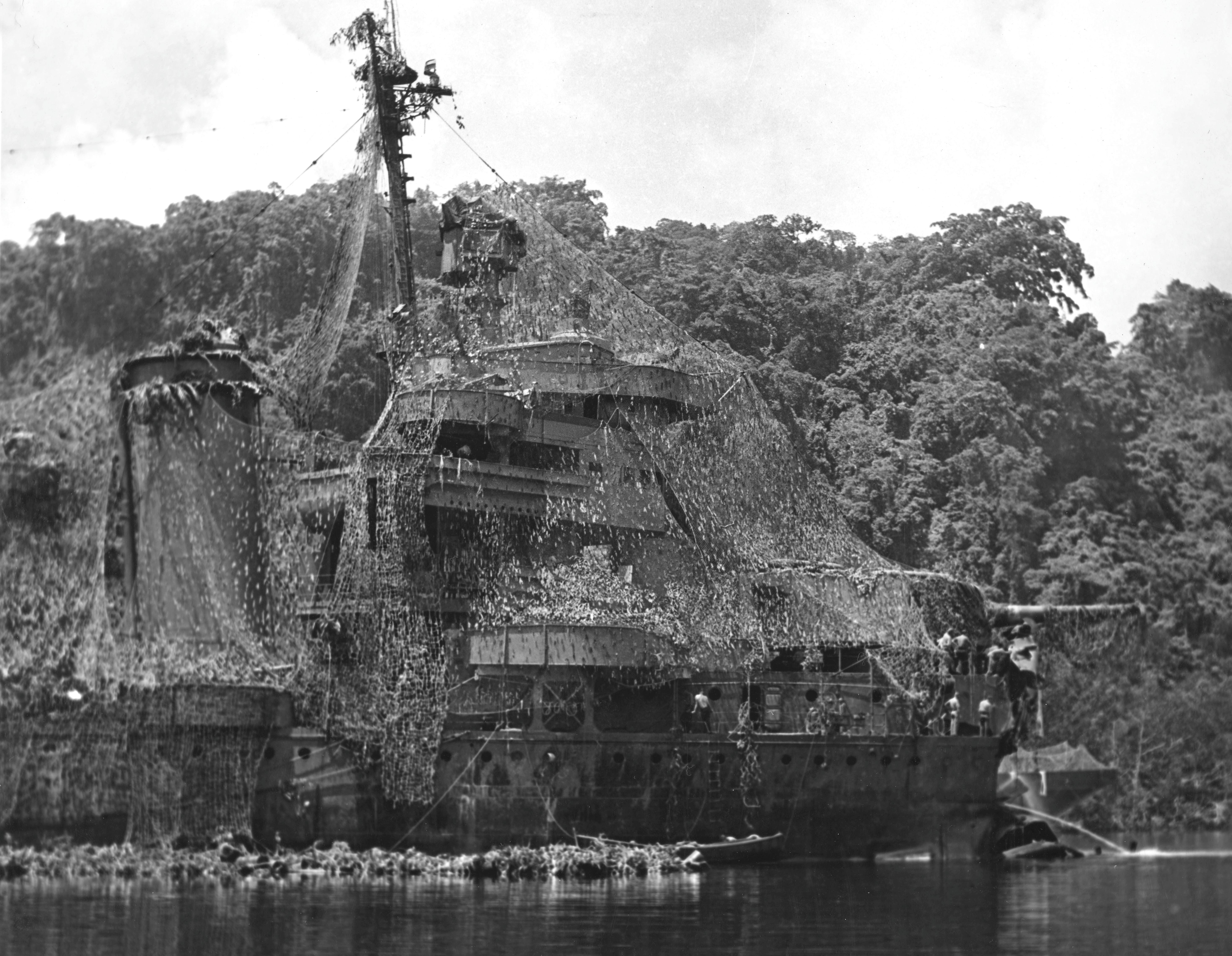
Hidden under camouflage netting near Tulagi, the USS New Orleans prepares to depart to Sydney, Australia for repairs. Courtesy National Archives
As she sailed the 1,800 miles to Australia, the New Orleans made part of the trip cruising backwards to keep the damaged vessel from plunging to the bottom. In Sydney, workers installed an inelegant “stub bow” as a watertight stopgap to get her to Pearl Harbor and then the shipyard in Bremerton, Washington. There, workers attached a new bow section onto the cruiser using plans from the ill-fated USS Astoria, which had been built there less than a decade before.
“NO Boat” went back to sea with a 1940s welded bow and a surviving riveted hull from the 1930s. She also plunged back into war with a trio of 8-inch guns borrowed from her sister ship, the USS Minneapolis (CA-36), which was undergoing repairs in California.
The USS New Orleans’ first target, in October 1943, was Wake Island. During the nine months she’d been out of the Pacific war, the naval situation had changed. American industry had built more aircraft carriers, and they were faster than their predecessors. Likewise, newer and faster warships had arrived on the scene to overwhelm Japan’s ever-shrinking navy.
As a result, the New Orleans took on a new job: bombarding the next island outpost on the “hit list” of America’s island-hopping campaign. At the Gilberts, Marshalls, Truk, the Marianas, and beyond, “NO Boat” blasted enemy positions from offshore with her 5-inch and 8-inch guns.
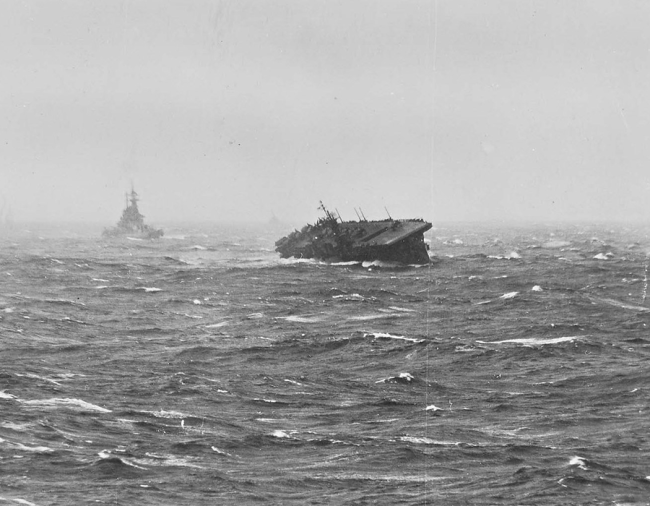
As the war continued, the New Orleans was everywhere, it seems. As part of the Come Back Fighting exhibit, a large projected map shows the “NO Boat” zigzagging all over the Pacific. She traveled more than 430,000 miles during the war, including sailing through Typhoon Cobra, and blasting soon-to-be famous battle locations such as the Philippines, Iwo Jima, and Okinawa.
She was in Subic Bay, Philippines, preparing for the invasion of Japan when the war ended. After working in the northwest Pacific to secure Japanese naval assets, she brought troops home from Guam as part of Operation Magic Carpet.
On her way to the East Coast, the New Orleans sailors wrote to the Mayor of New Orleans, Robert S. Maestri. In the response letter, which is on display in the exhibit, the captain of the USS New Orleans, Charles Frederick Erck, states that seven sailors aboard the ship actually were from the Crescent City. The USS New Orleans was returning home.
The New Orleans pulled into that familiar curve in the Mississippi River for a final visit just in time for Mardi Gras in early March 1946. It was the first full-scale celebration in years in the “Big Easy,” and the remaining sailors aboard “NO Boat” made the best of their final postwar blowout.
Upon her departure, the New Orleans joined the US Navy reserve fleet in Philadelphia. In 1959, she was sold to a scrapping company, and soon after, as some people are fond of saying, she was “turned into razor blades.”
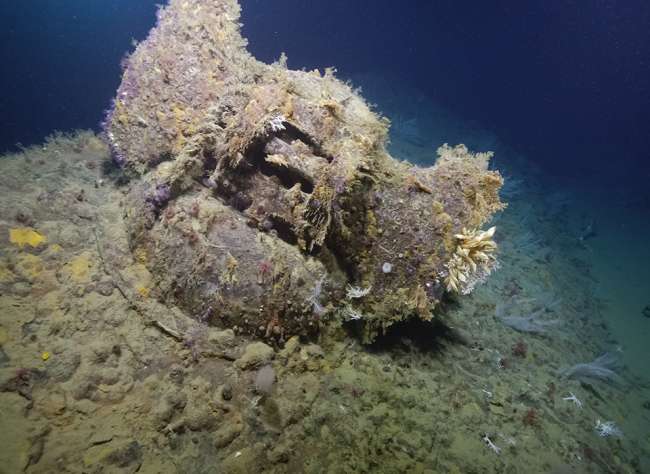
That was the end of the story for decades, until the summer of 2025, when a remotely operated vehicle (ROV) happened upon an unaccounted-for piece of wreckage on the floor of Ironbottom Sound. The crew of the R/V Nautilus soon determined they had found the severed bow of the city of New Orleans’s hometown hero—and the resting place for the sailors who were killed that November night in 1942.
That shattered fragment is the only known surviving piece of the once-proud USS New Orleans. But, as one New Orleans crewman wrote after the war, “I would rather remember her as she was at sea, a strong ship, flag flying, guns at the ready, vibrant and alive, with a crew of fine sailors ready to meet whatever they must.”2

Cory Graff
Cory Graff is a Curator and Restoration Manager at The National WWII Museum.
Cite this article:
MLA Citation:
APA Citation:
Chicago Style Citation: