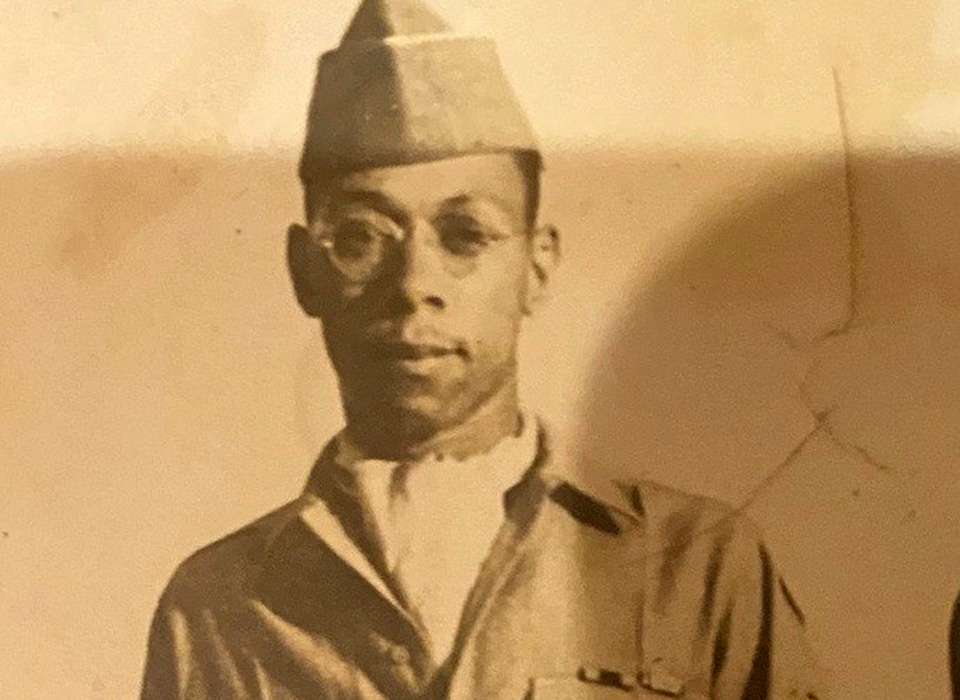
Top Photo: Roy Caldwood. Courtesy of Roy Caldwood
In the mountains above Viareggio, Italy, Roy J. Caldwood learned quickly that being a medic did not exempt him from danger. Within days of joining his unit, he found himself descending a mountainside under active mortar fire to treat a wounded civilian—despite being warned that the shelling would not stop. Moments like these, where compassion collided with combat, defined Caldwood’s experience as an African American medic serving with the 92nd Infantry Division during World War II.
On Veterans Day 2024, I sat down with Roy J. Caldwood for a two-and-a-half-hour conversation during which he shared some of his memories of being a soldier during World War II.
From Harlem to the Army
Roy J. Caldwood was born in the Harlem neighborhood of New York City in 1922. Like most young men of his generation, he registered for the draft after graduating high school. He then went on with his life as he anticipated being called up for military service. Caldwood did not have long to wait —he was drafted into the US Army in July 1943.
Training in a Segregated Army
After completing basic training, Caldwood was sent to Camp Patrick Henry, Virginia, for medical training. Although he had experienced discrimination in New York both before and after entering military service, Virginia exposed him to a far more rigid and institutionalized system of racial segregation. Camp Patrick Henry itself was segregated, and Jim Crow laws governed nearly every aspect of daily life. African Americans were forced to ride in the rear of buses and trains and to sit in segregated sections of movie theaters—even when other seats were empty.
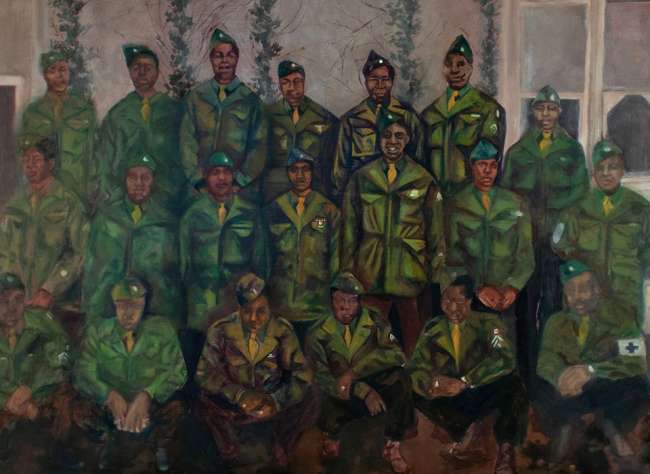
Like many African American soldiers serving in segregated units, Caldwood assumed he would be assigned to logistics battalion as a medic. That expectation changed one day while he was reading Stars and Stripes. In its pages, he saw a call for volunteers for the 92nd Infantry Division—the famous Buffalo Soldiers. For Caldwood, this opportunity represented more than a change of location. Service with the 92nd meant the chance to serve in a combat unit rather than be relegated to manual labor. He and two other soldiers volunteered immediately and were sent by train to Fort Huachuca in Arizona, where the 92nd Infantry Division was preparing for eventual overseas deployment.
Serving with the 92nd Infantry Division
Caldwood and the 92nd Infantry Division deployed to Italy late in the summer of 1944. Upon his arrival in Viareggio, Caldwood learned that he was being assigned to the 92nd Reconnaissance Troop (Mechanized) as a medic. He recounted that he was proud to serve in the 92nd Infantry Division and equally proud to serve as a medic because he would be saving lives rather than taking them.
Within a day or two of his arrival, Caldwood was led up into the mountains above Viareggio by one of the unit’s muleskinners—usually soldiers but in this case an Italian civilian responsible for handling pack mules used to transport supplies through terrain inaccessible to vehicles. The Reconnaissance Troop was positioned along one of the division’s flanks, holding defensive positions and conducting combat patrols in the surrounding mountains.
Treating Civilians and Soldiers Under Fire
While serving in Italy, Caldwood treated many American servicemembers, but many of the encounters that remain most memorable to him involved Italian civilians.
One such incident that stands out in Caldwood’s memory occurred shortly after he joined the 92nd Reconnaissance Troop (Mechanized). According to Caldwood, as he approached a mortar position in the mountains above Viareggio one day, he observed gun crews registering their weapons—firing test rounds to adjust their aim—on terrain near a farm below their position. After several rounds were fired, Caldwood was informed that an Italian civilian had been wounded and several farm animals injured by the mortar fire. He told the mortar section sergeant that he was going down the mountain to treat the wounded man and help move his animals to safety. The sergeant allowed him to go but made it clear that the mortar fire would continue. Caldwood warned him that if the firing continued while he was down at the farm and did not kill him, the sergeant had better make sure to leave before Caldwood returned. A lieutenant standing nearby immediately reprimanded him, but Caldwood went down the mountain anyway to render aid.
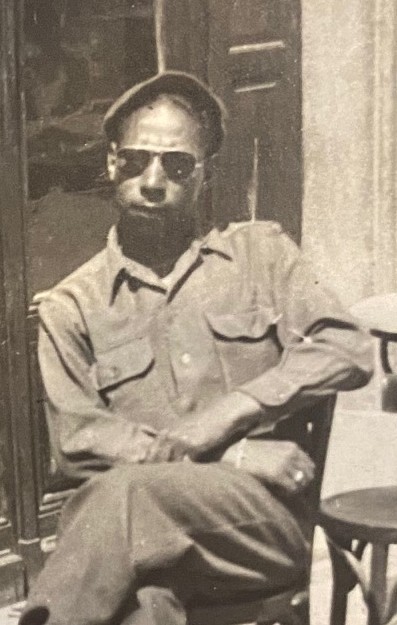
Roy Caldwood. Courtesy of Roy Caldwood
Another encounter Caldwood recalled involved the same lieutenant who had reprimanded him and took place not long after the first one. This time, according to Caldwood, there was a very different outcome. After diagnosing a soldier suffering from shingles, Caldwood said that he informed the lieutenant that the man needed to be sent to the rear for treatment. The lieutenant, he continued, resisted, citing the unit’s lack of manpower at the front and for patrols. Caldwood sent the man back regardless. When the next patrol was formed, Caldwood removed his medical gear, donned combat gear, and volunteered to take the sick man’s place. Seeing Caldwood’s willingness to put his life on the line for his fellow soldiers impressed the lieutenant. From that point forward, the officer treated Caldwood with respect and even offered him the use of his M1911 .45-caliber pistol and shoulder holster.
During our conversation, Caldwood also shared a story about being injured by artillery fire. He said that one day he and a fellow medic were approached by an Italian civilian seeking help for a sick friend. The patient lived in a village scheduled to be shelled by a British artillery battery. Caldwood was told he could provide treatment, but needed to leave the area before the shelling began at 2:00 p.m. By the time he and the other medic departed, the deadline had passed. According to Caldwood, as they left the village, Allied gunners mistook them for German soldiers, and a rain of artillery fire immediately fell around them. One shell detonated just yards in front of Caldwood, the force of the blast throwing him several yards through the air. Luckily, he escaped serious injury, was treated in a nearby aid station, and soon returned to his unit.
A Dangerous Encounter
Not every encounter with Italian civilians that Caldwood recounted during our conversation was positive. He recalled one occasion during which, according to Caldwood, he convinced his lieutenant to allow him, two riflemen, and another medic to escort several Italian women to a nearby market to buy food. To reach the market, they had to pass through an area Caldwood said was nicknamed “Purple Heart Stretch.” Shortly after beginning their journey, he realized the group was likely under observation from a German mortar battery. Undaunted, he chose to keep them moving forward, and the group eventually reached the market, only to find it empty. Caldwood said he turned the group around, but as they made their way back to where they started, they came under fire from German mortars, forcing them to take cover behind a partial cement wall.
As the mortar shells rained down on the group, Caldwood believed the Germans were not actually trying to kill him but instead were trying to talk to him. To Caldwood, the barrage of mortar shells said to him that the Germans had seen him go into the market with the Italian women and they had seen him come out. Further, he believed that the Germans were trying to tell him that they had no desire to continue fighting and wanted to surrender to his platoon.
Caldwood’s group eventually left the protection of the cement wall and made their way back to the American positions. They were not fired on again. When Caldwood arrived back at his outpost, he recalls witnessing the surrender of a group of German soldiers. Caldwood believes that the surrendering enemy troops were the same mortar crews who had shelled them earlier.
Caldwood recounted another incident involving civilians that happened near the end of the war. According to Caldwood, an Italian man working as a muleskinner with the 92nd Reconnaissance Troop informed Caldwood’s lieutenant that local partisans had abducted a young woman and were holding her against her will because she had been “friendly with the Germans.” The muleskinner, Caldwood recalled, guided him, the lieutenant, and several riflemen to the partisans, who ultimately released the young woman after realizing they were outgunned by the American soldiers.
After the War
When reflecting on his service in Italy, Caldwood stated that what left the deepest impression on him was the way many Italian civilians treated African American soldiers. In his experience, Italians did not categorize people by race as Americans did. He was not seen as a Black soldier, but as an American soldier. These attitudes often translated into invitations to share meals, sleep in civilian homes, and attend local gatherings. While exceptions existed, these interactions stood in stark contrast to the segregation Caldwood experienced both before and after the war, helping make an otherwise brutal conflict more bearable.
After the war in Europe ended, Caldwood was transferred to a medical clinic, where he remained until completing his overseas tour of duty. In early 1946, he returned to the United States and was discharged from the Army at Fort Dix, New Jersey, with the rank of Private First Class. In the years that followed, Caldwood began a long career as a corrections officer at Riker’s Island, one of the largest prisons in the world. Over more than two decades, he rose to become assistant deputy warden. His humanistic approach and smooth institutional operations as a program director and training lecturer not only contributed to his success but garnered him respect from both his fellow corrections officers and the prison’s inmate population. That respect likely saved his life when he was taken hostage during one of Rikers Island’s infamous riots in 1972. Roy J. Caldwood retired in 1976, concluding a life of public service that began during wartime.
Joey Balfour
Joey Balfour is the Assistant Director of Oral History at The National WWII Museum and oversees the collection, preservation, of curation of the interviews housed in the Museum’s Oral History Collection.
Cite this article:
MLA Citation:
APA Citation:
Chicago Style Citation: