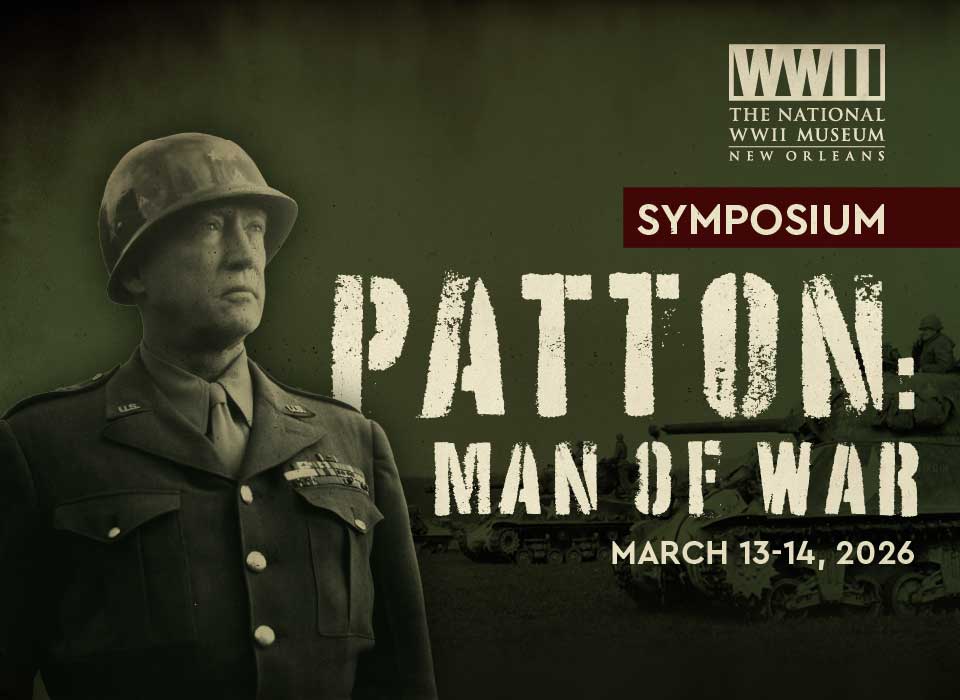
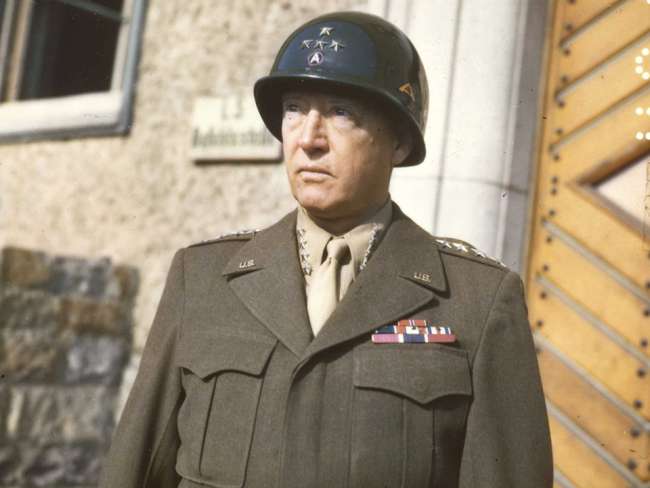
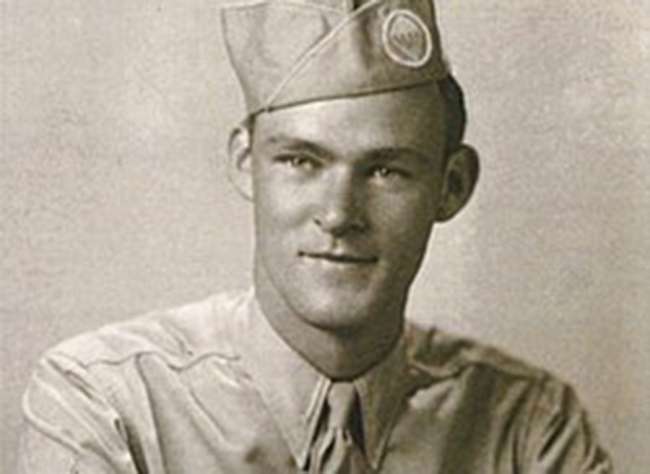
Top Photo: Lieutenant General George S. Patton; National Archives
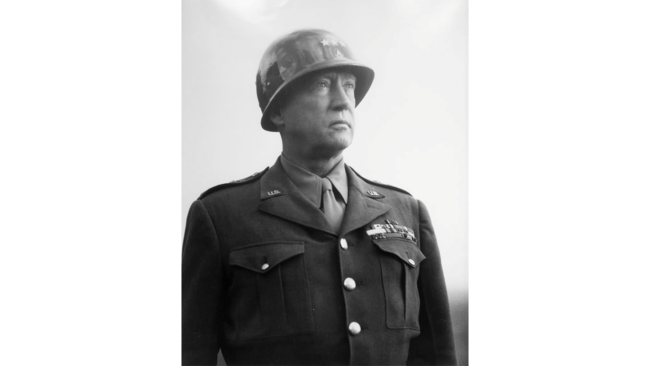
General George Smith Patton Jr. was one of the most renowned and recognizable American generals in World War II. Known as “Old Blood-and-Guts” and often surrounded by controversy, Patton is celebrated for his motivational leadership, audacity, and the rapid advance of his forces across Europe following D-Day. 1
Patton was born in San Gabriel, California, on November 11, 1885. After first entering the Virginia Military Institute in 1903, Patton transferred to the US Military Academy at West Point. He graduated in 1909 and was commissioned as a Cavalry officer in the US Army. The following summer, Patton married Beatrice Banning Ayer.2

Lieutenant George S. Patton as personal aide to General John J. Pershing in Mexico, 1916. National Archives.
In 1912, Patton represented the United States at the Olympic Games in Stockholm, Sweden, in the modern pentathlon, placing fifth out of 42 athletes.3 Patton’s first combat experience came after Francisco “Pancho” Villa attacked Columbus, New Mexico, in 1916. Patton joined Brigadier General John J. Pershing’s staff on the Punitive Expedition to capture Villa. Patton became known for his interest in new military innovations, including mechanized warfare.4
When the United States entered World War I in April 1917, Patton joined General Pershing, then commander of the American Expeditionary Force (AEF), in France. Later that year, Patton left Pershing’s staff to organize and lead the Army’s new tank school in France. As such, he helped develop early American armored tactics by standardizing training, coordinating tank and infantry cooperation, and emphasizing mobility in offensive operations.5 He also commanded the 304th Tank Brigade at Saint-Mihiel. Wounded in combat in Cheppy, France, in September 1918 at the start of the Meuse–Argonne offensive, Patton left the war convinced that speed, aggression, and offensive momentum would define future battlefields.6 Throughout the rest of his career, he remained a student of combined arms, new technology, and communications.
Following the outbreak of World War II in Europe in 1939, Patton advocated for strong American armored forces and was an innovator in combined arms doctrine. After rising to the rank of Major General and making a name for himself during the Army’s prewar maneuvers, he assumed command of the new Desert Training Center in California in January 1942.

General George S. Patton (second from left) in North Africa, date unknown. National Archives
Patton’s combat service in World War II began with Operation Torch, the Allied invasion of North Africa, in 1942. Under the overall command of Lieutenant General Dwight D. Eisenhower, Patton commanded the Western Task Force, which was responsible for the US landings in Morocco. Patton’s forces landed on November 8, 1942, to secure the port of Casablanca. Initially opposed by Vichy French forces, Patton’s I Armored Corps quickly gained control of the beaches. By November 11, Patton’s 57th birthday, Morocco was secure.7 Later in the campaign, Patton was promoted to Lieutenant General and assigned to command II Corps for the assault into Tunisia. He subsequently assumed command of the US Seventh Army ahead of the invasion of Sicily.

Major General George S. Patton Jr., Commanding General of the US Army’s Western Task Force (left), and Rear Admiral H. Kent Hewitt, Commander of the US Navy’s Western Naval Task Force (center), share a light moment aboard the heavy cruiser USS Augusta (CA-31) off Morocco during the Operation Torch landings in November 1942. US Navy.
On July 10, 1943, troops from Patton’s Seventh Army landed in Sicily during Operation Husky. Tasked at first with protecting the British Eighth Army’s flank, Patton’s troops captured Palermo on July 22 and secured Messina on August 17. The Allies’ campaign objectives were met, Mussolini had fallen, and the American fighting reputation was established. Patton’s drive, however, was not without friction in Allied ranks. During this campaign, Patton reportedly slapped two soldiers suffering from what would today be diagnosed as post-traumatic stress disorder, drawing national attention. As punishment, he was ordered to personally apologize to the two soldiers and the entire Seventh Army. He was also relieved of command in the Mediterranean and was ordered to the United Kingdom.8

From left, an unidentified Brigadier General, Lieutenant General George Patton, General H.H. Arnold, and Lieutenant General Mark E. Clark at Castelvetrano Airfield, Sicily, December 27, 1943. Courtesy of the National Archives.
The slapping incident was not the end of Patton’s career, however. In the summer of 1944, Patton took command of the First US Army Group (FUSAG), a fictitious Army group meant to deceive German commanders into thinking that an Allied cross-channel attack would take place in Pas-de-Calais, France, rather than the true target of Normandy, in a plan known as Operation Fortitude. This deception allowed the Allies to successfully land on June 6, 1944, as part of Operation Overlord and fixed German mobile reserves and counterattack forces away from the Normandy assault. Because of Patton’s stature in the eyes of the German High Command, the deception held for several weeks after the D-Day assault.
As the Allies expanded their beachhead in Normandy, Patton took command of the very real US Third Army on August 1, 1944. By the end of the month, the Third Army had broken through German defenses, cleared the Brittany coast, and crossed the Meuse River. In September 1944, Patton and his Third Army fought and defeated the German Fifth Panzer Army counterattack in Lorraine known as the Battle of Arracourt, the largest tank battle in World War II in Western Europe until the Battle of the Bulge.9
On December 16, 1944, German forces launched a major surprise attack in the Ardennes Forest, creating a bulge in the American front lines. Bad weather cut off Allied troops from ground and air support for over a week, until elements of Lieutenant Colonel Creighton Abrams’s 37th Tank Battalion of the 4th Armored Division arrived on December 26 and relieved the 101st Airborne Division and other American forces trapped at Bastogne.10 Patton’s troops kept the corridor to Bastogne open against heavy attacks.
After the Battle of the Bulge, Patton’s troops pushed aggressively into Germany. In early April 1945, they liberated the first concentration camps encountered by the Western Allies. On April 4, the 4th Armored and 89th Infantry Divisions of Patton’s Third Army liberated the Ohrdruf concentration camp, a subcamp of the wider Buchenwald camp system. A week later, on April 12, Generals Dwight D. Eisenhower, George S. Patton, and Omar Bradley toured the camp and saw the extent of Nazi atrocities. Overcome by the scene, Patton was seen to weep, vomit, and refuse to enter a shed that contained 30 emaciated bodies of dead prisoners.
Two weeks later, on May 8, 1945, Germany unconditionally surrendered and the war in Europe was over. Under Patton, the Third Army had achieved impressive results. The Third Army traveled farther than any other army in Europe, capturing over 1,250,000 prisoners and killing or wounding 530,000 more enemy troops.
Following the end of the war in Europe, Patton asked General George C. Marshall, Chief of Staff for the US Army, for a command in the Pacific. Marshall told Patton he would, but only if the Chinese secured a major port to support Patton’s operations. Instead, Patton reluctantly accepted the post of military governor of Bavaria.11 Two months later, on August 15, 1945, Japan’s emperor announced his intention to surrender and on September 2; World War II was over.
On December 9, 1945, while Patton was sitting in the backseat of his command car, his driver sped too fast over a railroad crossing and plowed into an Army truck. Patton was thrown in the accident and was left paralyzed after hitting his head. He was the only one hurt. Twelve days later, Patton died in his sleep at the US Army Hospital in Heidelberg, Germany. He was buried at the Luxembourg American Cemetery alongside his men from the Third Army.

General George S. Patton’s pet bull terrier, Willie, mourns his owner’s passing in Bad Nauheim, Germany. International News Photo courtesy of the National Archives.
General George S. Patton remains one of the most complex and compelling figures in American history. His tactical innovations and battlefield leadership helped lead and inspire the Allies to victory in Europe during World War II, while his personal mythology and media portrayals, including in the 1970 Academy Award–winning film, have cemented his status as an American icon.12 Patton’s life and legacy, though celebrated and debated, endures in the American military, the soldiers he inspired, and in modern understanding of leadership in times of crisis and the people who rise to meet those challenges.
- 1
“Sneak Peek: Patton Symposium in New Orleans,” World War II On Topic Podcast, The National World War II Museum, February 10, 2026. https://www.nationalww2museum.org/war/podcasts/world-war-ii-topic/sneak-peek-patton-symposium-new-orleans.
- 2
Carlo D’Este, “The Pattons of Virginia,” Patton: A Genius for War (New York: HarperCollins 1995), 117.
- 3
D’Este, 131.
- 4
“Sneak Peek: Patton Symposium in New Orleans.”
- 5
D’Este, 208-209.
- 6
“Sneak Peek: Patton Symposium in New Orleans.”
- 7
Kevin M. Hymel, “TORCH: Planning and Execution,” Patton’s War: An American General’s Combat Leadership, Vol. 1 (Columbia: University of Missouri Press 2021), 43-45.
- 8
D’Este, 533-541 and Hymel, 261.
- 9
Sneak Peek: Patton Symposium in New Orleans.”
- 10
Sneak Peek: Patton Symposium in New Orleans.”
- 11
Sneak Peek: Patton Symposium in New Orleans.”
- 12
Patton. Directed by Franklin J. Schaffner. Hollywood, CA. (1970).

Haley Guepet, JD, PhD
Haley Guepet, PhD, is the Research Historian at The National WWII Museum’s Jenny Craig Institute for the Study of War and Democracy.
Cite this article:
MLA Citation:
APA Citation:
Chicago Style Citation: