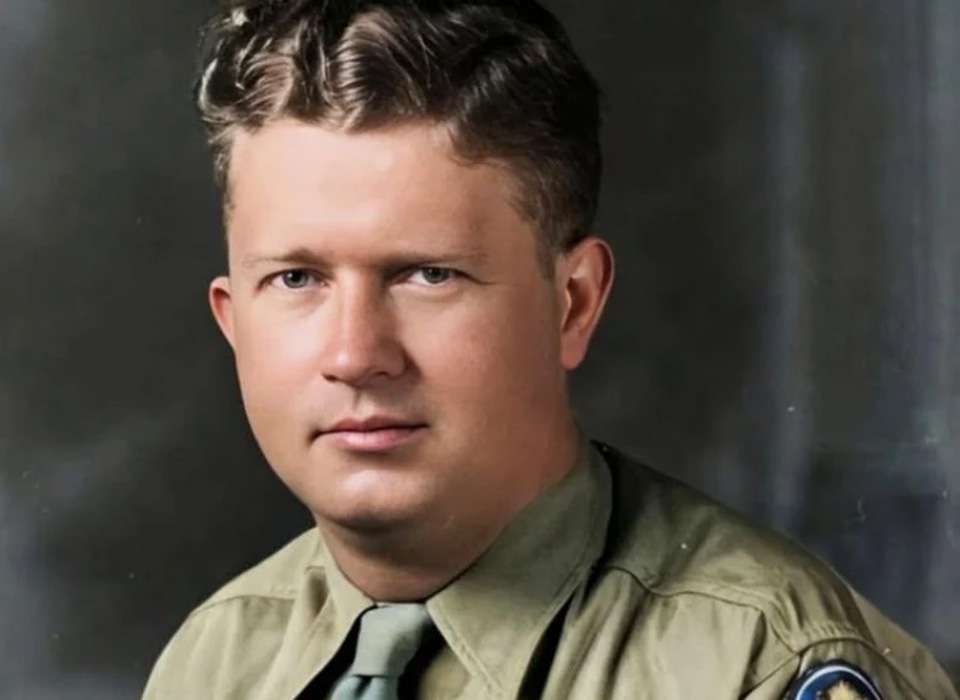
Top Photo: Roderick W. "Roddie" Edmonds, Courtesy of the Congressional Medal of Honor Society
In the European theater, 93,941 Americans were held as prisoners of war. Their conditions varied widely, but, generally, the Germans adhered to the principles of the Geneva Convention with American POWs. The survival rate of US forces in German-run prisoner-of-war camps was nearly 99 percent, with 92,820 former POWs arriving home to their families after the end of the war in Europe.1
One factor in their survival was the social sustenance and physical protection provided by fellow POWs. In instances of abuse of power by captors, this protection was vital. On January 27, 1945, at Stalag IX A in Ziegenhain, Germany, the courage of Master Sergeant Roderick W. “Roddie” Edmonds to speak up for his fellow POWs shielded them from certain persecution and potential death.
Edmonds was born August 20, 1919, in South Knoxville, Tennessee, the youngest of four boys. Before he turned three, Edmonds’s mother died in childbirth, and his Aunt Sallie stepped in to him. In school, he was a hard-working student and had a typical social life—playing baseball, taking part in clubs, and singing in the choir. Raised in a born-again Methodist family, Edmonds had his own spiritual awakening as a young teen and remained a devout Christian throughout his life.
After graduating from Knoxville High School, where he was part of the JROTC, Edmonds went to work for a time before enlisting in the US Army in March 1941. In March 1943, when the 106th Infantry Division was formed, Master Sergeant Edmonds was appointed a communications chief in the 422nd Regiment’s Headquarters Company. He trained up many replacements who were drawn from the Army Specialized Training Program (ASTP) as the demand for men caused trainees to be reassigned to infantry units. Edmonds led the men of the 106th in drills as they prepared to go overseas. They traveled on RMS Aquitania, arriving in Scotland on October 29, 1944.
Following a monthlong stay in Britain, they reached France on December 2, assigned to the VII Corps, First Army, 12th Army Group. By December 9, Edmonds’s regiment was in the frozen Ardennes Forest near St. Vith, Belgium. Within the next 10 days, during the opening of the Battle of the Bulge—the massive German counteroffensive that began on December 16—life changed drastically for the 106th. The division’s regiments were battered, encircled, cut off, and depleted. They faced an experienced enemy, severe cold, German artillery fire, and a desperate fear.
On the morning of December 19, Edmonds and the remainder of his regiment, the 422nd, along with the 423rd, had no choice but to surrender if they wanted a chance at survival. Edmonds was one of thousands of Americans taken prisoner in between December 1944 and January 1945 during the German’s last major counterattack. One-third of all American prisoners of war held by the Germans were captured during the Battle of the Bulge. In total, the 106th had more than 6,500 POWs.2
Treatment of Allied “Kriegies”—English slang for Kriegsgefangenen, the German word for prisoners of war—differed depending on the physical structure of each camp, the individual camp commanders, the stability of supply, and the situation of the war. While those captured prior to the fall of 1944 faced longer imprisonment, the camps they entered were often better equipped to receive and sustain POWs. But the circumstances facing those captured in the winter of 1944–45 were often more dire.
During the Battle of the Bulge, Kriegies faced an especially uncertain fate. As German losses mounted, food became scarcer overall, and as Soviet forces advanced from the East, treatment of American POWs worsened. The Germans were simultaneously evacuating POW and concentration camps as they retreated. During a brutally cold winter, with temperatures dipping below zero, many thousands were forced to march across Europe.
Edmonds’s journey as a POW began with a three-day, 31-mile march without food or water. The Americans had heard of German war crimes, instances where POWs had been murdered, and the knowledge that they might be killed by their captors at any moment filled the men with dread. Jewish American prisoners of war stood in a particularly vulnerable spot. The American uniform protected them, but they were under constant threat, actual and potential, that they would be singled out as Jews, who had been persecuted and murdered by the Nazis for many years.
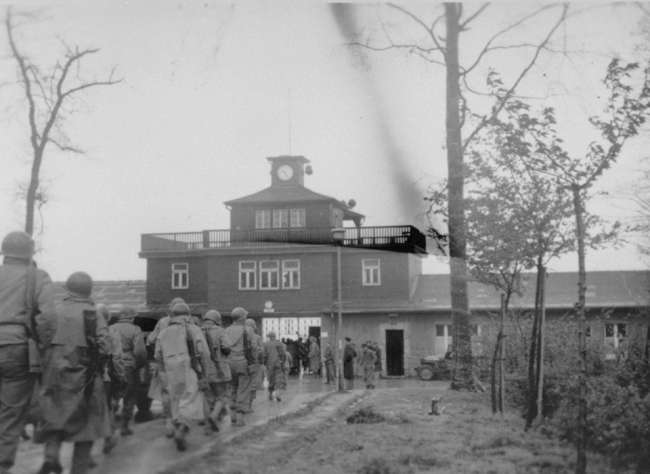
Edmonds and the other POWs were packed into boxcars, where they sat crammed for days with no food or drink. Sergeant Russell Hoff, who had been in charge of a machine gun squadron with the 422nd, recalled eating snow scraped off the sides of the boxcars. On Christmas Eve, their train was bombed by British aircraft, one of many terrifying moments in their captivity. As First Lieutenant L. Martin Jones of the 423rd recalled, “During this air raid, while locked in a boxcar and exposed to the falling bombs, I suffered the most helpless feeling I experienced during my time as a POW.”3 Eventually, the group arrived at Stalag IX B at Bad Orb, 20 miles east of Hanau. There, they were registered as POWs and separated by rank, as was common practice for the Germans. But at Bad Orb they were also segregated by religion, Jews from non-Jews, which was uncommon even in German-run POW camps (with a notable exception at Stalag Luft I in 1945).
On January 25, 1945, 1,292 noncommissioned officers, Edmonds included, were transferred roughly 60 miles north to Stalag IX A at Ziegenhain. Within each camp, the American rank structure was maintained by the POWs. A representative, usually the highest-ranking officer, was designated to mediate with their German captors. Edmonds became that man.
Upon arrival at IX A on January 26, the Germans announced that all Jewish prisoners and no others were to assemble at the next morning’s roll call, and that disobeying this order meant death. Edmonds had witnessed this same degradation at Bad Orb. Some of his closest friends and confidants in the service were Jewish. He called a meeting and ordered the men, now under his command, to disobey the German demand that they segregate themselves. They were to all present themselves at roll call as a unified front.
When all 1,292 men appeared before the German commandant on the morning of January 27, he was furious and shouted at Edmonds to name the Jewish POWs. Drawing on his own faith and his strong belief in standing up for good, Edmonds stated, “We are all Jews here.” Even as the commandant aimed a gun at his head, Edmonds remained firm in his refusal to turn over his fellow Americans. When Edmonds threatened him with a war crimes charge after the war, the commandant finally gave in and walked away. Edmonds’s strong leadership and his defiant action became a source of courage for his comrades in the face of hatred and hopelessness. The roughly 200 Jewish POWs among the group were spared what would have been potentially deadly consequences. Stalag IX A was liberated by the American 6th Armored Division on March 30, 1945.
After the war, Edmonds returned home and started a family. He was recalled to active duty and served in the Army during the Korean War, but he rarely spoke of his time as a POW in World War II. He passed away in 1985 without any recognition for his act of extreme courage. Edmonds’s son discovered his father’s diaries and corroborated the story with several men who testified that Sergeant Edmonds’s bravery had saved their lives. Based on those statements in 2015, he became one of only four Americans, and the only US solider, to be recognized by Yad Vashem as Righteous Among the Nations, an honor bestowed on those who put their lives at risk to save Jewish lives.
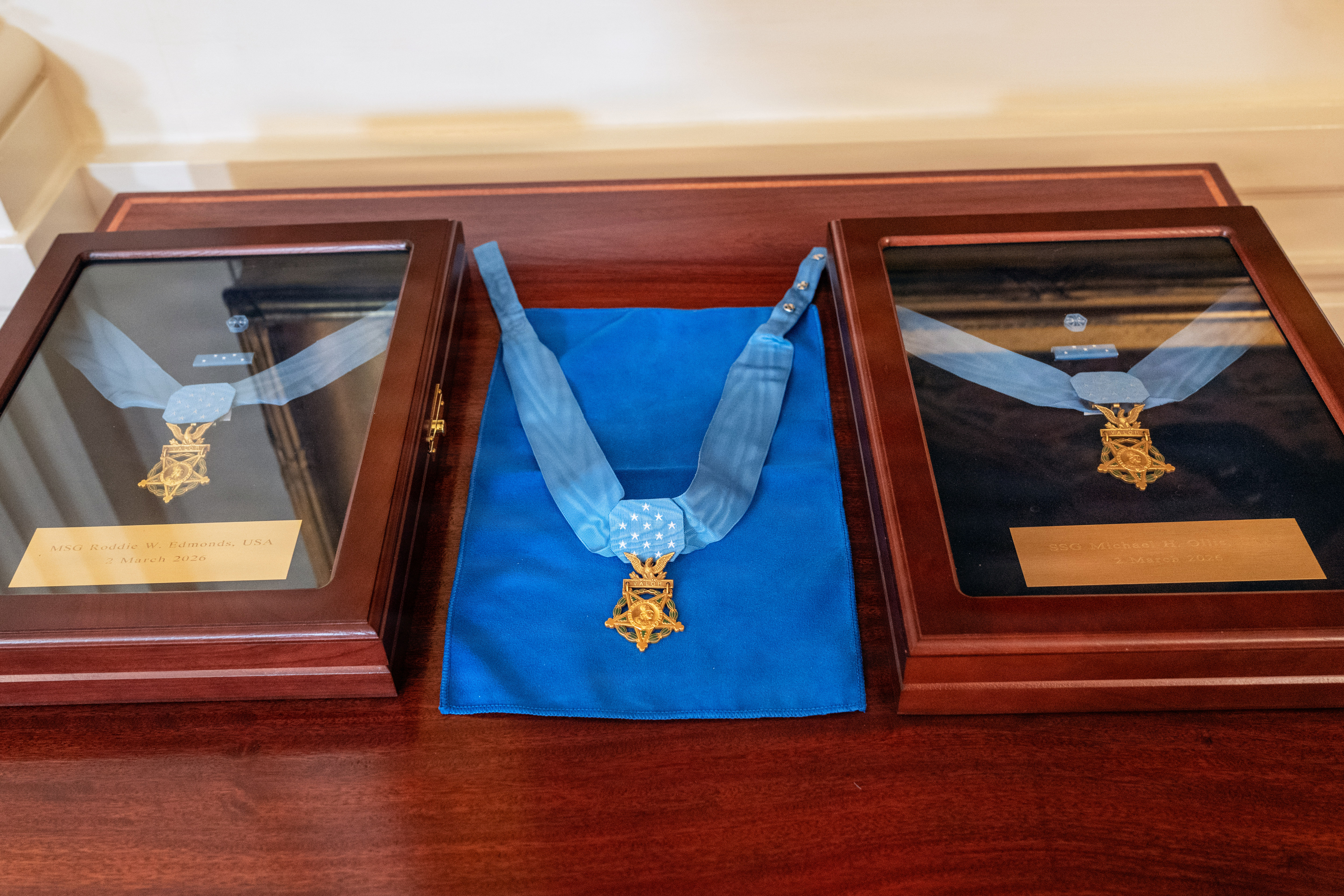
Three Medals of Honor are displayed in the East Room of the White House prior to a ceremony on March 2, 2026, in Washington, D.C. President Donald Trump awarded the Medal of Honor to three US soldiers for acts of gallantry and intrepidity above and beyond the call of duty, including Command Sgt. Maj. Terry P. Richardson, Staff Sgt. Michael H. Ollis (posthumous), and Master Sgt. Roderick “Roddie” W. Edmonds (posthumous). US Army photo by Christopher Kaufmann
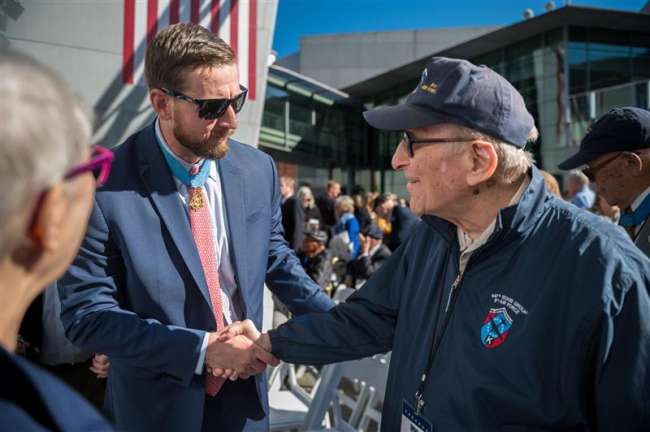
After a decade of advocacy from his family, community, and legislators, Edmonds’s bravery was recognized with the nation’s highest military decoration, the Medal of Honor, which President Donald J. Trump awarded posthumously to Edmonds on March 2, 2026.
His citation reads:
Master Sergeant Roderick W. Edmonds distinguished himself by acts of gallantry and intrepidity above and beyond the call of duty from January 27, 1945, to March 30, 1945, as a prisoner of war in Germany, while assigned to Headquarters and Headquarters Company, 422d Infantry Regiment, 106th Infantry Division. Upon arrival at Stalag IXA in Ziegenhain, Germany, he was soon put to the test as Senior Non-Commissioned Officer. On the evening of January 26, 1945, the Germans announced that only Jewish-American prisoners would fall out for roll call the following morning, at the threat of execution. Master Sergeant Edmonds quickly understood that segregating more than 200 Jewish-American prisoners of war would likely result in their persecution and possible death, so he directed his senior leaders to have all 1,200 American prisoners present themselves for roll call. The following morning, the Nazi Commandant became incredulous after realizing that so many Americans were standing in formation. Master Sergeant Edmonds bravely resisted his fury, while also recounting the rights afforded to all prisoners under the Geneva Convention. Still enraged, the Commandant removed his pistol, pressed it hard against Master Sergeant Edmonds’ forehead between his eyes and demanded that he order all Jewish-American prisoners to step forward, or he would be shot. With unwavering courage at the risk of his life, above and beyond the call of duty, Master Sergeant Edmonds fearlessly held his ground, refusing to concede and verbally warned the Commandant that if he executed him, he would be prosecuted for war crimes once the war was over. Finally, the Commandant, who was visibly reddened with anger, lowered his weapon and returned to his office without further attempts to segregate the Jewish-American prisoners. Master Sergeant Edmonds’ actions inspired his fellow prisoners of war. Several weeks later, in March 1945, as Allied forces were rapidly advancing toward the area, the Germans ordered all prisoners to assemble outside the barracks for evacuation farther east to another camp. Fully intending to undermine his enemy captors, Master Sergeant Edmonds ordered all American prisoners to form in front of the barracks, and when the enemy transports arrived, they would break ranks and rush back to their barracks. Without regard for his own life Master Sergeant Edmonds gallantly led these prisoners in a relentless pursuit of opposition and resistance, forcing the Germans to abandon the camp leaving the 1,200 American prisoners behind. The full extent of his bravery, unbending will, and courageous leadership would be realized when soldiers from 3d U.S. Army liberated the camp on March 30, 1945. Master Sergeant Edmonds’ conspicuous gallantry and intrepidity at the risk of his life, above and beyond the call of duty, are in keeping with the highest traditions of military service and reflect great credit upon himself, his unit, and the United States Army.
- 1
William Paul Skelton, III, MD, Prisoners of War: The American Experience (American Ex-Prisoners of War, 1989), 3.
- 2
Chief Warrant Officer E. J. Kahn, Jr. and Technical Sergeant Henry McLemore, Fighting Divisions (The Infantry Journal Incorporated, 1945), 149
- 3
Lloyd M. Jones, “Infantry Platoon Leader My Experiences in World War II,” last modified 11/28/2006, https://www.indianamilitary.org/German%20PW%20Camps/Prisoner%20of%20War/PW%20Camps/Stalag%20IX-B%20Bad%20Orb/LMartinJones/LMartinJones.htm.
Kim Guise
Kimberly Guise holds a BA in German and Judaic Studies from the University of Massachusetts Amherst. She also studied at the Universität Freiburg in Germany and holds a masters in Library and Information Science (MLIS) from Louisiana State University. Kim is fluent in German, reads Yiddish, and specializes in the American prisoner-of-war experience in World War II.
Cite this article:
MLA Citation:
APA Citation:
Chicago Style Citation: