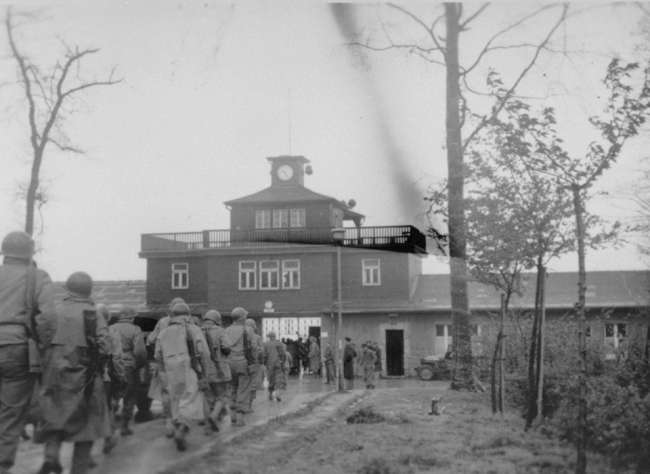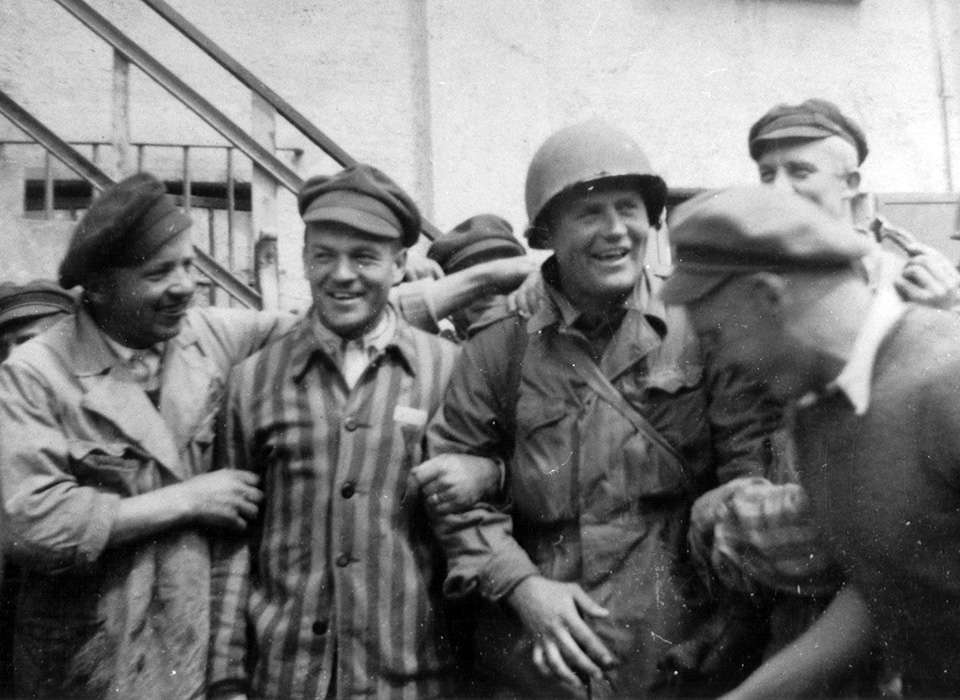
Top Photo: An American Soldier is surrounded by survivors at the newly liberated Dachau concentration camp, April 29, 1945 in Dachau, Germany. American Soldiers of the U.S. 7th Army, including members of the 42nd Infantry and 45th Infantry and 20th Armored Divisions participated in the camp’s liberation. U.S. Army photo courtesy of the U.S. Holocaust Memorial Museum.
Dachau was the first concentration camp in the Nazi system, erected at the early date of March 22, 1933. Originally a place for “political enemies” and “asocial elements” of German society, the camp evolved into a brutal slave labor facility and a twisted laboratory where Nazi doctors used prisoners for experiments with malaria drugs, the effects of high altitude, and hypothermia.1
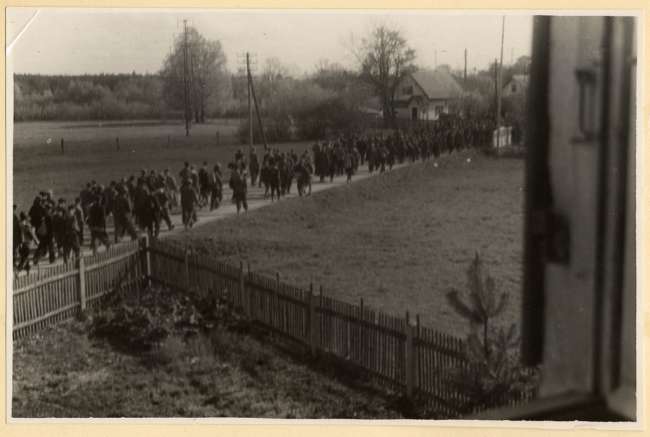
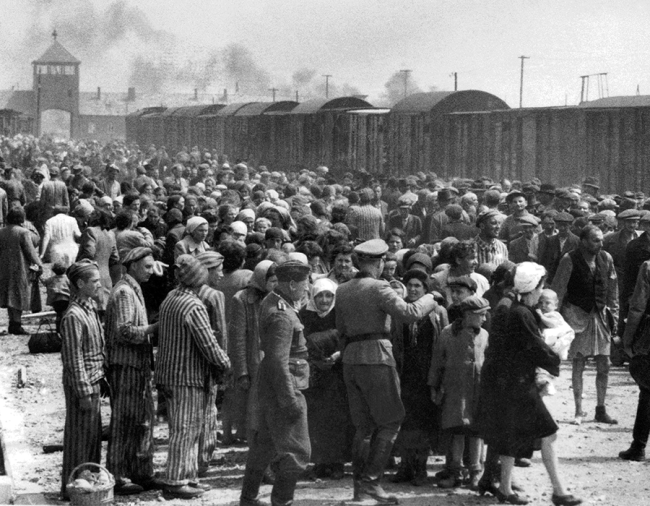
Toward the end of World War II, Dachau became a destination for Nazi death marches. The population swelled with sick and emaciated prisoners evacuated from other camps ahead of advancing Allied armies. In April 1945, historians estimate that more than 40,000 people from 30 different nationalities were packed into the camp complex, and without adequate medical care and food, more than 200 per day were dying.2 In the first four months of 1945 alone, the death toll ranged from 2,625 to 3,977 per month, with half of all deaths at the camp occurring in the six months before liberation.3
Dachau survivor Ben Lesser arrived at the camp on a death train just a few days before liberation. “We walked into the camp of Dachau and we see mountains full of dead bodies,” he explained. “Apparently the Nazis ran out of coal to burn the bodies in the crematorium so they piled them up as high as they could. And they put me and my cousin in a barrack right next to the crematorium, next to these bodies. … On the third day we hear ‘liberation,’ ‘Americans, Americans.’ I tell my cousin, ‘Let’s go out and see,’ and we’re holding each other going out and we see these inmates are crawling on their hands and knees and kissing the boots of the GIs. They looked like gods to us.”4
Hailed as saviors from the depths of Nazi terror by the survivors, nothing could have prepared American troops for what they encountered at Dachau. In the words of William McCormick of the 15th Reconnaissance Group, US Seventh Army, “When I first went into the camp, the first thing I saw was people walking around and they looked like skeletons. And you could look like … you could almost … see through them. They were so thin, and they looked like zombies walking around. And you couldn’t believe a human being could be so thin and still be on its feet. … I’d say there was 25 boxcars full with bodies that were just laying there. And they threw lime on these people to keep the smell down. It didn’t help much … the odor was still terrible. … I’d say there was, I couldn’t estimate, but there was thousands of people dead there. It was terrible.”5
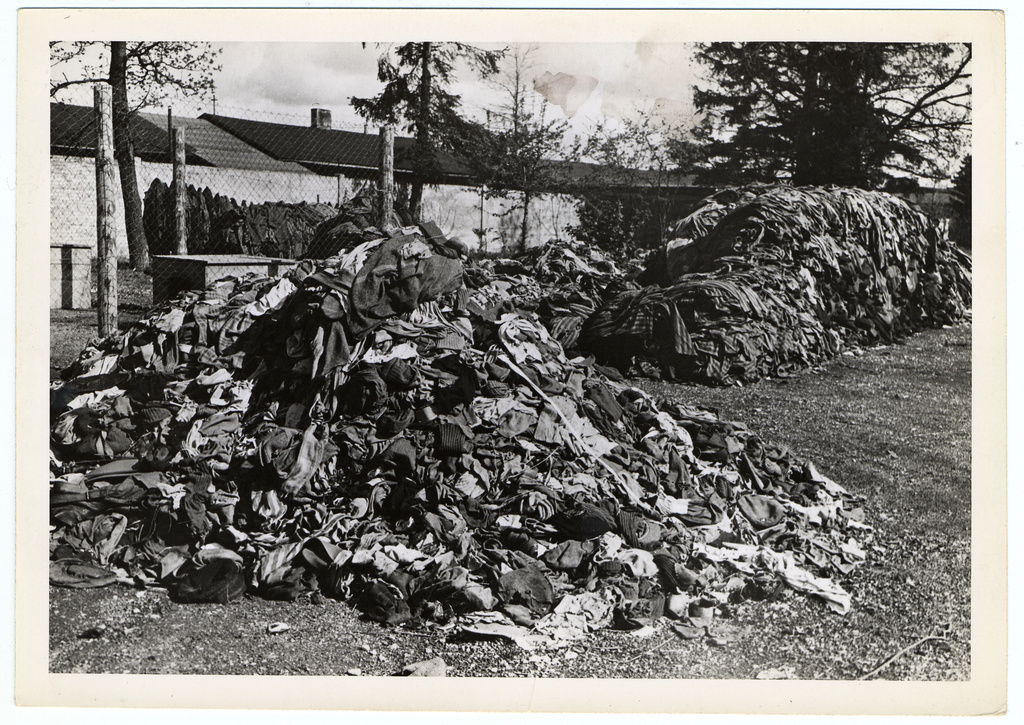
Tattered clothes from prisoners who were forced to strip before they were killed lay in huge piles near the crematorium of Dachau on April 30, 1945. United States Holocaust Memorial Museum
Orderly Cobblestone Streets and Colorful Flower Beds
The United States Holocaust Memorial Museum has recognized the Seventh Army’s 42nd Infantry, 45th “Thunderbird” Infantry, and 20th Armored divisions as the “Liberating Units for Dachau.”6 Yet aside from a few officers, none of the enlisted soldiers in these units were particularly aware they would be securing, and ultimately liberating, a concentration camp. According to historian John McManus, “April 29 began for them as just another day in action, carrying out a mission, hoping to survive to see another sunrise.” 7
In fact, the 45th Division had been held up for nearly a week and took heavy casualties in nearby cities of Aschaffenburg and Schweinheim, which the Germans defended almost to the last man. Fighting their way through the town of Dachau, the 42nd Division had suffered a casualty during a skirmish that very morning with fleeing Waffen-SS.8 For most American troops, Dachau, “with its orderly cobblestone streets, wood-framed, gingerbread-like homes, and colorful flower beds was … just one more place they had to conquer on the way to final victory.”9
Despite the liberations of Ohrdruf, Buchenwald, and other concentration camps earlier in the month, most American had little concept of Nazism’s darkest horrors.
But April 29, 1945, would radically depart from a “normal” day advancing through the crumbling Reich. Sid Shafner, a member of an intelligence and reconnaissance platoon in the 20th Armored Division, described arriving in Dachau: “As we approached the town, we did what we normally do when we approached little towns where they have a church steeple in the center of the town. As the church steeple came into view, we shot out the top of the steeple because it was known that Germans had snipers in those church steeples.”
Then things veered into the abnormal. “As we were doing this, two young people ran across the road towards us from our right, approaching us. And they were dressed in black and white striped, prison-type clothing, and one of them excitedly said to us, ‘Come quickly, they’re killing people in this camp down the road.’ I was able to converse with them, and I said to them, ‘Hey, if you kids are circus people or carnival people, this is no time for jokes.’”10
Shafner reported his encounter with these oddly dressed civilians up the chain of command, but other similar reports were coming in, and soon the direction of the Americans’ advance changed entirely. Elements of the 42nd Infantry Division operating nearby received a reorientation to their mission, while Lieutenant Colonel Felix Sparks and his 3rd Battalion of the 157th Infantry Regiment, along with the combined arms task force of tanks from the 191st Tank Battalion and artillery from the 158th Field Artillery Battalion, were redirected from the 45th Infantry Division’s push to Munich and attacked toward the camp.11
First Contact at Dachau
Colonel Bill Walsh of the 45th Division was among the very first Americans to enter Dachau later that day as US Army forces converged on the camp. The first thing he and his men confronted was a train of 39 open boxcars filled with as many as 2,300 corpses.12 As one soldier described it, “Their cadaverous arms and legs seem disproportionately long compared to their sunken abdomens, narrowed bony chests, visible ribs, protruding shoulder blades, and withered necks—all signs of starvation.”13
Miraculously, Technician Fourth Grade Antony Cardinale, a radioman with the 42nd Infantry Division, found a person still alive amid the bodies: “I saw this hand weakly waving back and forth. It was poked up between some of the bodies on top of it. It was quite evident that its owner was alive, and had heard our voices, and was desperately trying to attract our attention.”14 Lieutenant Colonel Don Downard, commander of the 2nd Battalion, 222nd Infantry Regiment of the 42nd Infantry Division, along with Captain Roy Welbourn, entered the car, dug through the bodies, and reached the survivor. His pants slid off and his hip bones were visible, but the Americans noticed he had a smile on his face. He looked at Cardinale and asked in German: “Frei? Frei?” To which Cardinale nodded and said, “Du ist frei” several times. The scene was almost surreal as the young man continued repeating the words: “Frei, frei,” as if in shock.15
Beyond the train lay the camp gates, and soon thousands of screaming prisoners descended on the American soldiers with applause, even lifting some up in gratitude. Such an overwhelming greeting combined with the sights, smells, and sounds of Dachau overpowered nearly everyone who experienced the moment. Camp survivor Gleb Rahr described a sound “which I had never heard in my life. It was a howling—not the howling of wolves—but of men.”16 Visually, the soldiers “were absorbing the disturbing sight of the ragged, hungry prisoners, figuring out the geographic layout of the compound. … Some had also gotten their first glimpse of the crematorium and gas chamber … where hundreds of emaciated bodies lay in heaps, awaiting incineration. These sights, together with all the others, ratcheted up the tension still further.”17
Odor featured prominently in many liberators’ memories of Dachau. The smell of burned flesh and hair, body odor, rotting bodies, and raw sewage commingled into an olfactory affront. Private First Class Russell McFarland remembered: “The stench from the Camp stayed in my lungs for about three days after leaving.”18
Shock and Retribution
Of the liberation of Dachau, Supreme Allied Commander General Dwight D. Eisenhower had reported that nearly 300 camp guards were quickly neutralized in the effort to seize the camp. The situation in the camp, however, was messier than Eisenhower’s report suggests.
“During the early period of our entry into the camp, a number of company men, all battle-hardened veterans, became extremely distraught,” Lieutenant Colonel Sparks recalled. “Some cried, while others raged. Some thirty minutes passed before I could restore order and discipline.” Simultaneously, the nearly 30,000 surviving prisoners began to shout in unison as they pressed against the barbed wire reaching for any “informer,” whose bodies they collectively tore apart in mass retribution.19
In one instance, SS guards from the gate tower came down with their hands up when American troops opened fire, but one of the SS troopers had pistol concealed behind his back and was shot. In the confusion of the camp, one group of SS troopers had surrendered and were placed under the watch of American GIs, while fighting continued with those who had not surrendered. Indeed, amid the emotional and sensory overload, some American soldiers may have committed reprisals against those SS guards. By some accounts, as many as 30 to 50 SS guards who initially had surrendered, or indicated that they would surrender, were killed during the liberation of the camp.20
Piecing together several accounts of the liberation highlights the horror and confusion American soldiers operated under as combat continued. Describing the incident in which SS prisoners were shot reportedly trying the escape, Sparks later reflected that he had just placed a group of SS under guard and was walking away when: “I hear the machine gun guarding the prisoners open fire. I immediately ran back to the gun and kicked the gunner off the gun with my boot. I then grabbed him by the collar and said: ‘What the hell are you doing?’ He was a young private about 19 years old and was crying hysterically. His reply to me was: ‘Colonel, they were trying to get away.’ I doubt that they were, but in any event he killed about twelve of the prisoners and wounded several more.”21
The 19-year-old was likely Private William C. Curtin, who historian Alex Kershaw noted fired three bursts of the machine gun, as many as 30 rounds, before Sparks arrived, “pulled his .45 from his holster, thrust out his palm, shouted for his men to stop, and fired shots in the air. The firing got everyone’s attention and stopped the shooting.”22 The American lieutenant in charge of Curtin’s detachment admitted to giving orders to the machine gun squad that “if [the SS prisoners] didn’t stay back, fire at them. … I told the machine gun to fire to hold them back.”23
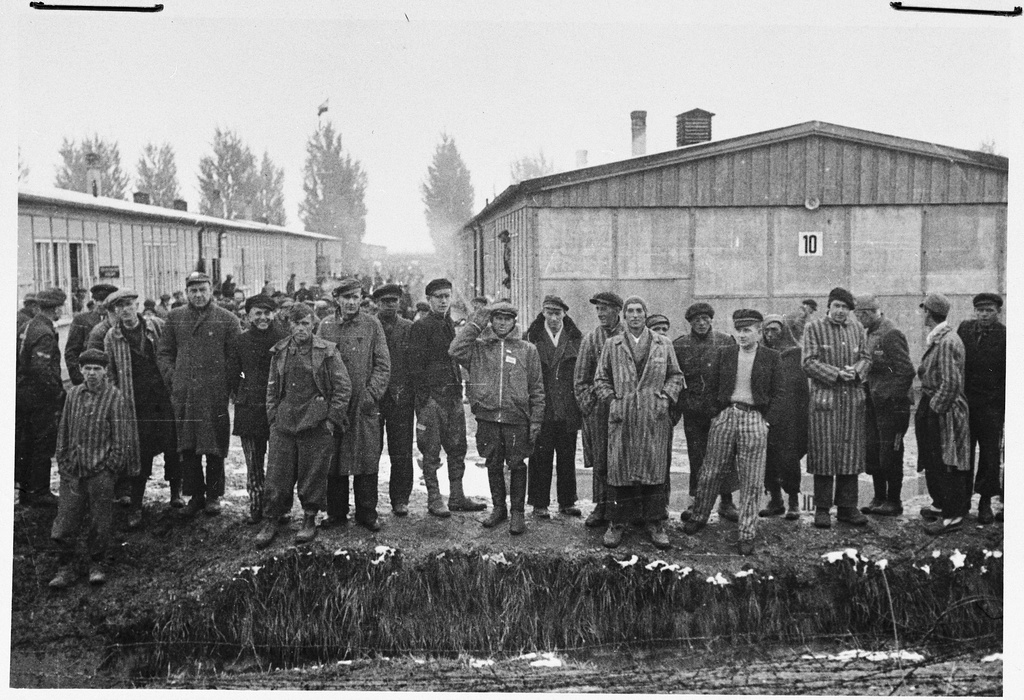
Group portrait of survivors standing next to the moat in the Dachau concentration camp following liberation.April 1945. United States Holocaust Memorial Museum
Sparks was relieved of his command soon afterwards, but General George S. Patton overturned a recommendation for a court martial, telling Sparks: “I have already had these charges investigated…and they are a bunch of crap. I’m going to tear up these goddamn papers on you and your men.” Sparks remembered: “It was a with a characteristically dramatic flourish that Patton did indeed tear up the papers on his desk before dumping them in a wastebasket. ‘You have been a damn fine soldier,’ added Patton. ‘Now go home.’”24
Later in 1945, after an investigation, Deputy Judge Advocate Colonel Charles L. Decker, concluded that “in light of the conditions which greeted the eyes of the first combat troops … it is not believed that justice or equity demand that the difficult and perhaps impossible task of fixing individual responsibility now be undertaken.” 25
The Meaning of Dachau
After overcoming their initial shock, American soldiers quickly had to dispatch unpopular news: the prisoners had to remain in place for now. Food, medicine, and clothing were all inbound, but letting 30,000 prisoners out with the war still raging nearby was a recipe for disaster.26 In the meantime, as liberation turned into occupation, many other American soldiers entered the camps over days and weeks, bearing witness to the horrors.
The one common refrain from liberator testimonies of Dachau was seeing the stacks of bodies. Nearly 5,000 bodies needed to be dealt with upon liberating the camp, and that number may have increased as survivors died from their conditions even after liberation. Most disturbing for soldiers was the horrific, emaciated condition of both the living and the dead. For Private First Class Robert Perelman, they were “so much like skeletons it was hard to tell the men from the women.” Perhaps Private First Class Jim Dorris best summed up Dachau: “This has got to be what hell is like. God, help me get out of this place.”27
With liberations of Buchenwald and Bergen-Belsen fresh in the minds of Allied reporters, news of Dachau’s liberation sparked a media blitz. General Alexander Patch, who commanded the US Seventh Army, wanted the evidence of German brutality untouched before it was inspected and documented. Thus, when a congressional delegation arrived on May 1, and an 18-member newspaper delegation two days later, they encountered piles of decomposing human remains and recorded raw scenes of the suffering. Beginning on May 1, just two days after liberation, newsreels began running in Allied movie theaters, and on May 7, Life magazine showed graphic photographs from Dachau.28
After the main camp at Dachau was secure, American officials followed a routine that had now become familiar: bringing local Germans into the camp to view the crimes carried out in their names. On May 7, after warm temperatures made burial of the dead urgent, soldiers requisitioned all farm wagons in the vicinity of Dachau and selected local townspeople to load and transport bodies from the camp to be buried in mass graves dug by captured SS men. As historian Harold Marc29use noted, “For three days, columns of twelve horse-drawn carts each laden with about thirty emaciated corpses passed through the town to a nearby hill called Leiten, where the SS had begun burying its Dachau victims in the fall of 1944. Afterwards, at least one soiled cart was left at a central point in town as a warning for the citizenry.”30
Other German citizens professed ignorance but contradicted themselves within the same narrative. “Yes, the conditions of the camp are frightful, but you must understand we knew nothing of its horrors,” one teacher stated. “We understood a little, but it was dangerous to know too much. A man must live himself.” Damning in its incongruence, the statement reveals how locals had knowledge of the camps but knew enough to know they did not want to know more.
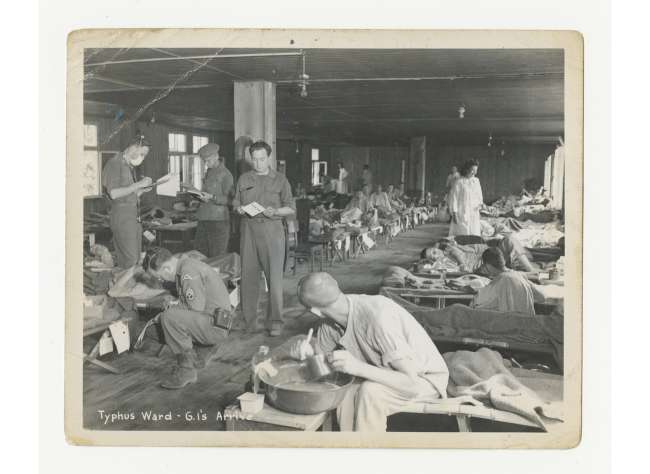
Americans liberated 31,000 people at Dachau. Some perished from their diseases or destitute states, and others over-consumed food and drink given by the liberating forces. But for all who lived through this period, recovery and freedom were high on their to-do lists. Americans quarantined the camp on May 2, and by late June, all who wanted to be repatriated and returned home had completed that journey. Left were Poles, Russians, Hungarians, and Romanians, who did not want to return to their homes, which were now in Soviet-occupied territory, as well as many Jews with nowhere left to go. These individuals were moved out of the prisoner barracks, and by early July 1945, that now-empty portion of the camp was transformed from a displaced persons camp to a “war crimes enclosure,” which held up to 30,000 Germans who had been active at high levels of the SS, Nazi Party, and Wehrmacht.31
Today, the concentration camp at Dachau, liberated by the US Army toward the end of World War II in Europe, has become a memorial to the victims of the Nazi regime.
- 1
John C. McManus, Hell Before their Very Eyes: American Soldiers Liberate Concentration Camps in Germany, April 1945 (Baltimore: Johns Hopkins Press, 2015), 65-73.
- 2
McManus, 74.
- 3
Harold Marcuse, Legacies of Dachau: The Uses and Abuses of a Concentration Camp, 1933-2001 (Cambridge: Cambridge University Press, 2001), 49.
- 4
“Holocaust Survivor Talk: Ben Lesser,” Holocaust Museum LA, October 7, 2021, https://youtu.be/R2MihZMx5ZE?si=Iiz8PeZ0YrPaBeQG, 1:03:00-1:04:45.
- 5
United States Holocaust Memorial Museum, RG-50.462.0092, “Oral History Interview with William McCormick,” Interviewed January 11, 1988, 2:30-4:20.
- 6
Jason Dawsey, “The last Days of the Dachau Concentration Camp,” National World War II Museum, July 15, 2022, https://www.nationalww2museum.org/war/articles/last-days-dachau-concentration-camp; McManus, 77.
- 7
McManus, 77-78.
- 8
Marcuse, 51.
- 9
McManus, 77-78.
- 10
RG-50.467.0010, Oral History Interview with Sid Shafner, United States Holocaust Memorial Museum, 1:00-2:15.
- 11
McManus, 78.
- 12
Marcuse, 51.
- 13
McManus, 80.
- 14
McManus, 82.
- 15
McManus, 83.
- 16
McManus, 109.
- 17
McManus, 108.
- 18
McManus, 120.
- 19
“Dachau and Liberation; Dawsey, “The Last Days.”
- 20
Dachau and Liberation – Personal Account by Felix L. Sparks Brigadier General, US (Retired), https://remember.org/witness/sparks2, Accessed January 30, 2026; Dawsey, “The Last Days,”
- 21
Ibid.
- 22
Alex Kershaw, The Liberator: One World War II Soldier’s 500-Day Odyssey from the Beaches of Sicily to the Gates of Dachau (New York: Broadway Books, 2012), 286-287.
- 23
Ibid, 314.
- 24
Kershaw, 319.
- 25
Kershaw, 320.
- 26
McManus, 111.
- 27
Both quoted from McManus, 119.
- 28
Marcuse, 54-55.
- 29
Marcuse, 58.
- 30
Marcuse, 57.
- 31
Marcuse, 65-66.
Jacob Flaws, PhD
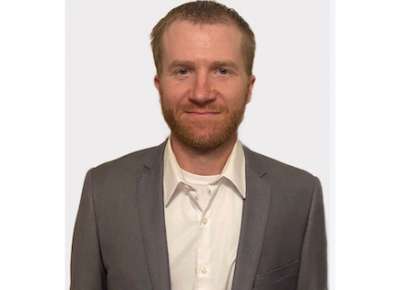
Jacob Flaws, PhD, is an assistant professor of history at Kean University and a Nonresident Fellow at the National World War II Museum.
Cite this article:
MLA Citation:
APA Citation:
Chicago Style Citation: