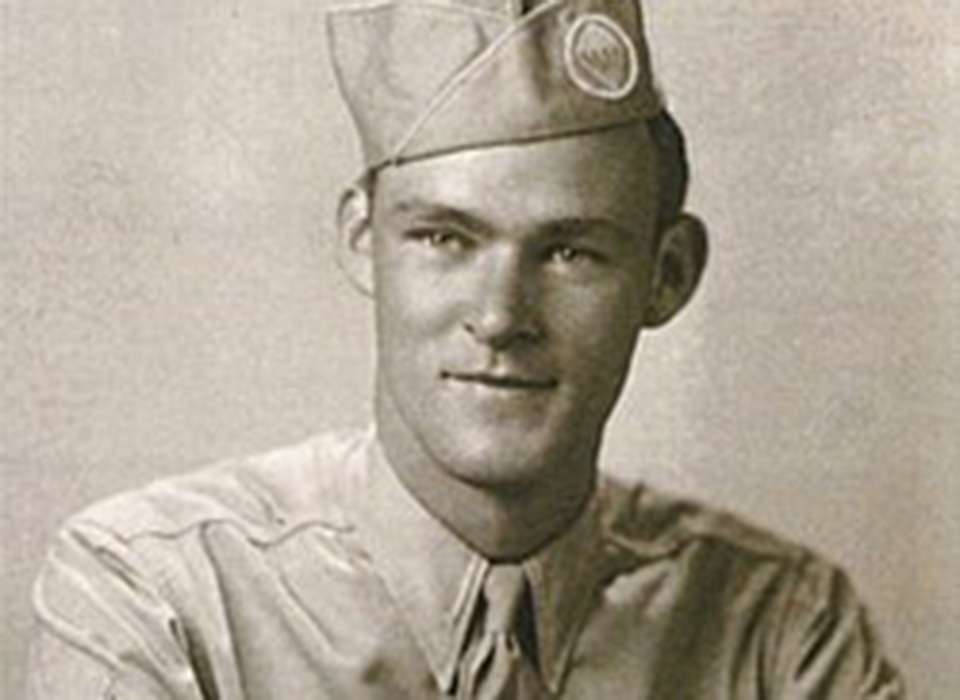
Top Photo: Joseph Beyrle. Wikimedia Commons
Most Americans who know the story of the 506th Parachute Infantry Regiment immediately think of Band of Brothers. The men of Easy Company have become synonymous with the American airborne experience during World War II, and deservedly so. Yet the 506th included thousands of paratroopers whose stories never reached the same audience.
Among those largely forgotten heroes was Staff Sergeant Joseph R. Beyrle, whose wartime experience was arguably more extraordinary than fiction. Beyrle is the only known American soldier to fight in combat with both the US Army and the Soviet Red Army. That distinction makes for a compelling headline, but it is not what makes his story important. His experience captures the initiative demanded of airborne soldiers, the brutality endured by prisoners of war, and the unlikely battlefield cooperation between American and Soviet soldiers during the final months of the war.
Beyrle was born in Muskegon, Michigan, on August 25, 1923, to William and Elizabeth Beyrle, whose parents had emigrated from Germany during the 19th century. The Great Depression shaped his childhood. When his father lost his factory job, the family lost its home and moved in with relatives. Beyrle later recalled standing in government food lines with his father, while two older brothers left school to join the Civilian Conservation Corps so they could help support the family. Despite those hardships, Beyrle excelled in athletics and received a scholarship offer from the University of Notre Dame. Like many young Americans after the attack on Pearl Harbor, however, he set aside his personal ambitions and enlisted in the Army in 1942.
Beyrle volunteered for the airborne, one of the Army's newest and most demanding organizations. He completed training at Camp Toccoa and Fort Benning as a member of the 506th Parachute Infantry Regiment of the 101st Airborne Division. The Army trained him as both a radio operator and demolition specialist, a combination of skills that made him particularly valuable during special operations. His fellow soldiers also gave him the nickname "Jumpin' Joe," a moniker that followed him throughout his life. Stationed in England before the invasion of France, Beyrle completed two covert missions into occupied France during the spring of 1944, delivering gold and other supplies to the French Resistance. These dangerous operations offered a preview of the independent action and improvisation that would characterize the rest of his wartime service.
Beyrle jumped into Normandy during the early hours of June 6, 1944, as part of Mission Albany, the airborne assault that preceded the amphibious landings. German antiaircraft fire struck his C-47 transport before it reached the drop zone, forcing him to jump from only about 360 feet. Like thousands of other American paratroopers that morning, he landed far from his intended objective. The scattered drops immediately created serious problems, but they also forced German commanders to contend with American paratroopers appearing in unexpected places. Isolated groups attacked bridges, destroyed communications, and spread uncertainty across the Cotentin Peninsula. Beyrle fit that pattern: After landing on the grounds of the church in Saint-Côme-du-Mont, he destroyed a power station and participated in additional sabotage missions before German troops captured him several days later.
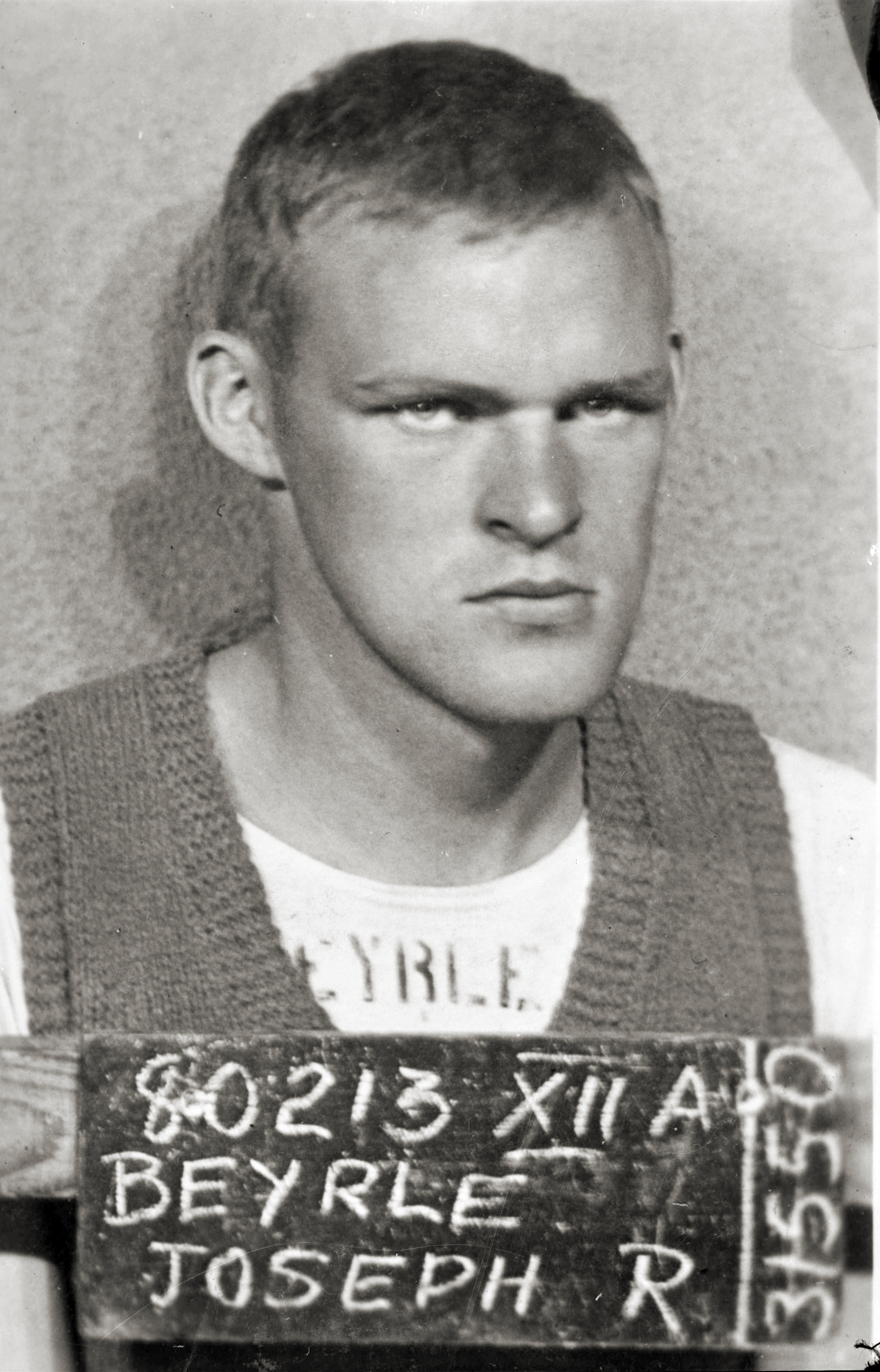
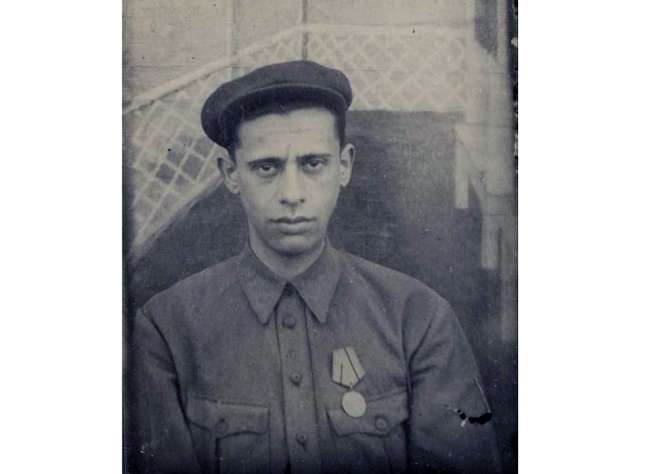
ID photo of Joseph Beyrle taken at Stalag XII-A POW Camp. Wikimedia Commons.
Captivity proved every bit as dangerous as combat. Over the next seven months, German authorities transferred Beyrle through seven different prisons and prisoner-of-war camps. He escaped twice, and German guards recaptured him both times. During one failed escape, he and several other prisoners mistakenly boarded a train headed toward Berlin rather than east toward advancing Soviet forces. A German civilian reported them to the Gestapo, who beat and tortured the escapees while accusing Beyrle of being an American spy. According to later accounts, Gestapo officials intended to execute the prisoners before officers from the regular German military intervened, arguing that prisoners of war fell under military rather than Gestapo jurisdiction. Beyrle also endured forced marches, overcrowded rail transport in boxcars packed with dozens of prisoners, and repeated physical abuse. Yet he continued to attempt escape.
In January 1945, Beyrle finally succeeded. Escaping from Stalag III-C near Alt Drewitz, he headed east toward the sound of Soviet artillery. When he encountered a Soviet tank unit, he approached cautiously with his hands raised, holding a pack of Lucky Strike cigarettes while shouting, "Amerikansky tovarishch!" or "American comrade!" His unusual introduction worked. After convincing Guards Captain Aleksandra Samusenko of his identity, Beyrle received permission to accompany the Soviet formation rather than await transportation to Allied lines. His demolition expertise quickly proved useful, and he spent roughly a month fighting alongside a battalion of the 1st Guards Tank Brigade during its advance toward Berlin. It remains one of the most remarkable examples of battlefield cooperation between American and Soviet soldiers during the war.
Beyrle's service with the Red Army ended in early February 1945 when German dive bombers attacked the Soviet column and wounded him in the leg. Soviet doctors evacuated him to a military hospital, where his story eventually reached Marshal Georgy Zhukov. Intrigued by the American in the hospital, Zhukov met with Beyrle through an interpreter and arranged for papers allowing him to rejoin American forces. When Beyrle reached the US Embassy in Moscow, he encountered an unexpected problem. The War Department had officially listed him as killed in action on June 10, 1944, after American forces recovered his identification tags from the body of a dead German soldier. His hometown newspaper had published an obituary, and a funeral Mass had already been celebrated in his memory. Embassy officials initially questioned his identity and placed him under Marine guard until fingerprint records confirmed that the supposedly dead paratrooper standing before them was, in fact, Joseph Beyrle.
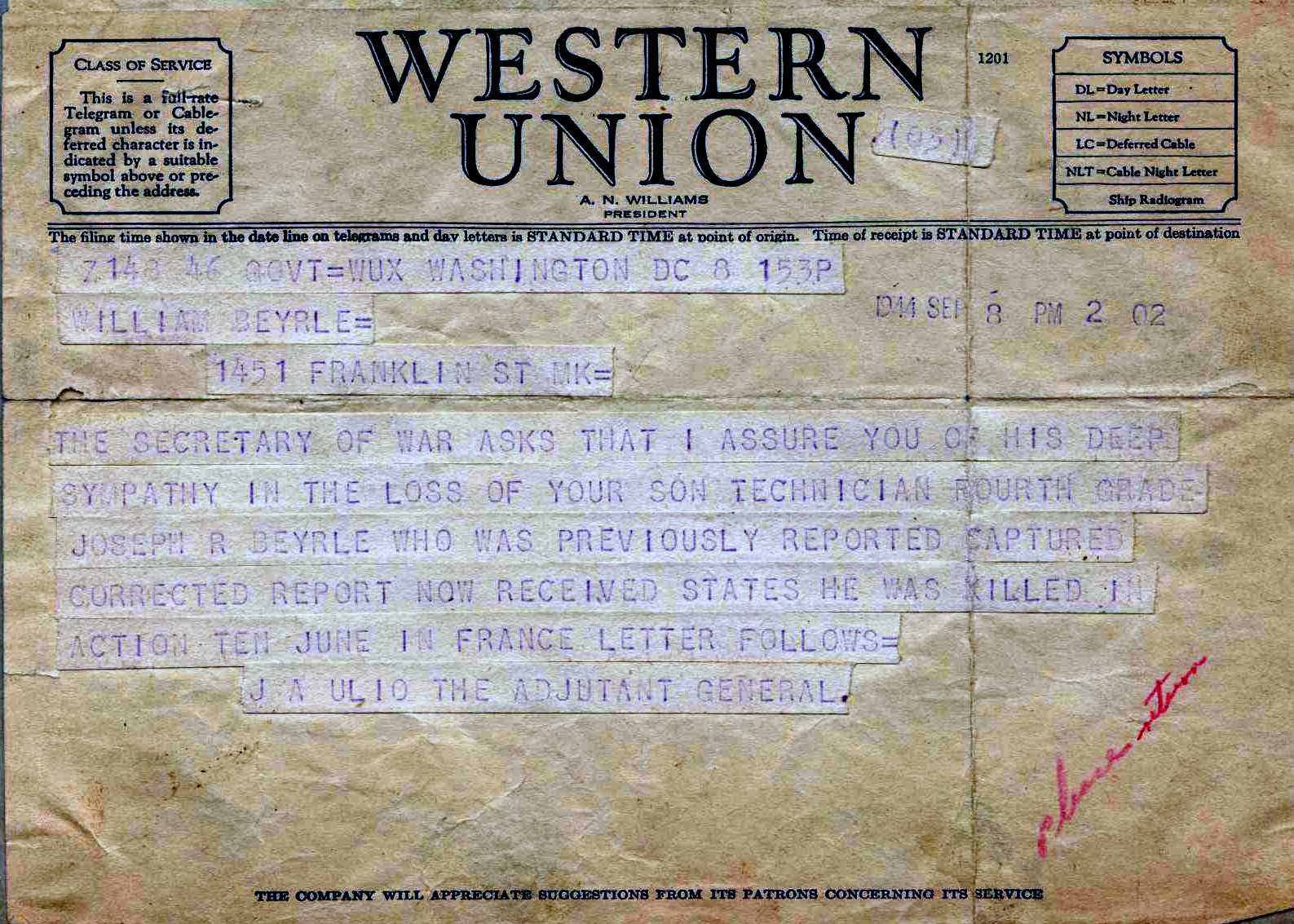
Scan of original War Department telegram received by Joe Beyrle's parents in Sept. 1944, informing them (erroneously) that he was killed in action. Wikimedia Commons
Beyrle returned to the United States in April 1945, only weeks before Germany surrendered. The following year, he married JoAnne Hollowell in the same church and before the same priest who had presided over his funeral Mass while he was still overseas. He worked for the Brunswick Corporation for nearly three decades before retiring, but his extraordinary wartime service gradually attracted wider recognition. In 1994, Presidents Bill Clinton and Boris Yeltsin jointly honored him during ceremonies marking the 50th anniversary of D-Day, a fitting tribute for a soldier whose wartime experience had linked American and Soviet forces in the fight against Germany. France and the Soviet Union also recognized his service, including the French Croix de Guerre and the Soviet Order of the Red Banner.
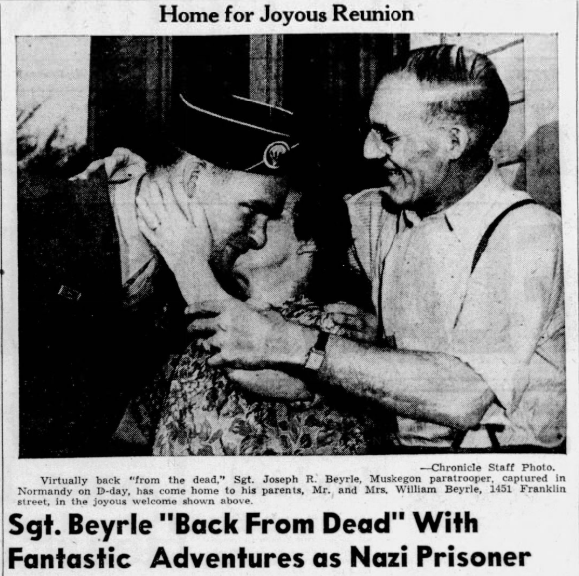
Newspaper clipping showing Joseph R. Beyrle reuniting with his family. Muskegon Chronicle, Saturday, April 21, 1945. Source: Newspapers.com
Beyrle died in December 2004 while visiting Toccoa, Georgia, where he had trained as a young paratrooper more than 60 years earlier. He was buried with full military honors at Arlington National Cemetery. In 2024, a street was named after him in Saint-Côme-du-Mont near the church where he landed on D-Day. While Easy Company has introduced millions of people to the history of the 506th Parachute Infantry Regiment, Joseph Beyrle reminds us that many of the regiment's most extraordinary stories still lie beyond the familiar narrative. His journey from American paratrooper, to German prisoner of war, to Red Army soldier stands as one of the most remarkable individual experiences of World War II.
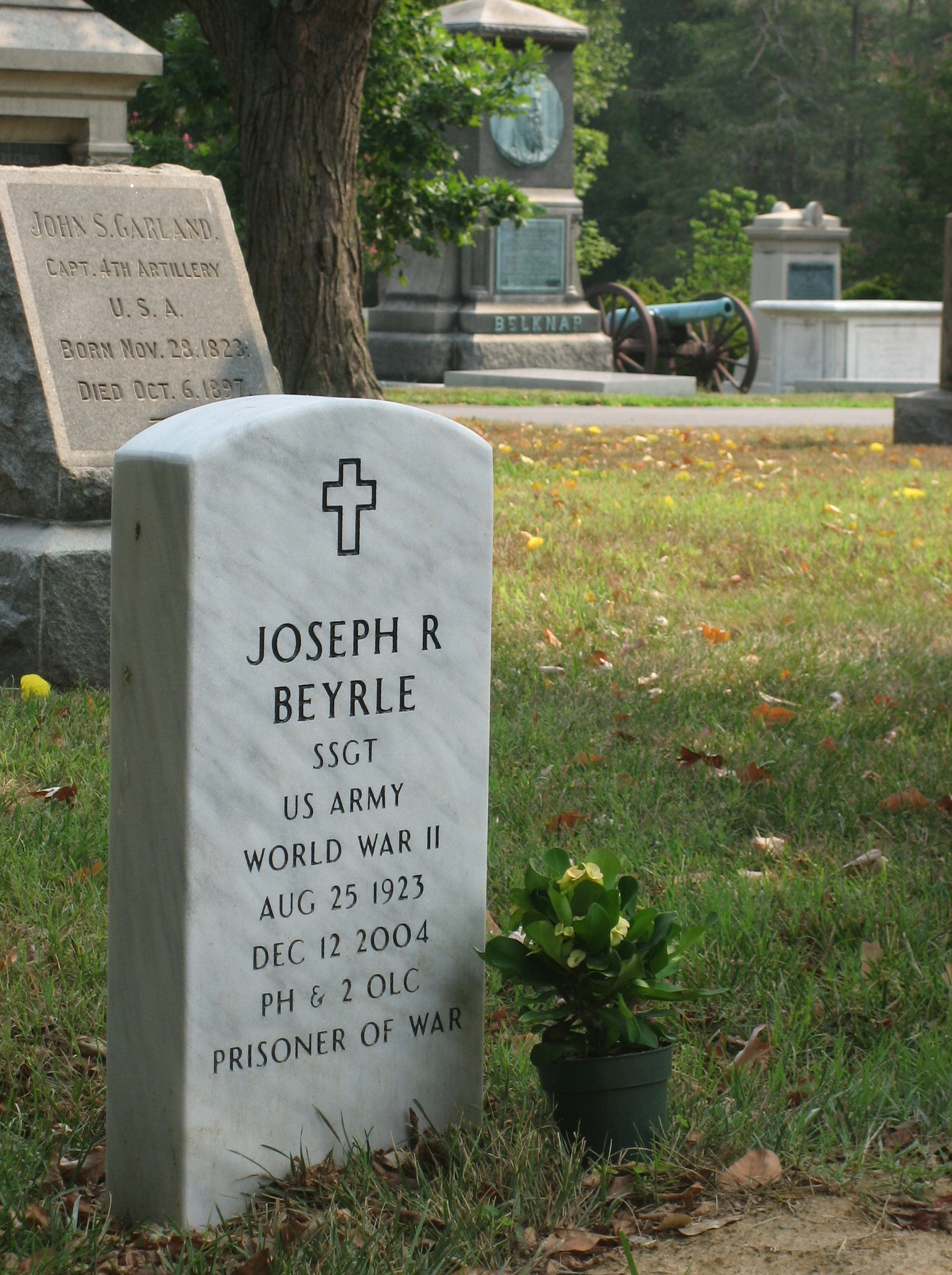
Joseph Beyrle gravesite, Arlington Cemetery. Photo: John Beyrle Wikimedia Commons
Adam Coste
Adam Coste is the World War II Historian for Digital Content at The National WWII Museum's Jenny Craig Institute for the Study of War and Democracy.
Cite this article:
MLA Citation:
APA Citation:
Chicago Style Citation: