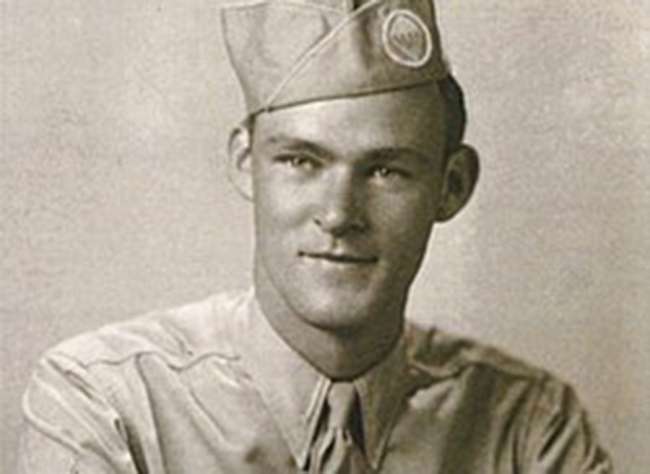
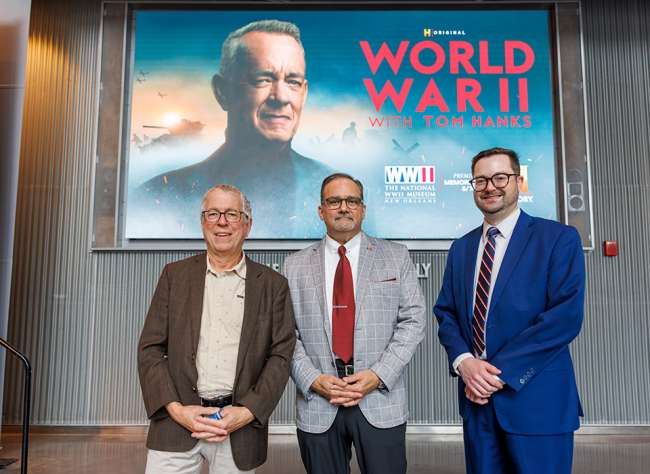
Top Photo: Stephen Ambrose and Dick Winters at the premiere of Band of Brothers in Normandy, June 2001. Courtesy of The National WWII Museum Institutional Records and Archives.
Twenty-five years after HBO’s Band of Brothers introduced the men of Easy Company to millions of viewers, the series continues to shape how Americans remember the soldiers who fought in World War II. The National WWII Museum marked the anniversary by revisiting the history behind the series, including the firsthand accounts that historian and author Stephen Ambrose collected from the veterans themselves. One particularly revealing example is a five-page letter Major Richard “Dick” Winters wrote to Ambrose on August 12, 1996, now housed in the University of New Orleans Eisenhower Center Peter Kalikow World War II Collection, preserved here at the Museum.
In the letter, Winters responded to Ambrose’s request for his thoughts on the strain of command, the problems he faced during the war, and the living conditions his soldiers endured. What emerged was also a concise explanation of Winters’s leadership philosophy.
Winters’s letter represents one part of a relationship that began in New Orleans. In May 1988, Ambrose learned that Easy Company veterans were holding a reunion at the Hotel Monteleone. He and his research assistant, Ron Drez, went to the sixth floor and joined the gathering. The veterans had little reason to welcome an historian who had arrived uninvited, but that changed when they learned that Ambrose was Dwight D. Eisenhower’s biographer. His knowledge of Eisenhower gave him credibility with the men, and the conversation opened the door to the oral histories that became the foundation for Ambrose’s Band of Brothers.
Ambrose’s relationship with Winters and the Easy Company veterans continued for years. Ambrose eventually interviewed Winters for more than 13 hours, and Winters became an important source for the book that was published in 1992 and later inspired the HBO miniseries. The Museum’s collection preserves not only those oral histories but also a series of letters Winters sent to Ambrose, Tom Hanks, and others involved in telling Easy Company’s story. The 1996 letter stands out because Winters was not simply recounting what happened—he was explaining what he had learned about leadership.
Winters began with preparation. “To be a good commanding officer, a leader, you must be in first class physical condition,” he wrote. For a combat commander, physical fitness was not simply a matter of personal pride. A leader had to keep pace with his soldiers and demonstrate that he was willing to endure the same conditions. Winters then connected physical readiness to a much broader responsibility: “To be a good leader you must do everything in your power for the good of your men and to train your men with the goal in mind of making them the best unit possible, better than any other platoon, company, battalion.”
Winters believed leaders created that standard through personal example. He compared the commander to “a good mother taking care of her children” and insisted that a leader should be “the first one up in the morning and the last to go to bed at night.” He then offered a second comparison, writing that a leader must also be “like a good father,” setting an example by being “up front and visible with the men before an attack and staying with the attack until it is over.” For Winters, leadership did not happen from a distance. Soldiers needed to see their commander sharing their risks.
“To be a good leader you must do everything in your power for the good of your men and to train your men with the goal in mind of making them the best unit possible, better than any other platoon, company, battalion.”
Major Richard “Dick” Winters
The ultimate test came when preparation and planning gave way to fear. Winters described a unit caught under a heavy concentration of mortar or artillery fire. “When this happens most men will freeze stiff as a board,” he wrote. “They can’t move. They can’t think. They are frozen by a fear of death.” Winters did not expect leaders to eliminate that fear. Instead, he expected them to function through it. “The good company commander will be able to think and reason under this fire,” he explained.
The leader then had to act. When the barrage ended, Winters believed the commander should immediately leave his foxhole, walk among his soldiers, and speak to them: “Is everybody all right? Be on the lookout for an attack. Let’s get moving.” The important thing, he emphasized, was “for him to be the first man on his feet, talking to his men.” That action could break the paralysis of fear. “Just as soon as he starts talking to the men,” Winters wrote, “that fear of death that had them frozen stiff a minute ago will be broken and they will be up and moving and ready to follow him to hell and back.”
He also made it clear that leadership involved much more than tactics. When Ambrose asked him to consider the problems he faced during the war, Winters admitted that this was the first time he had tried to make such a list. “It surprises me how simple it is to put my problems in a few categories and how few problems I really had,” he wrote. He identified six categories: tactics, weapons, terrain and weather, liquor, food, and personnel.
His comments on tactics reveal his belief in the fundamentals. “They did not change from being a platoon leader to battalion commander,” Winters wrote. The principles remained “simple, easy to understand, and very efficient when ... followed by good leaders.” The same applied to weapons. As a commander assumed greater responsibility, he gained access to more firepower, but “in using it the principles did not change.” Winters believed that increasing responsibility did not require abandoning fundamentals. It required applying them at greater scale.
Terrain and weather presented different challenges. Normandy brought the hedgerows. Holland brought “flat fields, drainage ditches, rain and mud.” In Germany, Winters recalled that retreating German forces destroyed bridges, creating problems for advancing American troops. His observations show a commander who understood that conditions on the ground could determine what soldiers and units could accomplish.
-

A five-page letter Major Richard “Dick” Winters wrote to Stephen Ambrose on August 12, 1996, now housed in the University of New Orleans Eisenhower Center Peter Kalikow World War II Collection at The National WWII Museum.
-
A five-page letter Major Richard “Dick” Winters wrote to Stephen Ambrose on August 12, 1996, now housed in the University of New Orleans Eisenhower Center Peter Kalikow World War II Collection at The National WWII Museum.
-
A five-page letter Major Richard “Dick” Winters wrote to Stephen Ambrose on August 12, 1996, now housed in the University of New Orleans Eisenhower Center Peter Kalikow World War II Collection at The National WWII Museum.
-
A five-page letter Major Richard “Dick” Winters wrote to Stephen Ambrose on August 12, 1996, now housed in the University of New Orleans Eisenhower Center Peter Kalikow World War II Collection at The National WWII Museum.
-
A five-page letter Major Richard “Dick” Winters wrote to Stephen Ambrose on August 12, 1996, now housed in the University of New Orleans Eisenhower Center Peter Kalikow World War II Collection at The National WWII Museum.


He treated the everyday problems of soldiers with the same directness. There was “too much drinking,” but Winters said he could handle it simply by looking a man in the eye and telling him to sober up. “We’ll have a party when the war’s over,” he would tell them. Food presented a more persistent challenge. In Normandy, Easy Company could supplement its supplies with cattle; in Holland, the men found vegetables and fruit. Bastogne was different: “Here for two weeks we were really hurting.” The 506th found no cattle and few potatoes, although some beans eventually reached the troops on the line.
Winters considered personnel the most significant issue. “You could write a book on that one problem,” he told Ambrose. Instead, he focused on battlefield promotions and the Army’s practice of transferring experienced noncommissioned officers to new companies after they received commissions. These men had entered the Army as recruits, worked their way up to platoon sergeant or first sergeant, and “won the respect of their men in training and proven themselves in combat.”
Winters believed the Army undermined that experience by separating those officers from the soldiers who already trusted them. “They did not have a chance to learn to know their men; the men did not have a chance to learn to know and trust them,” he wrote. “They were strangers; there was not that mutual trust they had with their old platoons.” Winters acknowledged that keeping officers from becoming too familiar with their soldiers might make sense in garrison, but he argued that “in combat that logic is flawed.”
He then pointed to three officers who became casualties after being transferred into unfamiliar units. Winters did not simply describe these incidents as bad luck. He saw a broader leadership problem. New officers had to establish themselves all over again, while their soldiers had to learn whether they could trust them. “These new 2nd Lts. had to do something special, outstanding to gain the mutual trust they had had with their old companies,” he wrote. His conclusion remains one of the sharpest observations in the letter: “But why transfer a proven junior officer to a new unit where he must prove himself again?”
Winters ended his letter by describing what those leadership decisions meant at the level of the individual soldier. In Normandy, he lost his weapons, ammunition, extra clothing, and food when his knee bag tore loose from his parachute harness. He eventually found a dead paratrooper and took his weapon and ammunition. He got food from his fellow soldiers. That experience taught him the value of “traveling light” and being able to move quickly under fire.

The statue of Maj. Dick Winters of Easy Company, 506th Parachute Infantry Regiment, 101st Airborne Division, stands as reminder of the sacrifice of the Greatest Generation near Utah Beach, Normandy, France, June 7, 2015. U.S. Army photo by Sgt. Austin Berner.
At Bastogne, the problem was different. Winters remembered that the 506th defended a sector with “absolutely no farmhouses, buildings, or shelter of any kind.” Other units could retreat into buildings to warm themselves or dry their socks. His men could not. They had no protection from German fire except their foxholes and no protection from the cold except massaging their feet. Winters estimated that one third of the 506th’s casualties resulted from trench foot.
His final description captures the physical reality of command better than any abstract definition could. One night, sitting “scrunched up in my foxhole,” Winters felt as though “the foxhole was closing in on me, getting smaller.” Ice had accumulated around him, and he rubbed his shoulders against the sides to scrape it away. His conclusion was characteristically understated: “That’s too cold for comfort.”
The letter reveals a leader who measured his own performance by the men around him. Winters believed that leaders had to prepare themselves, set the example, understand their soldiers, earn their trust, and remain visible when circumstances became dangerous. He understood that fear was inevitable but believed a leader could keep fear from paralyzing an organization. Above all, he believed leadership carried a responsibility to make the people entrusted to you better. Winters ended the letter as he often did in his correspondence with Ambrose, signing off with the words “Hanging tough,” or sometimes simply, “Hang tough.” The phrase became his customary signoff when writing to Ambrose, a small but memorable reflection of the straightforward, understated character that came through so clearly in his writing.
Twenty-five years after Band of Brothers brought Winters and Easy Company to the screen, the letter in the Kalikow Collection offers a chance to hear Winters explain those principles in his own words. His message is remarkably direct: Take care of your people. Train them well. Know your profession. Build trust before you need it. Understand what your soldiers are experiencing. And when the moment comes, get out of the foxhole and lead.

Adam Coste
Adam Coste is the World War II Historian for Digital Content at The National WWII Museum's Jenny Craig Institute for the Study of War and Democracy.
Cite this article:
MLA Citation:
APA Citation:
Chicago Style Citation: