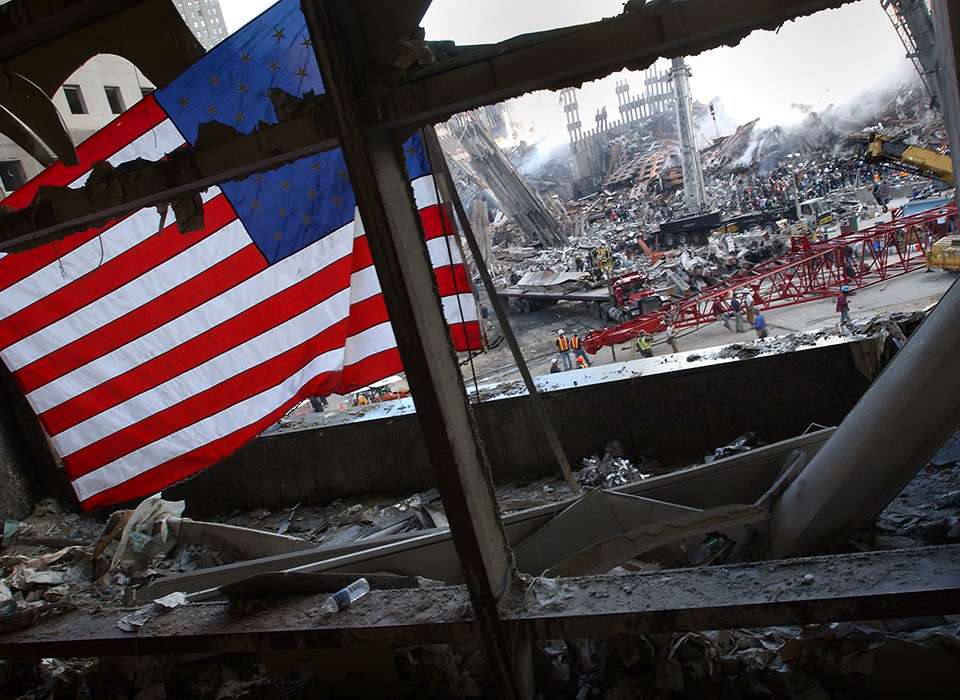
Top Photo: The American flag is a prominent icon in the heart of what was once the World Trade Center in New York City, Sept. 15, 2001. U.S. Navy photo by Journalist 1st Class Preston Keres.
On September 11, 2001, Americans watched the United States come under attack. Four commercial airliners were hijacked within the span of a few hours. Two struck the World Trade Center, one crashed into the Pentagon, and a fourth came down in a field near Shanksville, Pennsylvania. By the end of the day, 2,977 people had been killed.
December 7, 1941, and September 11, 2001, stand among the defining moments in American history. Both began with attacks on the United States; both changed the course of the nation in the years that followed. Pearl Harbor brought the United States into World War II and mobilized a generation of Americans for military and public service. September 11 launched another generation into a new era of war and national service.
The National WWII Museum tells the story of the generation that answered the call after Pearl Harbor. Among those killed on September 11 were members of that WWII generation. They had served their country, returned home, built families and careers, and lived through more than half a century of American history before another attack changed the nation once again. Their stories are largely unknown.
Robert Grant Norton and Francis Edward Grogan served in the US Navy during World War II. Norman O. Wahlstrom flew B-24 combat missions in the Pacific. John Talignani served in the US Army during the postwar occupation and reconstruction of Japan. Nearly six decades later, their lives intersected with September 11 in very different ways. Three of these veterans died in three different planes on September 11. And a fourth tragically lost his wife and daughter.
Robert Grant Norton
Born in Lubec, Maine, Robert Grant Norton worked as a maintenance mechanic for the American Can Company for five years before enlisting in the Navy on May 20, 1943. He was 27 years old and married, leaving behind his job and family to serve his country. He became a Seabee.
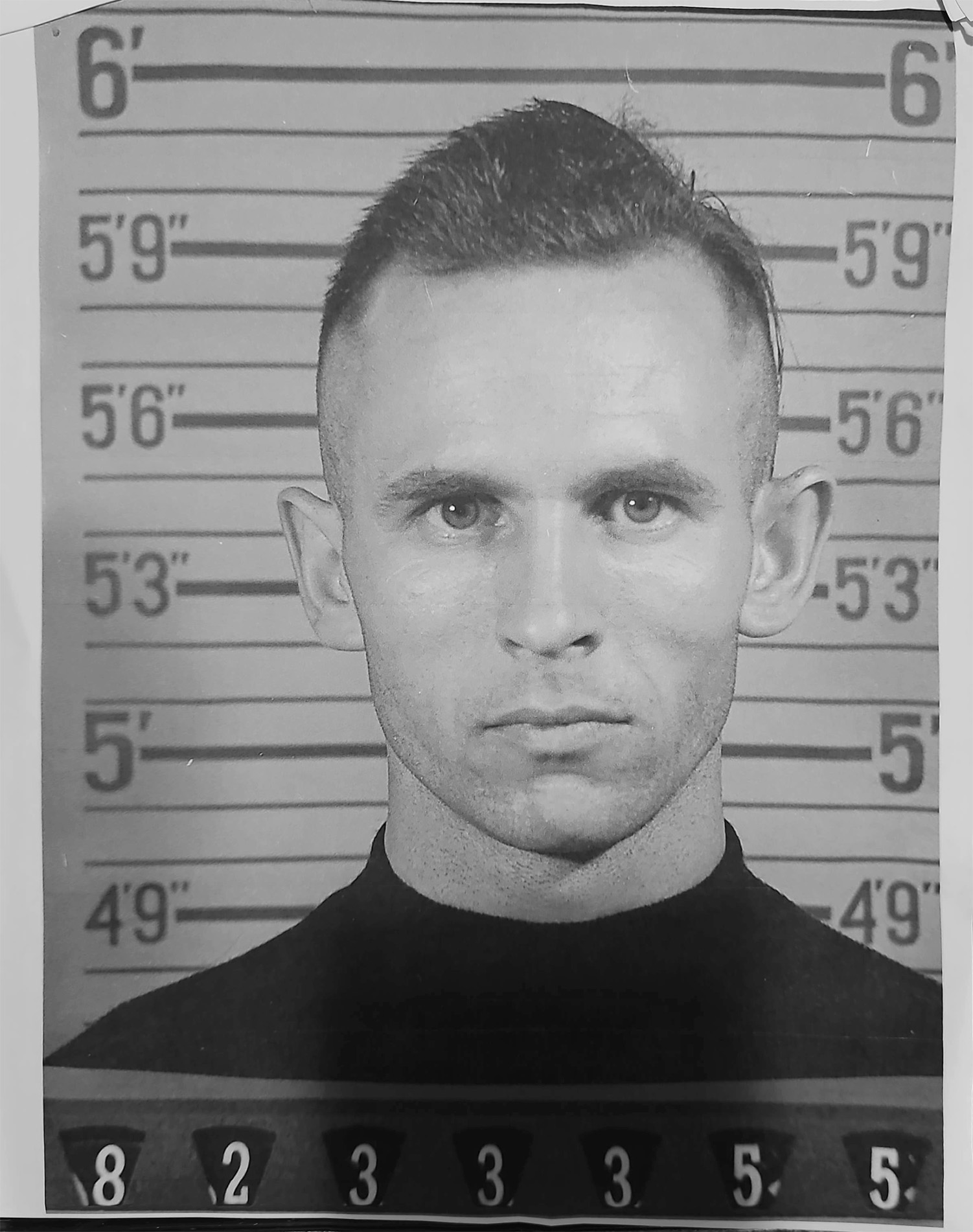
Official Military Personnel File photo of Robert Norton. National Archives and Records Administration
The Navy trained Norton as a carpenter before assigning him to the 103rd Naval Construction Battalion for additional instruction as a drafter. He eventually joined the 539th Naval Construction Battalion Maintenance Unit, becoming one of the Seabees who built and maintained the infrastructure that allowed American forces to operate across the Pacific. On December 28, 1943, Norton left Gulfport, Mississippi, and began the long journey to the Pacific. He crossed the equator and the International Date Line before reaching Ebon, a small atoll in the Marshall Islands, on February 7, 1944.
Norton and his fellow Seabees immediately went to work building and maintaining airfields, roads, ports, and other facilities that supported American logistical and amphibious operations. He spent approximately 21 months on Ebon before finally making the long journey home in October 1945. The Navy honorably discharged him, and he returned to Maine with the Asiatic-Pacific Campaign Ribbon, American Area Ribbon, World War II Victory Medal, and authorization to wear the official Seabee insignia.
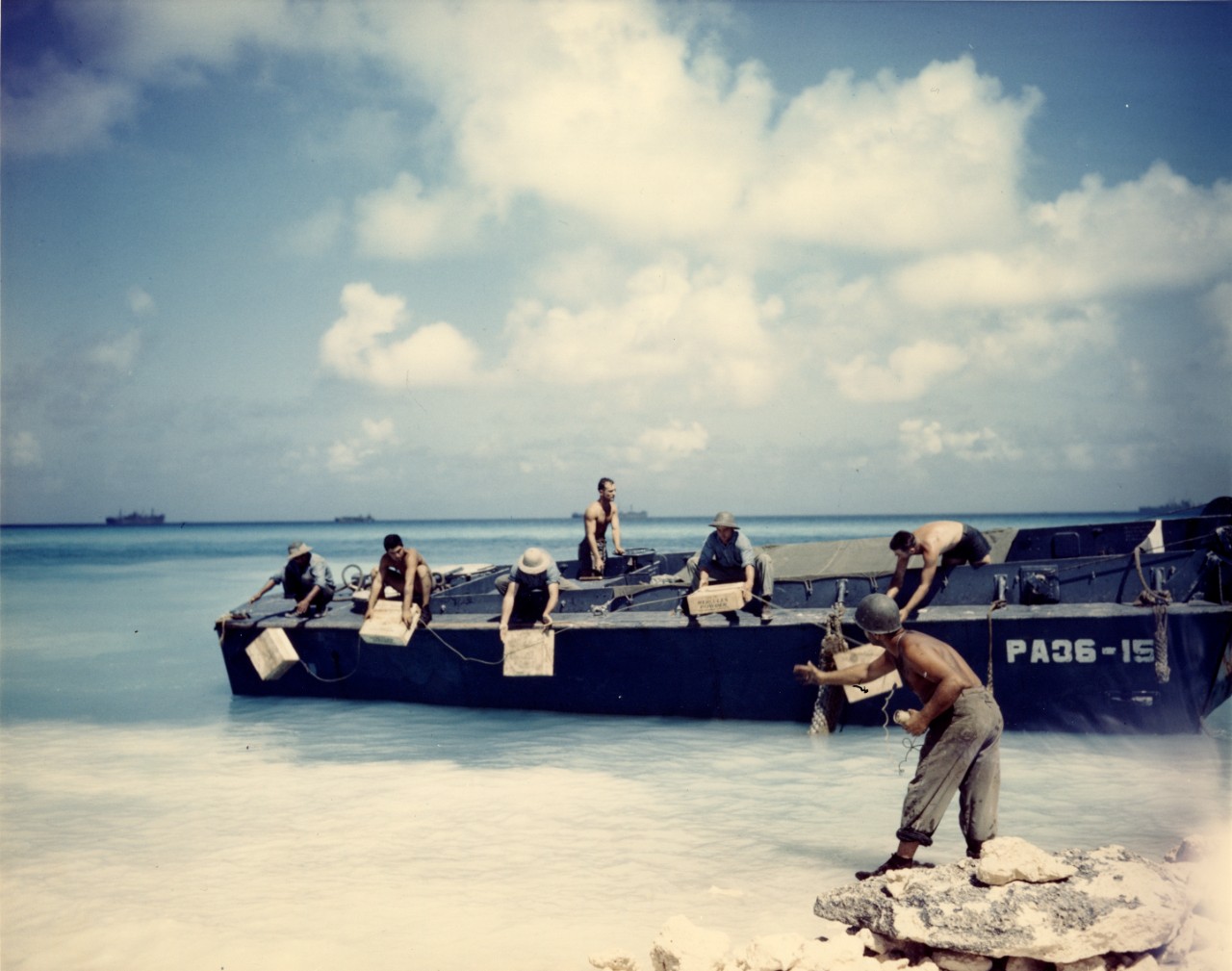
Seabees lower Hercules powder explosives over the side of an LCVP during construction of the Eniwetok Atoll airfield, February 1944. U.S. Navy Seabee Museum
After the war, Norton used the GI Bill to attend Franklin Technical Institute in Boston, where he earned an engineering degree. He worked in Massachusetts for several years before returning to Lubec in the early 1980s. There he became active in the local Congregational Christian Church and served as a deacon. Friends and neighbors remembered him as a quiet, generous man who was willing to give his time and talents to others.
By September 2001, Norton was 85 years old and the oldest victim of the terrorist attacks. He and his wife, Jacqueline, were traveling to California for a family wedding. They had flown from Bangor to Boston on September 10 before boarding American Airlines Flight 11 at Logan International Airport the following morning. The Boeing 767 departed at 7:59 a.m., bound for Los Angeles. At 8:46 a.m., hijackers crashed the aircraft into the North Tower of the World Trade Center.
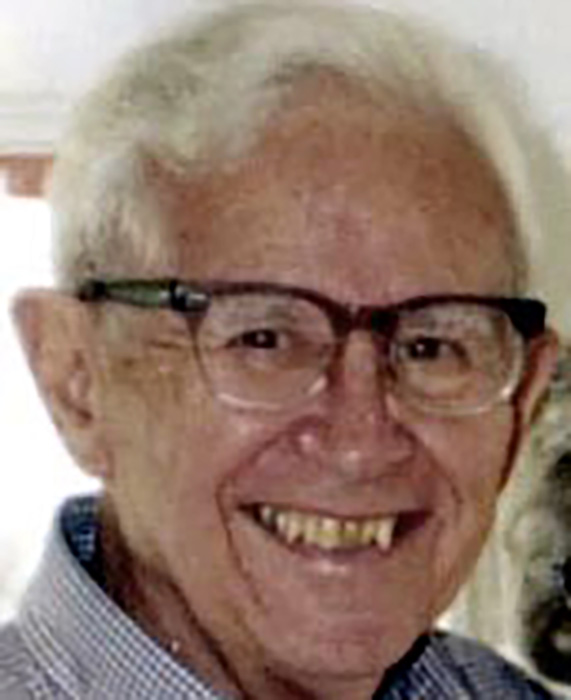
Robert Grant Norton. Photo: Bangor Daily News via FindAGrave.com
Nearly six decades had passed since Norton left Maine for the Pacific. In the years between, he had returned home from war, built a career, raised a family, served his community, and lived the life he had fought to preserve. On September 11, he was simply a husband traveling with his wife to celebrate with family. His storied life ended that morning aboard Flight 11.
Francis Edward Grogan
Francis Edward Grogan was only 18 years old when he entered the Navy during World War II. On August 30, 1943, the Navy inducted Grogan as an Apprentice Seaman and sent him to the Fleet Sound School in Key West, Florida, where he trained as a sonar operator. After completing his training, the Navy assigned him to the destroyer USS Barney (DD-149).
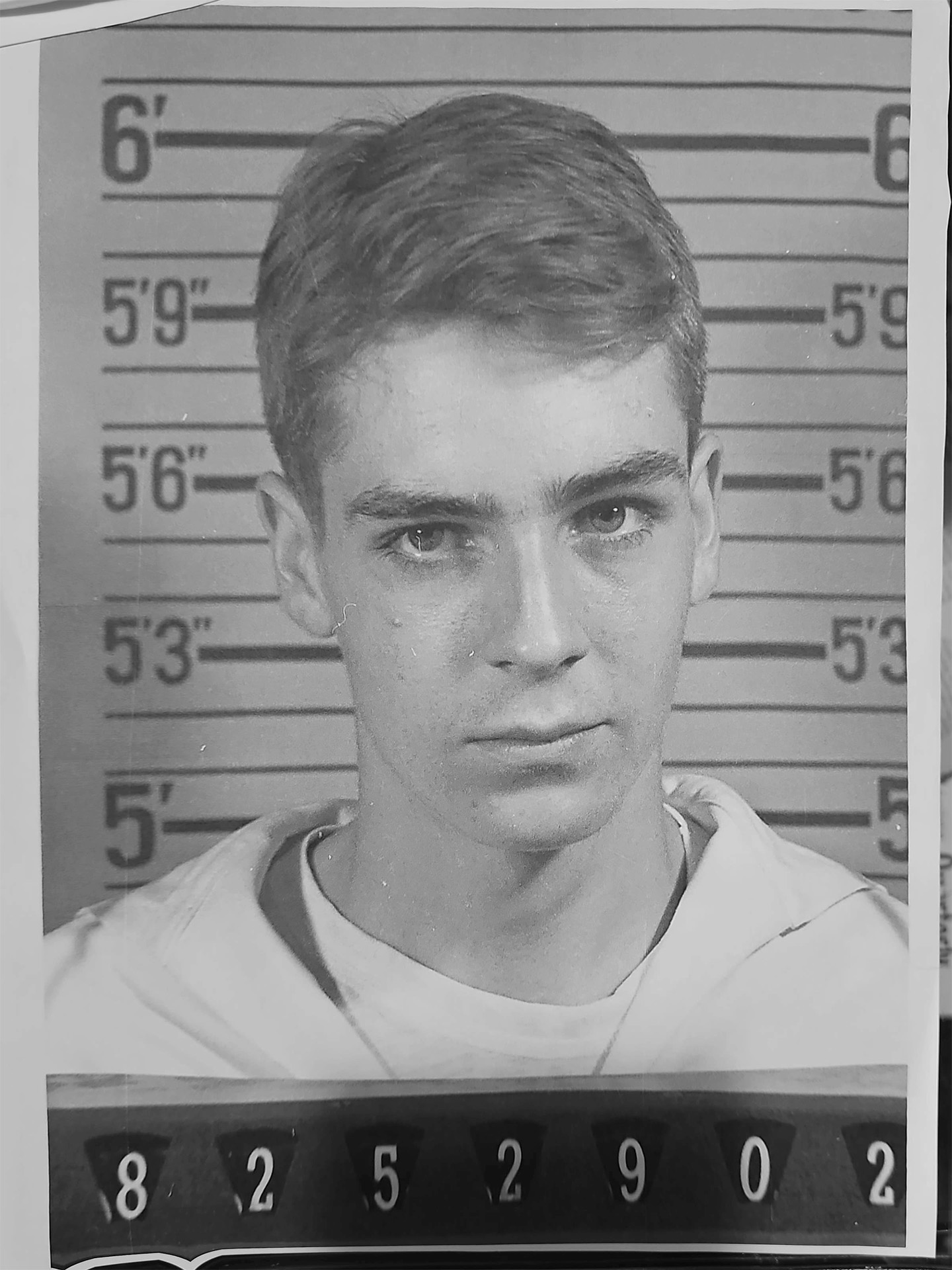
Official Military Personnel File photo of Francis Edward Grogan. National Archives and Records Administration
Grogan's new assignment placed him directly into the Battle of the Atlantic. Between January 14 and May 11, 1944, Barney completed two convoy escort crossings to North Africa. One of those missions brought Grogan and his shipmates into combat. Barney joined Convoy UGS-37, a group of 37 ships carrying armed guards from the Chesapeake Bay through the Strait of Gibraltar and into the Mediterranean Sea. Around midnight on April 11–12, approximately 35 miles east of Algiers, enemy aircraft attacked the convoy.
The ships opened fire as the attackers approached. Heavy antiaircraft fire filled the night sky as the convoy attempted to protect itself. Grogan and the crew aboard Barney narrowly avoided enemy torpedoes and bombs while other ships suffered minor damage and casualties. The Navy later credited Barney with a battle star for its participation in the escort of Convoy UGS-37.
Grogan continued serving until the end of the war. The Navy awarded him the World War II Victory Medal, American Campaign Medal, and European-African-Middle Eastern Theater Medal with one campaign star. He received an honorable discharge on April 2, 1946.
His life after the Navy took him in an entirely different direction. Grogan eventually became a Catholic priest and spent decades teaching, serving as a chaplain, and working with the Congregation of Holy Cross in North Dartmouth, Massachusetts.
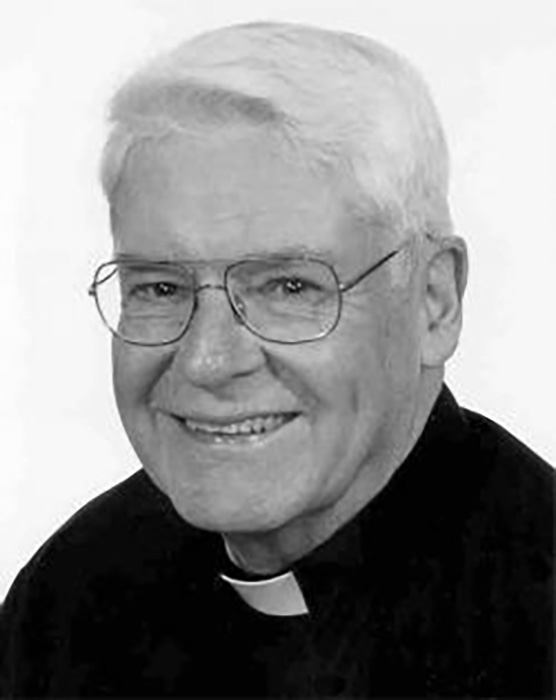
Father Francis Grogan, C.S.C. Photo via Congregation of Holy Cross
On September 11, 2001, Father Grogan, then 76, boarded United Airlines Flight 175 at Boston Logan International Airport, traveling to California to visit his sister. He would never arrive. The aircraft departed at 8:14 a.m. for Los Angeles. At 9:03 a.m., hijackers crashed Flight 175 into the South Tower of the World Trade Center.
Grogan's life had taken him a long way from the young sailor standing watch aboard Barney in the Atlantic. He was remembered by former students and parishioners as a quiet and positive influence who remained proud of his Navy service during World War II.
Norman O. Wahlstrom
Norman O. Wahlstrom's story connects World War II and September 11 in another way. He did not die in the attacks, but his wife and daughter were among those killed that day.
Wahlstrom graduated from Utah State University in 1939 and entered Army Aviation as an aviation cadet in December 1940. He completed preliminary flight training at Randolph Field and advanced flight training at Kelly Field, Texas. The training demanded long hours of formation flying and day and night navigation. In February 1942, Wahlstrom earned his wings and began his career as an Army aviator.
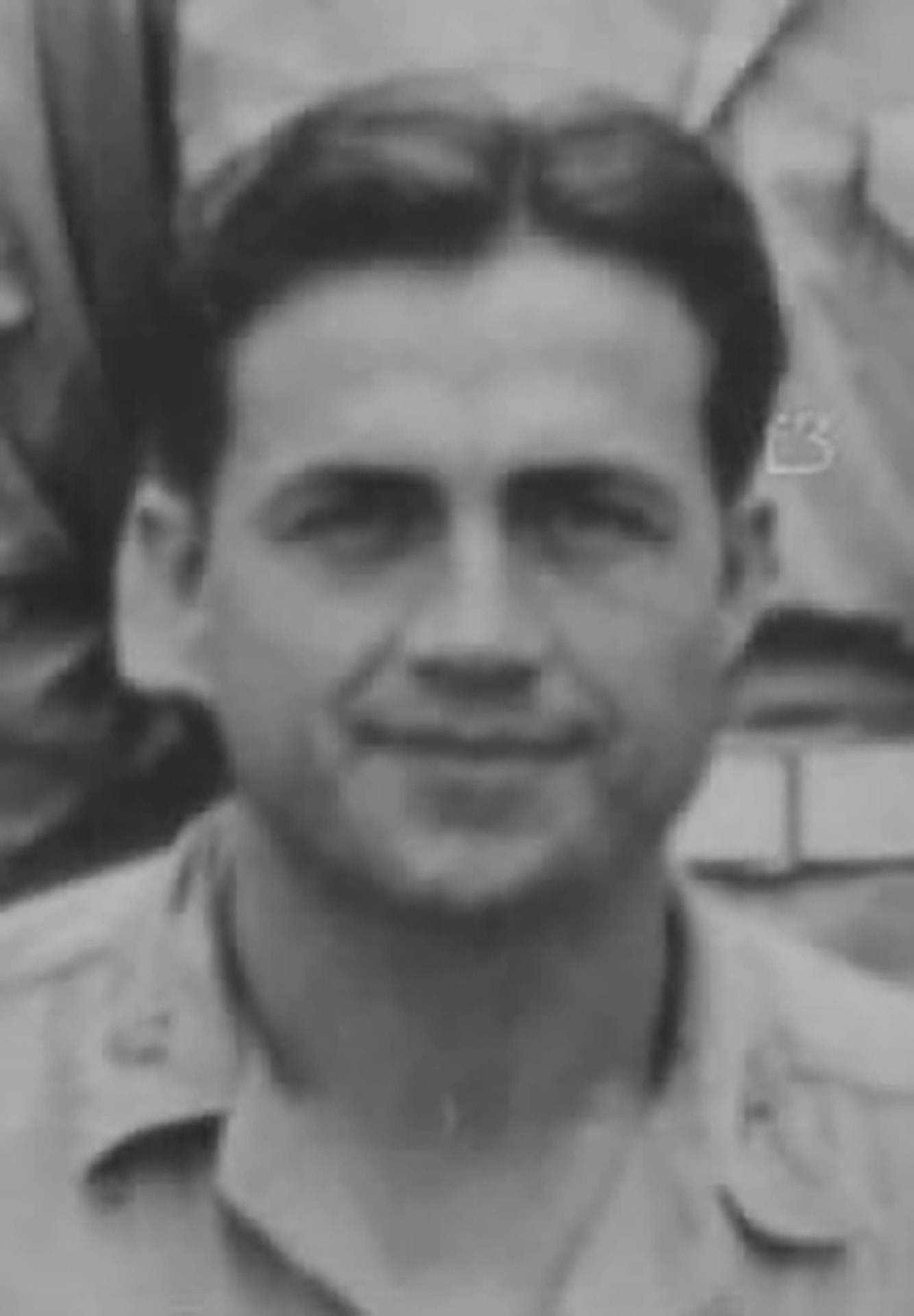
Norman O. Wahlstrom. Photo reportedly taken in June 1945 in Borneo. Photo via Fold3, FindAGrave.com
Wahlstrom went on to fly B-24 Liberator combat missions throughout the Pacific theater. He eventually commanded the 72nd Bomb Squadron of the 5th Bomb Group, 13th Army Air Force. During his wartime service, he received the Air Medal with Oak Leaf Cluster indicating a second award. He survived the war and continued serving his country in the years that followed. His military career included World War II, the Berlin Airlift, and the Korean War.
After World War II, Wahlstrom built a family and a career that eventually took him far from the Pacific. He married Mary Alice Sheehan in 1950, and together they raised their family. He retired from the Air Force in 1968 as a Colonel and later returned to Utah State University, where he earned a business degree at age 50 and worked at the university as the Director of Veteran Affairs. An active member of his community, he served two terms in the Utah State House of Representatives and six years as a Councilman for Logan City, Utah.
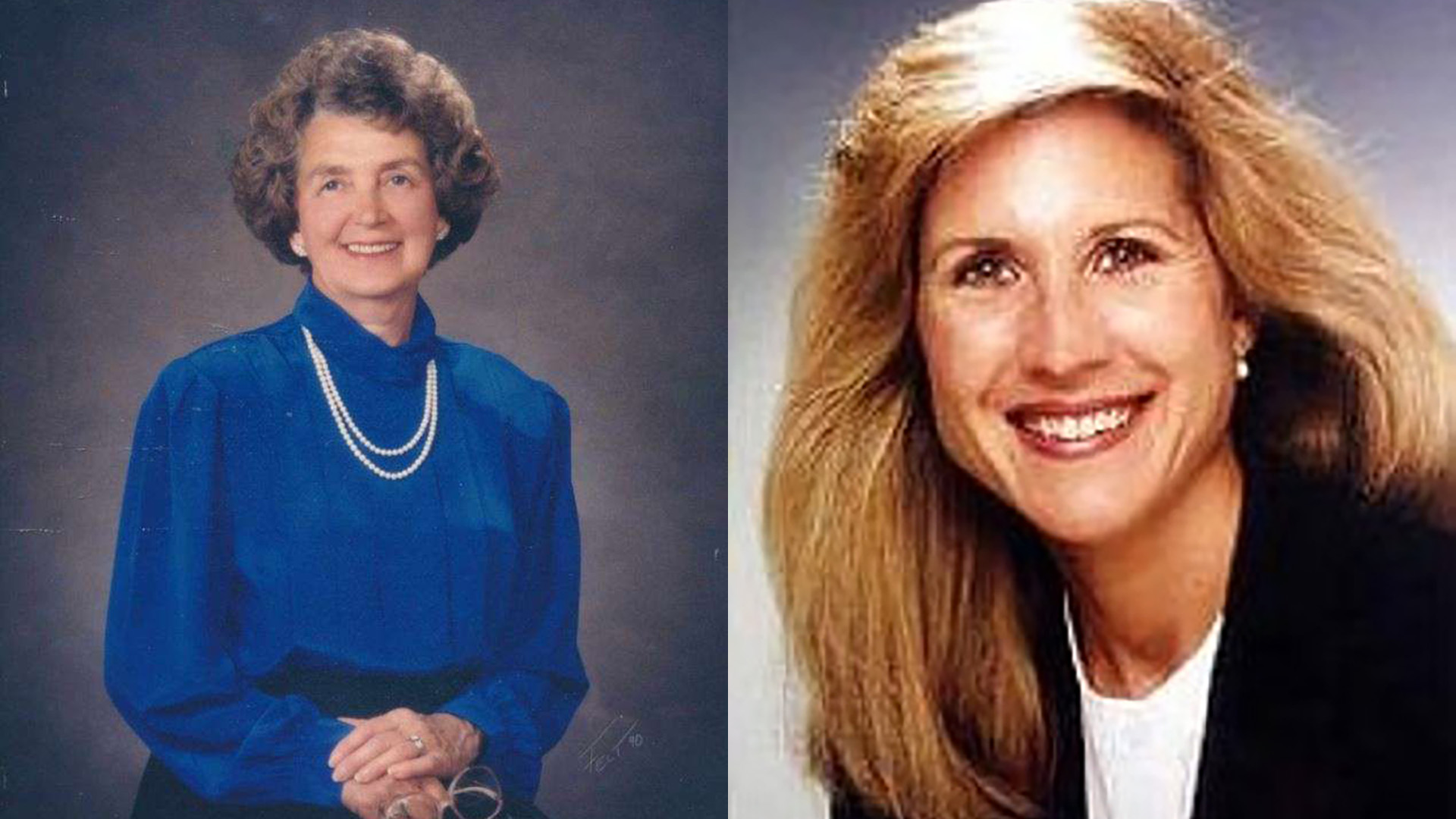
Mary Alice Sheehan Wahlstrom (left). Photo via FindAGrave.com. Carolyn Anne Beug (right). Photo via FindAGrave.com
His wife, Mary Alice, was 78 years old when she boarded American Airlines Flight 11 with their daughter, Carolyn Beug. Carolyn, 48, had worked in the entertainment industry and was the mother of three children. The two women had traveled east to help Carolyn's twin daughters settle into college at the Rhode Island School of Design. They were returning to California when they boarded Flight 11 at Boston Logan International Airport.
At 8:46 a.m., Flight 11 crashed into the North Tower. A man who had flown combat missions across the Pacific during World War II now faced the loss of his wife and daughter in an attack on the United States, nearly six decades after he had first gone to war.
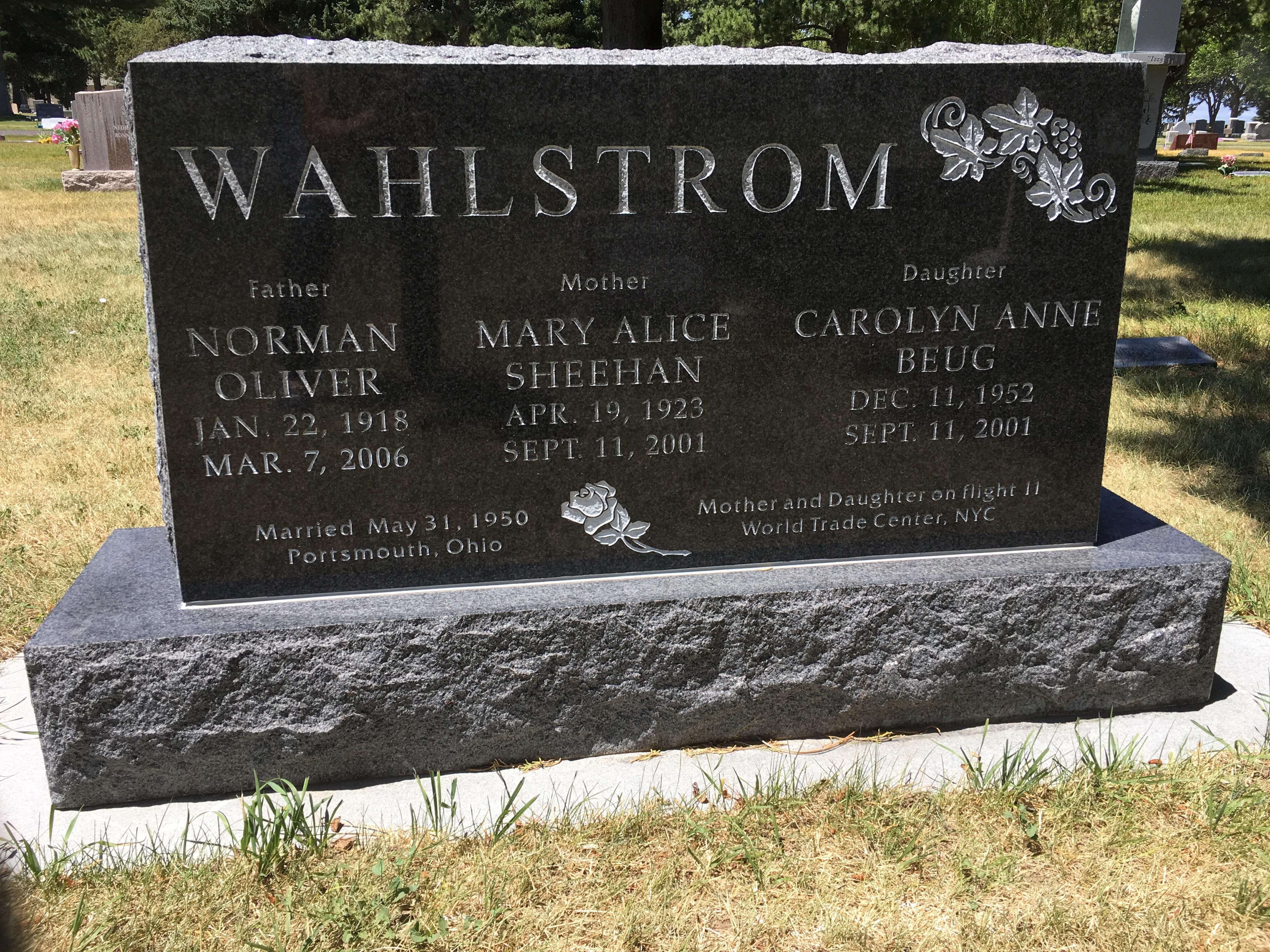
Memorial headstone for Norman Oliver Wahlstrom, Mary Alice Wahlstrom, and Carolyn Beug. Photo via Pershelle Rohrer, FindAGrave.com
Wahlstrom and his surviving children continued to honor Mary Alice and Carolyn. In 2002, his son carried the Olympic torch in Utah in their memory. A congressional tribute that year remembered Mary Alice as an active member of her community who traveled extensively, played piano, and volunteered at Temple Square in Salt Lake City, Utah. Wahlstrom died in 2006 at age 88 and was buried with full military honors—next to Mary Alice and Carolyn.
John Talignani
John Talignani lived a life that was deeply rooted in family and the New York community where he spent much of his adult life. Born in Italy, Talignani grew up in Brooklyn and became a family man devoted to his late wife and the three stepsons. He once owned a taxi and a pizzeria before spending 20 years working as a bartender and steward at Manhattan's Palm restaurants. After retiring, Talignani settled on Staten Island, where he enjoyed spending time with his family and following his beloved New York Mets.
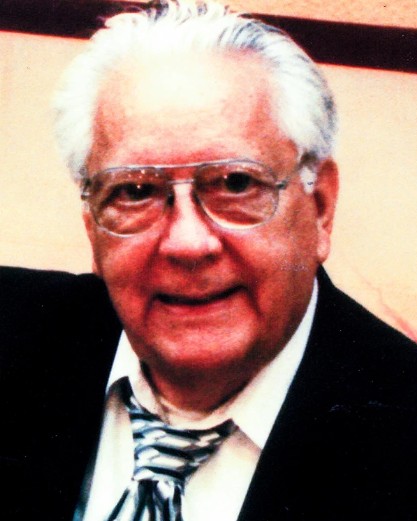
John Talignani. Photo via U.S. National Park Service
Talignani was also a WWII-era Army veteran. His service came during the postwar occupation of Japan rather than during combat operations in World War II. He belonged to the generation that entered military service during the years surrounding the war and served overseas as American forces occupied and rebuilt Japan after the fighting ended.
At 74 years old, Talignani remained devoted to his family. He boarded United Airlines Flight 93 at Newark International Airport on September 11, 2001, to travel to California. His stepson had been killed in an automobile accident during his honeymoon and his daughter-in-law had been seriously injured. Talignani was making the trip to be with his family during an extraordinarily difficult time.
-

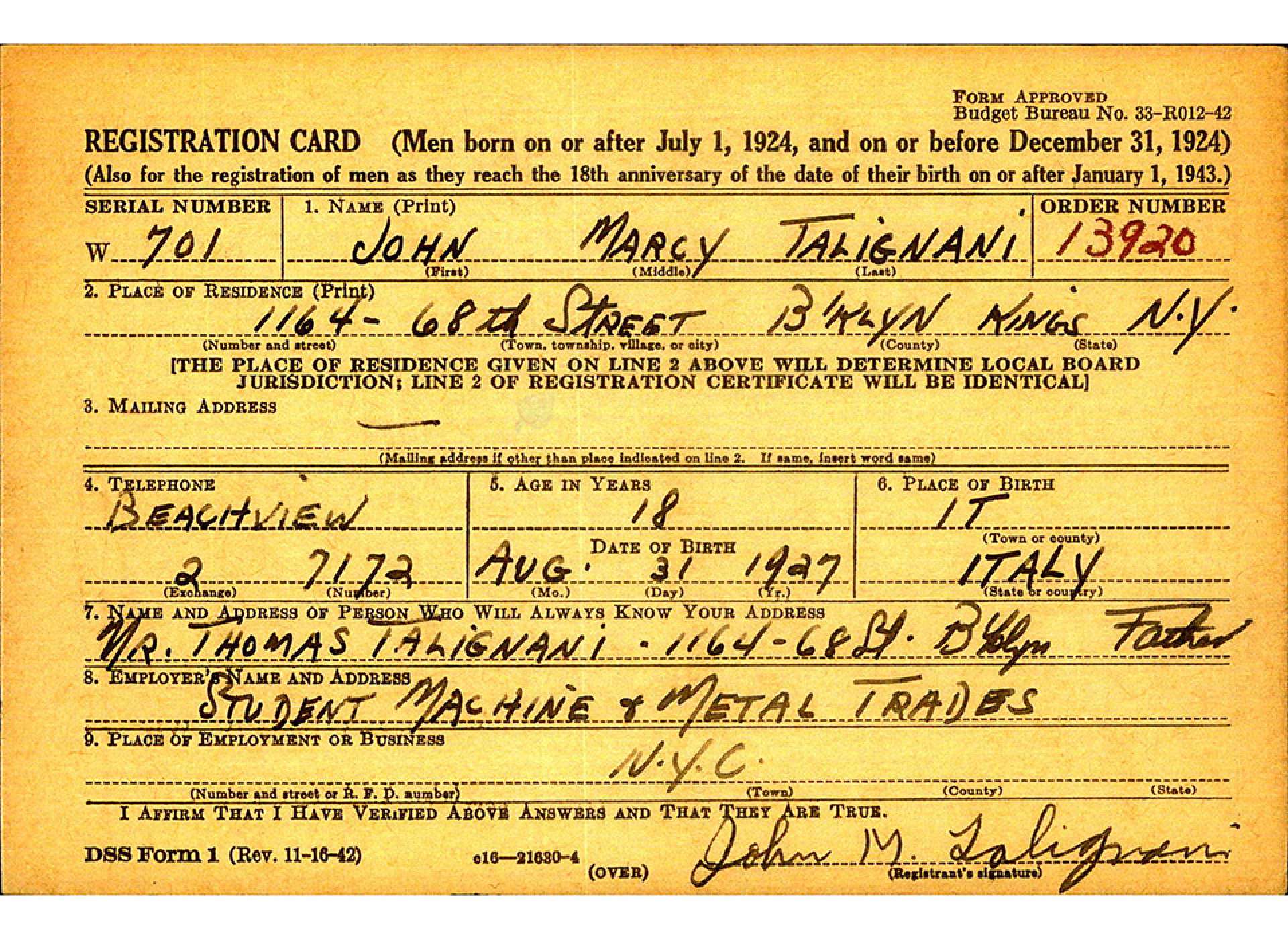
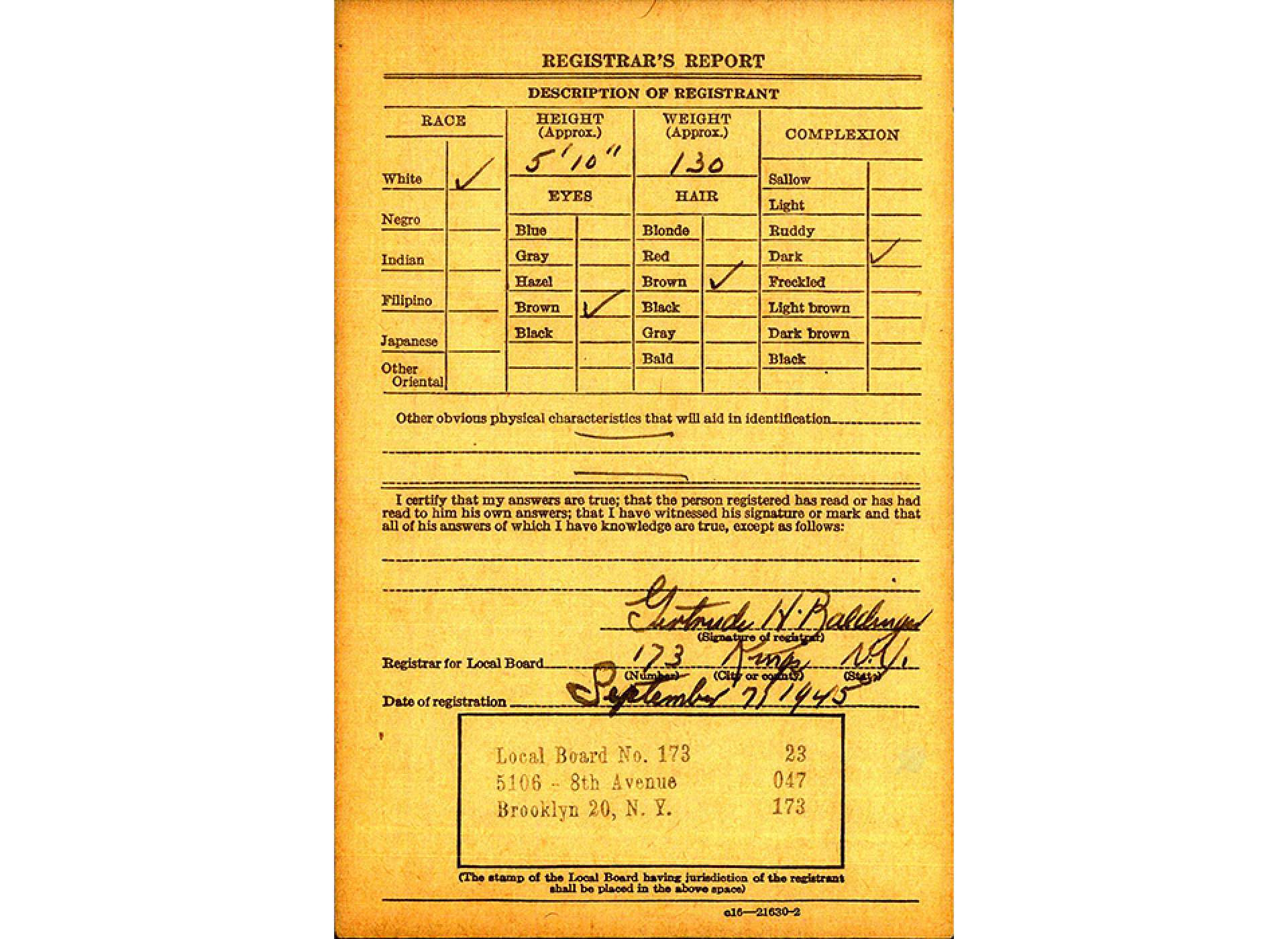
World War II draft card for John Talignani. Photo from Fold3, via National Archives
-
World War II draft card for John Talignani. Photo from Fold3, via National Archives
Flight 93 departed Newark at 8:42 a.m. for San Francisco. By 9:28 a.m., hijackers had taken control of the aircraft. Passengers and crew members began learning about the attacks through telephone calls. When they realized the hijackers intended to use their plane as another weapon, the passengers decided to fight back. At approximately 9:57 a.m., they launched their attempt to retake the aircraft; six minutes later, Flight 93 crashed into a field near Shanksville, Pennsylvania. Talignani was among the 40 passengers and crew members killed aboard.
Talignani had spent his retirement close to the people he loved, enjoying time with his family and following the New York Mets. On September 11, he boarded Flight 93 to California for one more act of devotion to his family. He never made it there.
Remembering Them
These men lived very different lives after World War II, but each carried the experience of that era into the decades that followed. By September 2001, they were no longer young servicemembers. They were husbands, fathers, priests, professionals, retirees, and members of their communities. Their lives had continued long after the war ended.
Twenty-five years later, their stories offer another way to remember September 11. The 2,977 people killed that day were not simply names or numbers. They were individuals with families, careers, memories, and histories that began long before the attacks. For some, that history included answering the call to service during World War II. Many other young Americans would answer the call to serve in the years and decades that followed the attacks.
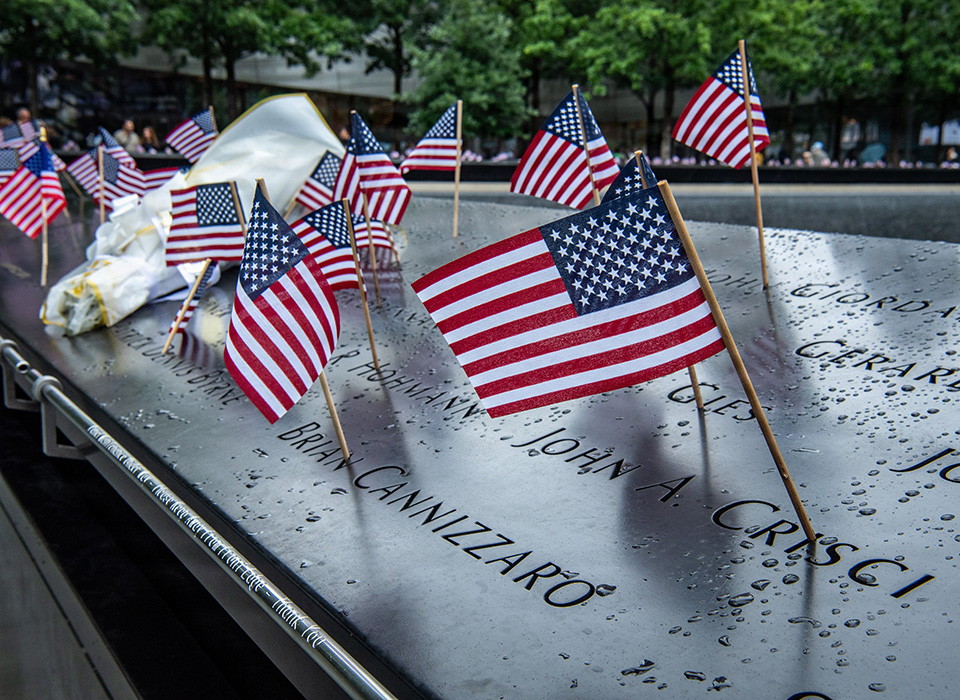
American flags are placed to honor the victims of the 9/11 terrorist attack at the South Tower Pool near the 9/11 Memorial & Museum during International Naval Review 250 in New York City, July 6, 2026. U.S. Navy photo by Mass Communication Specialist Seaman Octavio Borrego
At The National WWII Museum, remembering the anniversary of September 11 means remembering all those who perished that day and recognizing the many different stories they carried with them. By telling the stories of those who lived through one defining moment in American history and were lost in another, we help preserve the individual experiences behind events that changed the nation. Our responsibility is not only to remember how they died, but also to remember who they were. May we never forget.
Adam Coste
Adam Coste is the World War II Historian for Digital Content at The National WWII Museum's Jenny Craig Institute for the Study of War and Democracy.
Stephen Bateman
Stephen Bateman is an Institute Associate at the Jenny Craig Institute for the Study of War and Democracy at the National WWII Museum.
Cite this article:
MLA Citation:
APA Citation:
Chicago Style Citation: