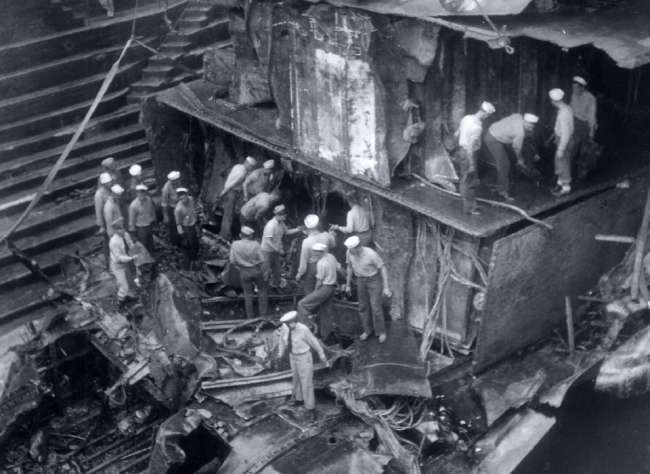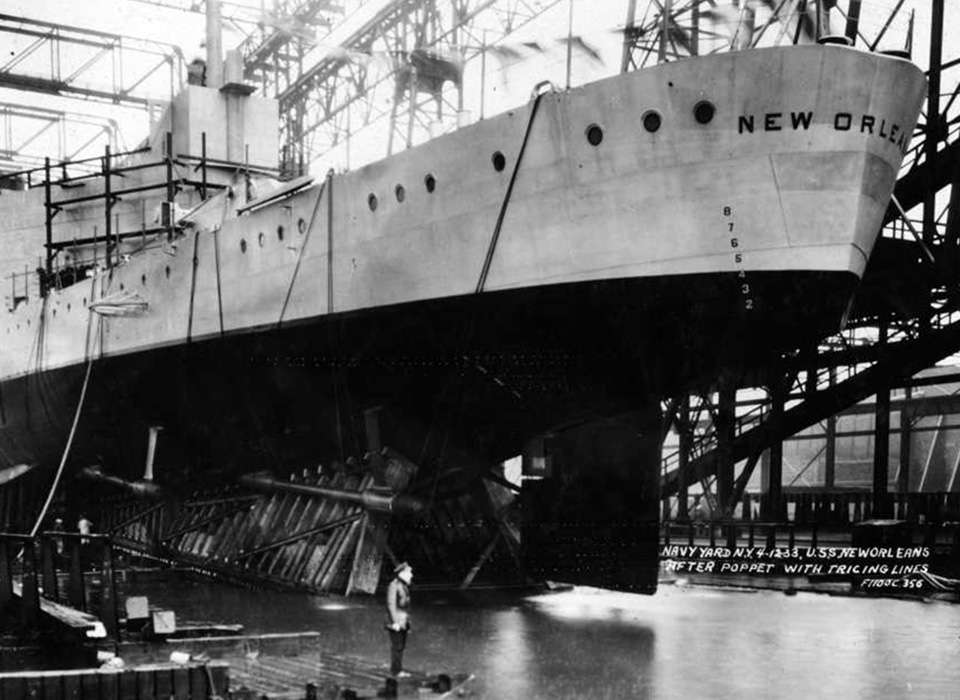
Top Photo: Crews ready the USS New Orleans for launch in 1933 at Brooklyn Navy Yard. Courtesy National Archives
On March 30, 1935, the cruiser USS New Orleans (CA-32) made her first visit to the city she was named for. A front-page article in The New Orleans States described the New Orleans as “trim and fast and graceful,” and during the ship’s four-day visit to the Cresent City, residents came aboard the recently completed cruiser to experience it firsthand.1
The officers and men of the New Orleans received a royal welcome from the city’s leaders and locals. Captain Allen Bevins Reed, the ship’s first commanding officer, told The Times-Picayune that, even though he had just arrived in the city, he already felt like a native. His hosts agreed: Mayor T. Semmes Walmsley told Reed, “When you reported for duty aboard the U.S.S. New Orleans, you became one of us.”2
The Road to the New Orleans: The London Naval Treaty of 1930
The construction of new cruisers such as the USS New Orleans came at a crucial moment for global disarmament talks. After World War I, many of the world’s leading military powers agreed to limit the strength of their navies during a series of international conferences. The Washington Naval Conference of 1921–22 limited the number of battleships that leading naval powers (including the United States, the United Kingdom, and Japan) could build, but it left many issues unresolved. While the treaty focused on battleships or capital ships, an unanswered question was how many non-capital ships (including cruisers, aircraft carriers, and submarines) signatory nations could build in the coming years.
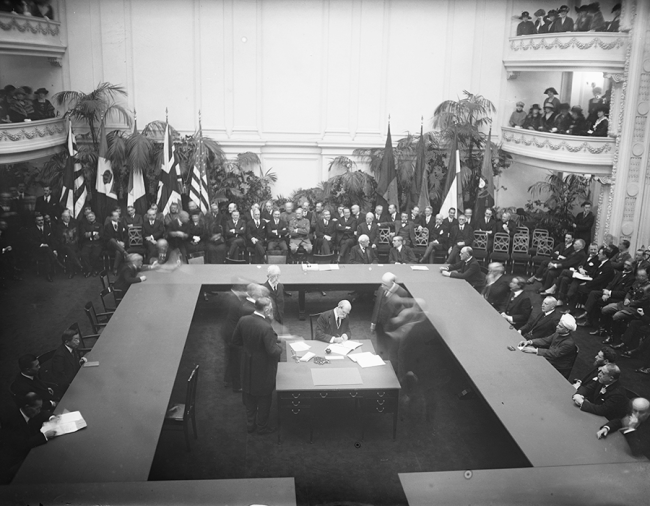
At the London Naval Conference in 1930, delegates from the United States, United Kingdom, Japan, Italy, and France agreed that the Americans were entitled to 18 cruisers, the British to 15, and the Japanese to 12 (a ratio of 5:4:3).3 The treaty, which was signed on April 22, 1930, cleared the way for the United States to build a new class of 10,000-ton heavy cruisers. Sometimes referred to as “pocket battleships,” these cruisers were armed with 8-inch guns and carried a crew of over 500 sailors and Marines.
The end of the London Naval Conference coincided with the retirement of the second ship in US naval history to be named for the city of New Orleans. In the spring of 1930, the USS New Orleans (CL-22) ended her long career as an American fighting ship. As The New Orleans States reported in March 1930, the USS New Orleans had “witnessed the evolution of the naval service from the stirring days of the Spanish–American War to these latter days of airplanes and giant submarines and airplane carriers.”4
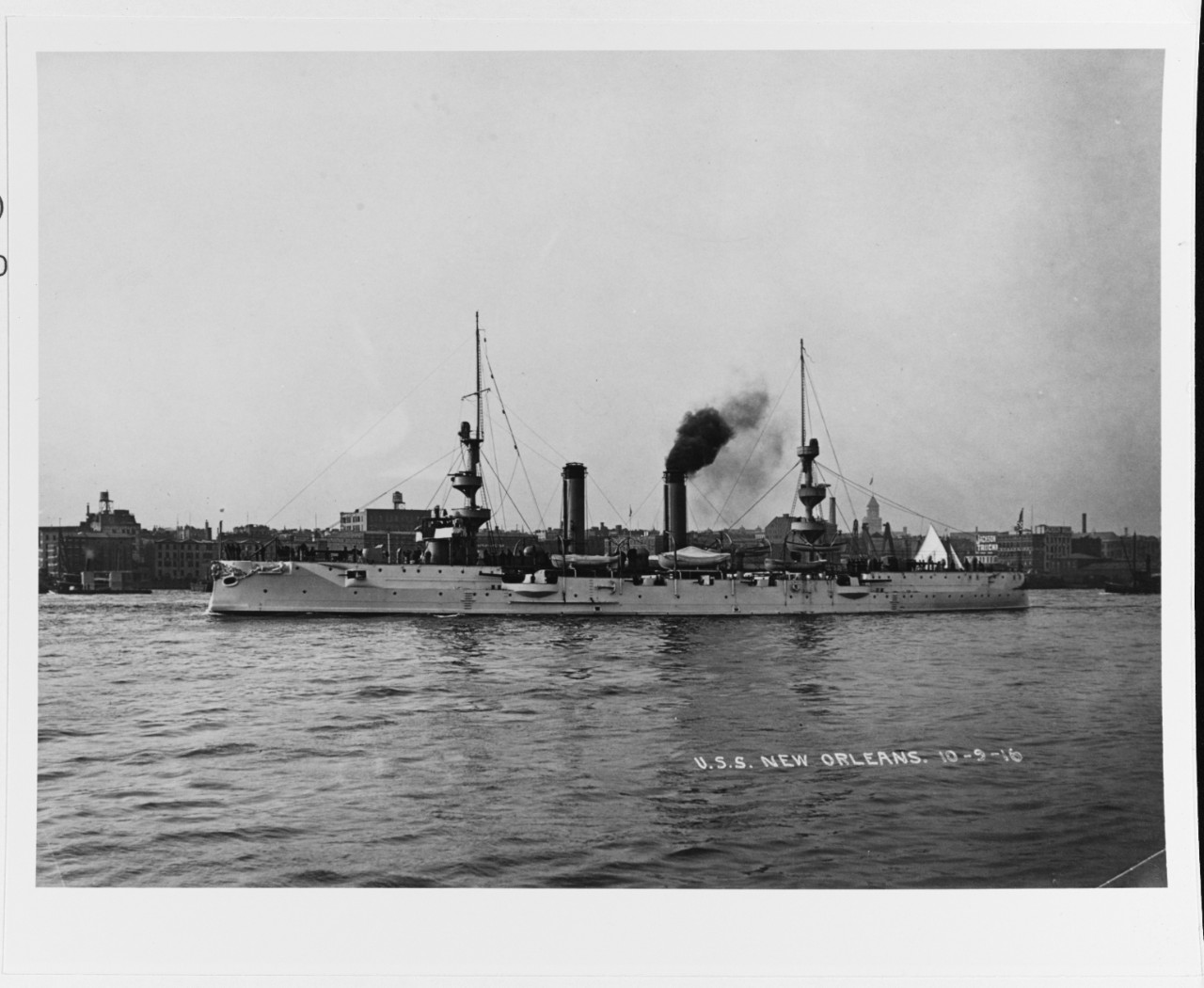
USS New Orleans (CL-22), circa 1900. Naval History and Heritage Command.
Building and Launching a Brand-New USS New Orleans
Construction of a new USS New Orleans began in March 1931 at the Brooklyn Navy Yard and lasted more than two years. For the official launch ceremony on April 12, 1934, New Orleans city officials came to New York City to send off the Navy’s newest vessel. Among them were the city’s mayor, T. Semmes Walmsley, police superintendent George Ryder, and city commissioner Joseph P. Skelly. Skelly brought with him a silver plaque featuring Jesuit missionary Jacques Marquette as a gift from the City of New Orleans.5
Other members of the New Orleans delegation included Ernest L. Jahncke Sr., an engineer and businessman who served as Assistant Secretary of the Navy under President Herbert Hoover, and his daughter, Cora Stanton Jahncke, the new vessel’s sponsor. US Navy tradition called for the sponsor to shatter a bottle of Champagne against a ship’s hull as it left the dock and entered the water. In this instance, however, with Prohibition laws still in effect under the 18th Amendment, newspapers at the time reported that the bottle Cora Jahncke smashed against the hull of the USS New Orleans contained Mississippi River water instead of Champagne.6
The Jahnckes’ connections to the ship extended even further: Among her inaugural crew was Ensign Ernest L. Jahncke Jr., a 1933 graduate of the US Naval Academy at Annapolis and one of the ship’s junior officers.7
Also present was Jahncke Sr.’s successor as Assistant Secretary of the Navy, Henry L. Roosevelt, a distant cousin of both former President Theodore Roosevelt and sitting President Franklin D. Roosevelt, and the fourth Roosevelt to occupy that position. Assistant Secretary Roosevelt linked the construction of the USS New Orleans to both American security and the ongoing economic depression in the United States: “Apart from the fact that such a navy will be the best insurance against warfare, the construction of ships will provide employment for many thousands of men and women throughout the country.”8
The Early Voyages of USS New Orleans
After her initial shakedown cruise, the New Orleans crossed the Atlantic and visited several European ports. Throughout June 1934, newspapers in New Orleans tracked her movements and her reception in a series of foreign ports. In Amsterdam, The Times-Picayune reported that an unnamed American sailor from the New Orleans saved a Dutch child from drowning in one of the city’s canals.9 Less than two weeks later, The New Orleans Item described how the cruiser was given a berth of honor at Great Britain’s Portsmouth naval dock yard. Upon her departure, British Admiral Sir John Donald Kelly sent a message to the New Orleans’s commander: “Your visit has been a very great pleasure to us. I wish you and all under your command a pleasant voyage home to your sweethearts and wives.”10
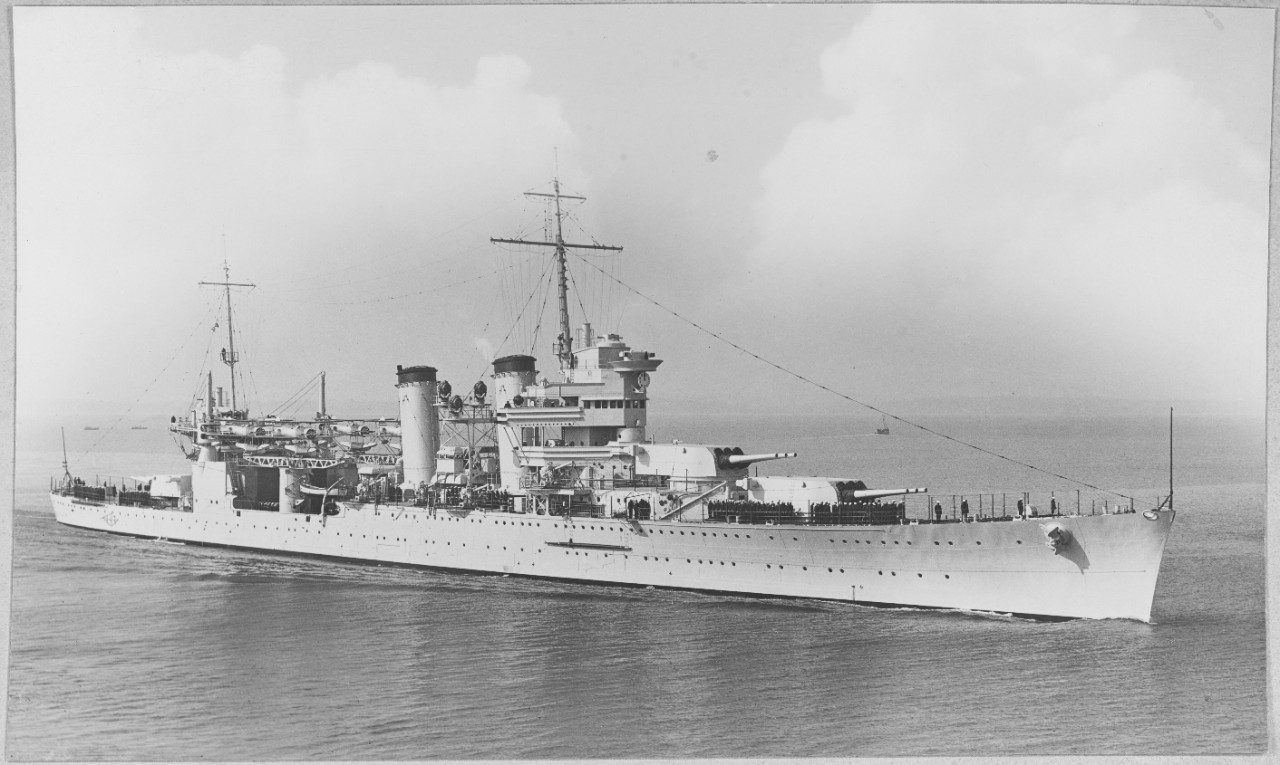
USS New Orleans (CA-32) in English waters, June 1934. Naval History and Heritage Command.
In July 1934, the USS New Orleans was one of several ships to escort President Roosevelt on a long journey from the East Coast through the Panama Canal to the Pacific and the Territory of Hawaii.11
At the end of March 1935, the New Orleans made her first visit to her namesake city. As part of their welcome ceremony, city leaders presented the ship’s captain and crew with a silver service designed by Coleman E. Adler & Sons, a jewelry business on Canal Street that opened in 1898 and closed in 2025.
This was no ordinary silver set—it was the very same silver set presented to the crew of the USS Louisiana (BB-19), a battleship that entered service in 1906, sailed around the world as part of President Theodore Roosevelt’s Great White Fleet, and escorted ships across the Atlantic during World War I before being decommissioned in 1921. Beside a depiction of city residents and leaders waving to the USS New Orleans arriving in the city, The Times-Picayune proclaimed that this still-new US Navy cruiser “inherits not only the silver services of the others but the same community admiration and goodwill in which they shared.”12
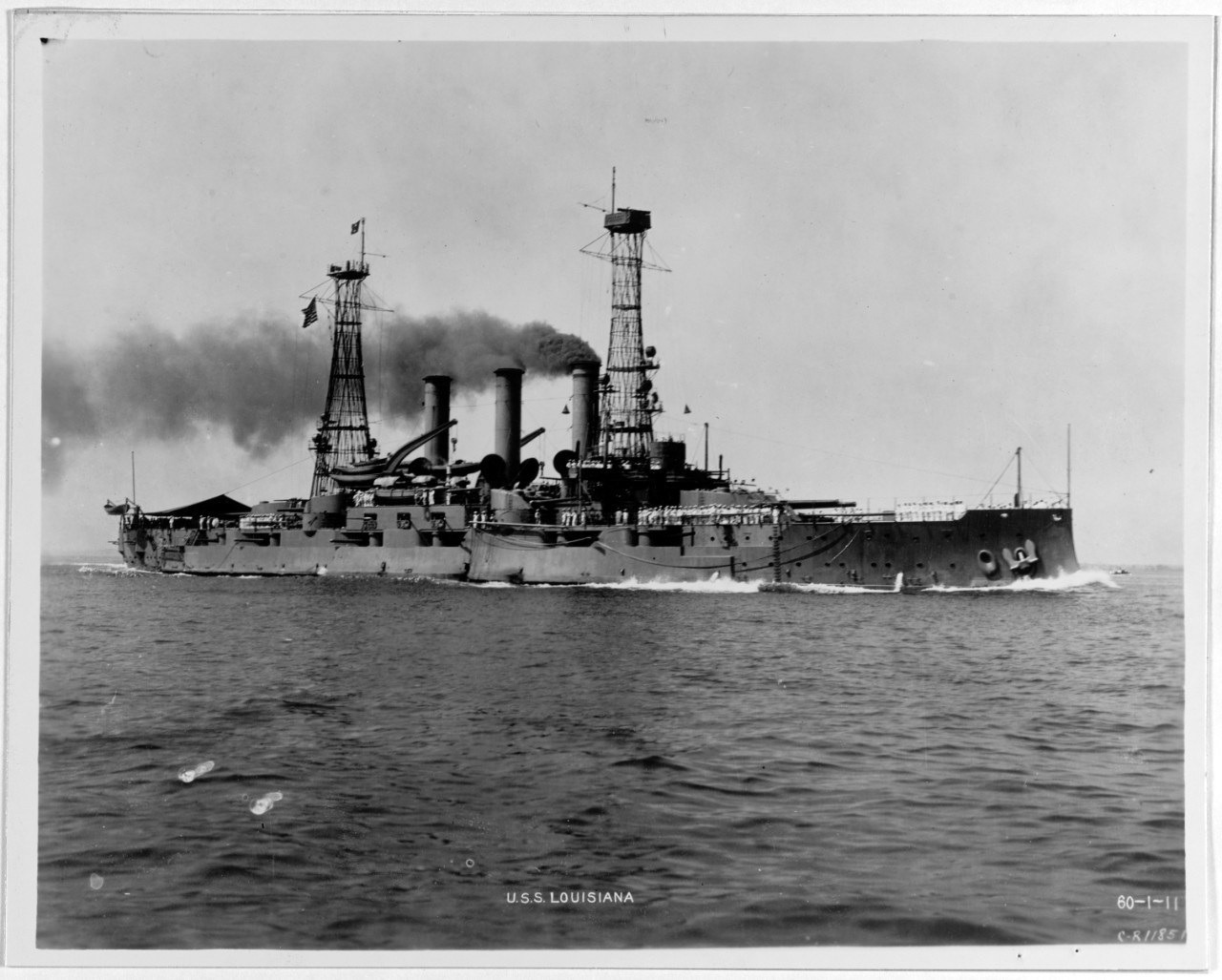
Battleship USS Louisiana (BB-19) underway, circa 1910-14. Naval History and Heritage Command
Seeing an opportunity to showcase their products, the owners of Coleman E. Adler & Sons placed an advertisement in The New Orleans Item. The advertisement proclaimed the high quality of their silverware and boasted that this particular set had tripled in value in the 30 years since it was presented to the crew of the USS Louisiana.13
The New Orleans Returns Home, But Her Visit Is Cut Short
After leaving her namesake city, the USS New Orleans continued her naval career in both the Pacific and Atlantic Oceans. In the spring of 1939, she was again preparing to return to New Orleans, this time accompanied by another cruiser, the USS Chicago (CA-29). Constructed on the West Coast, the Chicago was making her first visit to New Orleans. Their arrival was set for the first week of April, and the visit was supposed to last 10 days.
As the date of their arrival approached, Ernest Jahncke Sr. revealed that, contrary to what was reported at the time, the bottle that his daughter Cora broke against the New Orleans’s hull had contained real Champagne. This was, The New Orleans States reported, “in accordance with ancient navy tradition, and in spite of the order against christening warships of prohibition America with intoxicating beverages.” When interviewed by journalist Meigs Frost, Jahncke expressed disdain at the Prohibition-era practice: “No ship named New Orleans could face the world if it was christened with anything else. Water! Good Lord!”14
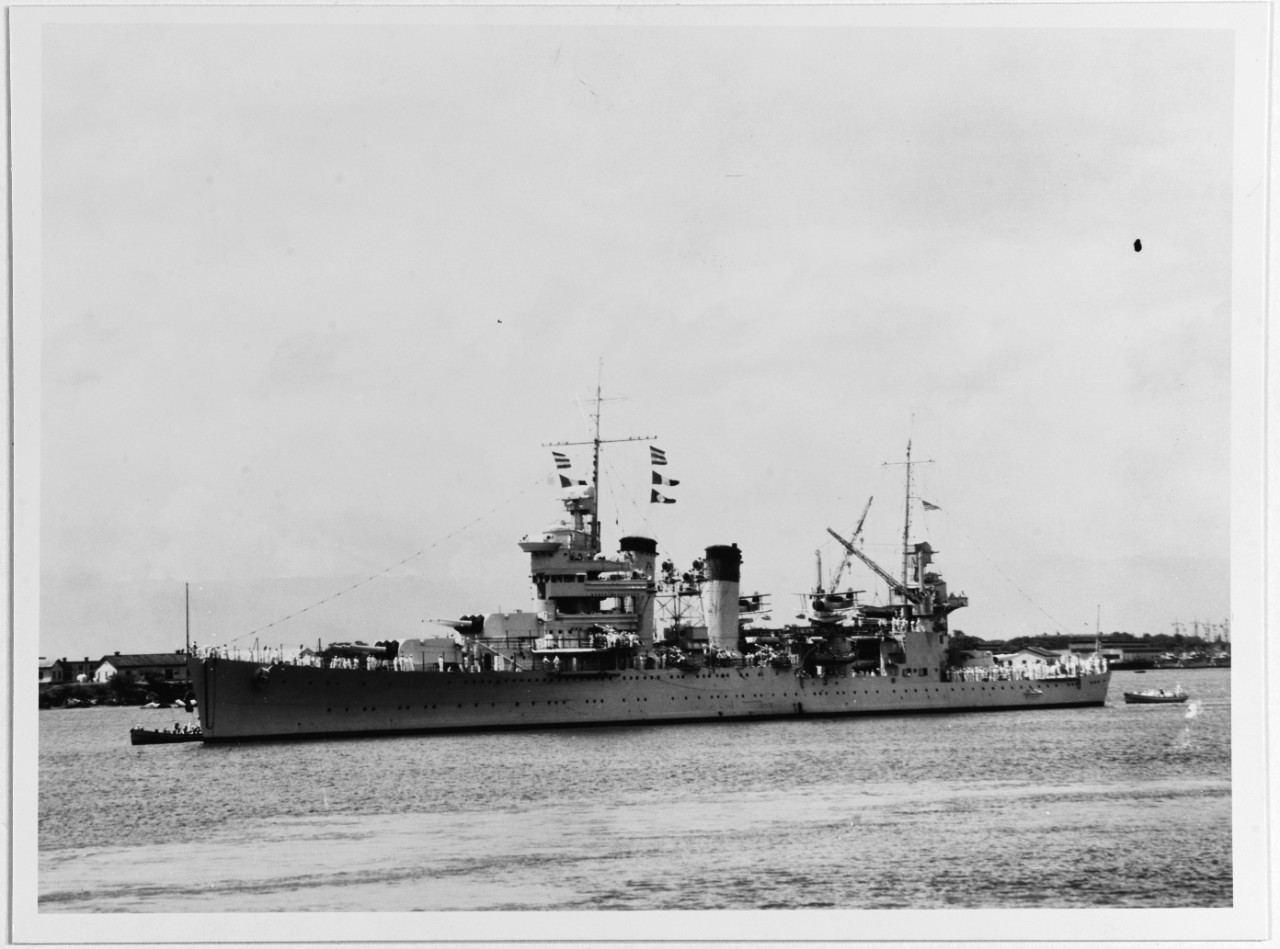
USS New Orleans in port, circa 1937. Naval History and Heritage Command.
Unbeknownst to the people of New Orleans and the crew of the USS New Orleans, events far beyond their control were about to shorten their reunion. Without warning, on Saturday, April 15, Secretary of the Navy Claude Swanson ordered the bulk of the US Navy to sail for the Pacific Ocean, where it would establish new permanent bases and a larger American military presence in the region to deter Japanese aggression.
According to journalist Frank L. Kluckhohn of The New York Times, who covered the Roosevelt administration, the president gave no specific justification for the dramatic order, although it came on the same day that Roosevelt released a personal message to the leaders of Germany and Italy asking them to agree to a 10-year pledge not to engage in aggressive warfare.15
Citing a “highly reliable source,” Kluckhohn wrote that American officials worried that the US position in the Pacific was vulnerable and believed that reinforcing the Pacific Fleet would signal to Japan that the United States had not abandoned the region. Sending American ships to the Pacific would also reassure US allies in Europe, especially France and Great Britain, who worried about their immediate security situation in Europe.16
Regardless of what happened at the highest levels of government, the Navy secretary’s order caught American officers and enlisted men by surprise. In New Orleans, the crews of the New Orleans and the Chicago received word the evening of Saturday, April 15, that they were to leave the city at daybreak on Tuesday, April 18. They were to rendezvous with other American ships at Guantanamo Bay, Cuba, before heading south for the Pacific via the Panama Canal. All shore leaves were canceled, as were plans for the ships to take part in a formal fleet review in Virginia and visit the World’s Fair in New York.17
But even though she was gone, the people of New Orleans did not forget their ship and her crew. Several weeks after the USS New Orleans departed, The New Orleans Item printed a letter from a young New Orleans girl. Her name was Agneita Myers, and in the late 1930s The Item printed several of her letters on a variety of topics. This time, she addressed accusations of bad behavior by American sailors during the recent visit by the New Orleans and the Chicago. Citing several individual sailors her family knew, she defended the sailors, calling them “the defenders of the grandest country in the world” who “would be acclaimed as a martyr and hero” if they died in battle. She concluded with a rebuke to her fellow citizens, telling them the American sailor deserved their respect and friendship: “Give it to him now, don’t wait until he is dead.”18
Less than three years later, many of those sailors were aboard the USS New Orleans when the Pacific Fleet was attacked at Pearl Harbor on December 7, 1941, by forces of the Imperial Japanese Navy.
- 1
“Warship that Bears City’s Name is Given Great Welcome Here,” New Orleans States, March 30, 1935.
- 2
“Navy Ship Named for New Orleans Met by Crowd at Toulouse Wharf,” The Times-Picayune, March 31, 1935,
- 3
Part III, Articles 15-18, London Naval Treaty of 1930, Proceedings of the London Naval Conference of 1930 and Supplementary Documents (Washington, D.C.: U.S. Government Printing Office, 1931), 215-216.
- 4
“Another U.S. Cruiser May Bear Names of Orleans,” The New Orleans States, March 9, 1930.
- 5
“Cruiser New Orleans, U.S. Fleet’s New ‘Pocket Warship,’ Launched,” Times-Picayune, April 13, 1933, page 1.
- 6
“Cruiser New Orleans, U.S. Fleet’s New ‘Pocket Warship,’ Launched,” Times-Picayune, April 13, 1933, page 1. Prohibition officially ended on December 5, 1933, with the ratification of the 21st Amendment.
- 7
“Navy Takes Over New Cruiser Here,” The New York Times, February 16, 1934.
- 8
“Cruiser New Orleans, U.S. Fleet’s New ‘Pocket Warship,’ Launched,” Times-Picayune, April 13, 1933, page 6.
- 9
“U.S.S. New Orleans Sailor Rescues Boy,” The Times-Picayune, June 8, 1934.
- 10
“England Honors U.S.S. New Orleans,” The New Orleans Item, June 19, 1934.
- 11
“Roosevelt Leaves Cocos for Hawaii,” The New York Times, July 15, 1934.
- 12
“U.S.S. New Orleans: Welcome Home!” The Times-Picayune, March 30, 1935, page 8.
- 13
“The Finest Silver Service In The Navy,” advertisement in The New Orleans Item, April 1, 1935, page 2.
- 14
Meigs O. Frost, “Champagne Christened Her Despite Prohibition: Use ‘Bootleg’ Champagne to Christen Ship,” The New Orleans States, April 4, 1939, pages 1 and 9.
- 15
The Associated Press, “The President’s Appeal,” printed in The New York Times, April 16, 1939.
- 16
Frank L. Kluckhohn, “Navy Aim Mystery,” The New York Times, April 16, 1939.
- 17
“Cruisers Visiting New Orleans Rush to Leave for Cuba,” The New Orleans Item, April 16, 1939.
- 18
Agneita Myers, “Sailors Wronged, She Says,” The New Orleans Item, April 30, 1939.

Sean Scanlon, PhD
Sean Scanlon is a World War II Military Historian at the Jenny Craig Institute for the Study of War and Democracy.
Cite this article:
MLA Citation:
APA Citation:
Chicago Style Citation: