
About the Episode
On December 7, 1941, at 7:55 a.m., a surprise attack stuns Pearl Harbor, and the United States enters World War II.
In this episode, historians Michael Bell and Nicholas Reynolds join host Bradley W. Hart to detail Japan’s plan of attack and America’s response.
Topics Covered in This Episode
- Pearl Harbor Attack
- Franklin D. Roosevelt
- Admiral Husband E. Kimmel
- General Walter Short
- Joe Rochefort
- USS Arizona and USS California
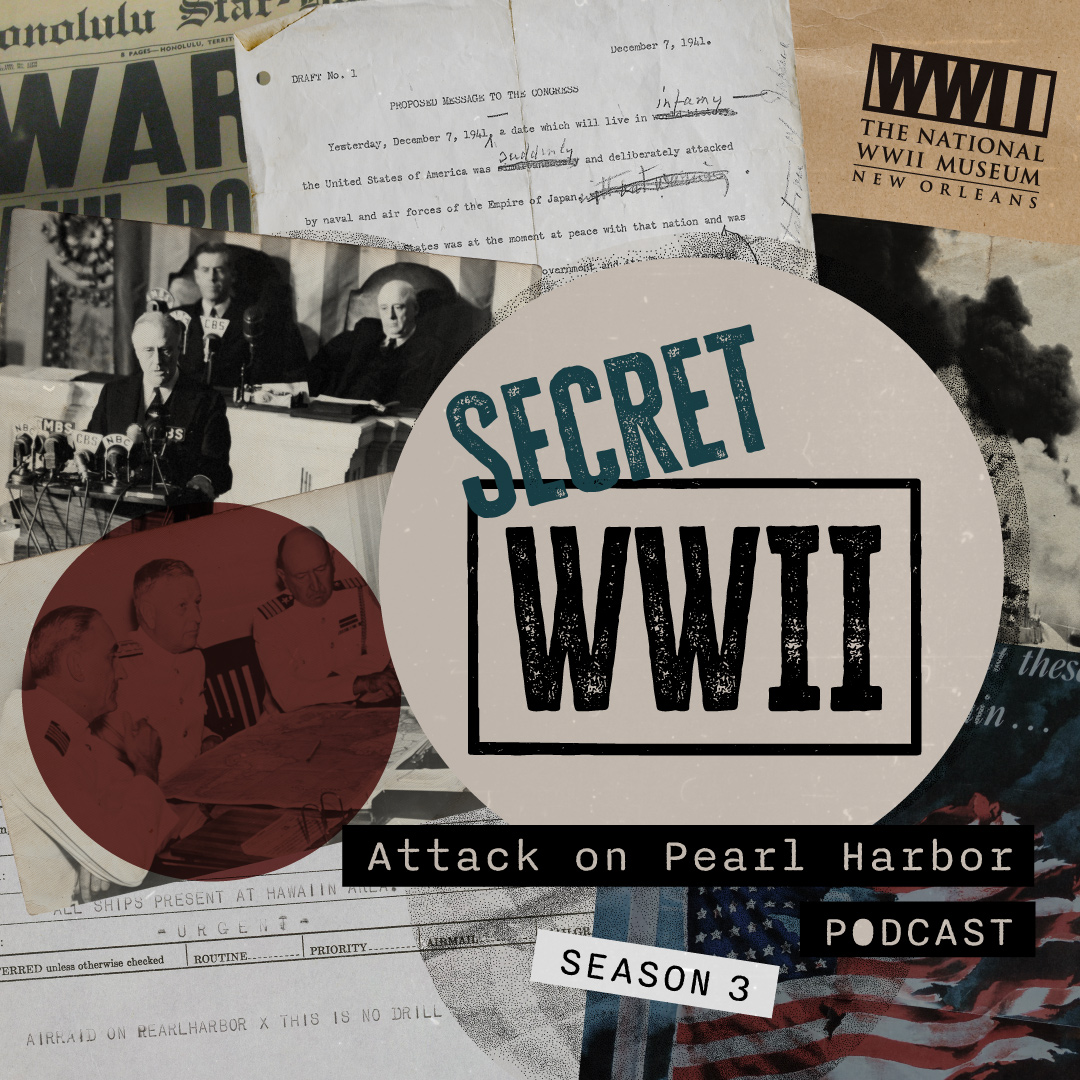
Nicholas Reynolds, PhD
Nicholas Reynolds is a US Marine Corps veteran, serving as an infantry officer and then as an official historian. As a Colonel in the Reserves, he was Officer in Charge of Field History, deploying historians around the world to capture history as it was being made. For many years, he worked at CIA, most recently as the historian for the CIA Museum. Reynolds has taught at the Naval War College, Johns Hopkins University, and the Osher Lifelong Learning Institute. He is the author of Need to Know: World War II and the Rise of American Intelligence.
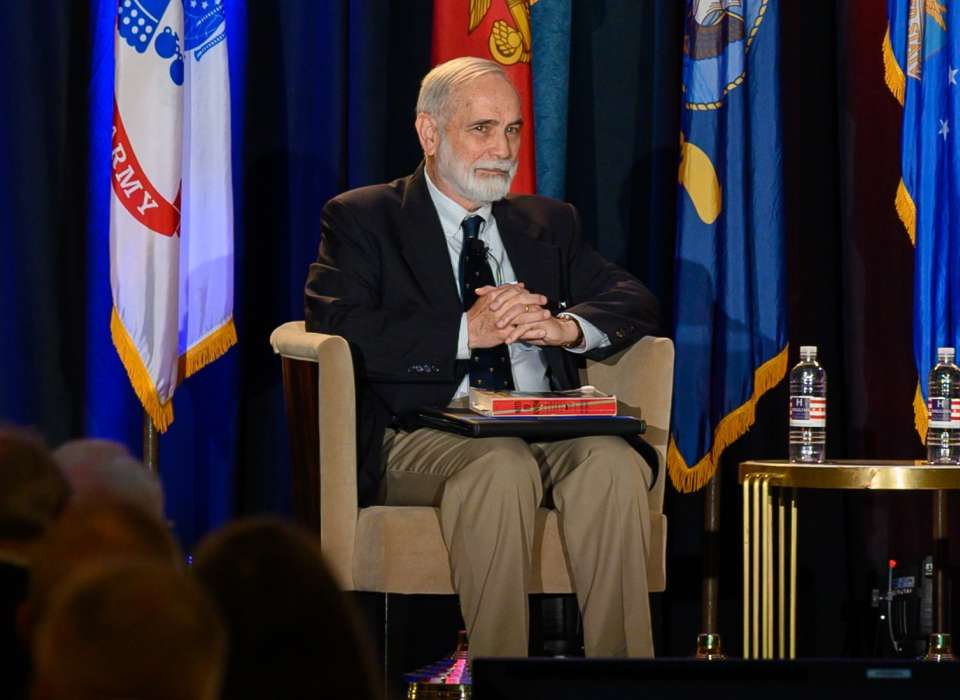
Michael Bell, PhD (COL, USA, Ret.)
Michael Bell is Vice President of Research and Education at The National WWII Museum. Commissioned in Armor following graduation from West Point, he is a combat veteran, historian, and strategist who has served at every level from platoon through theater army, as well as with US Central Command, the Joint Staff, the West Point faculty, and the National Defense University. As a civilian faculty member at the National Defense University, he also served details to the Office of the Secretary of State and as a National Security Council Senior Director and Special Assistant to the President.
-
 Article Type
US Intelligence Failures at Pearl Harbor
Japan’s attack on Pearl Harbor was a shock to the Americans, but it was preceded by serious intelligence failures
-
Article Type
The Road to Pearl Harbor: The Long Fuse
Major events are often rooted deeply in the past—the “long fuse” that leads to explosions.
-
Article Type
The Road to Pearl Harbor: The Short Fuse
The attack on Pearl Harbor was decades in the making, but still came as a shock.
-

The Attack on Pearl Harbor | WWII IN 2
On December 7, 1941, Japan launched a surprise attack on Pearl Harbor, bringing the United States into World War II. John Curatola... -
Topic
Pearl Harbor Attack, December 7, 1941
The National WWII Museum commemorates the "date which will live in infamy" through articles, oral histories, artifacts, and more.
-
Special thanks to The Dale E. and Janice Davis Johnston Family for their generous support of this series.
Part 3: December 7, 1941
Bradley Hart
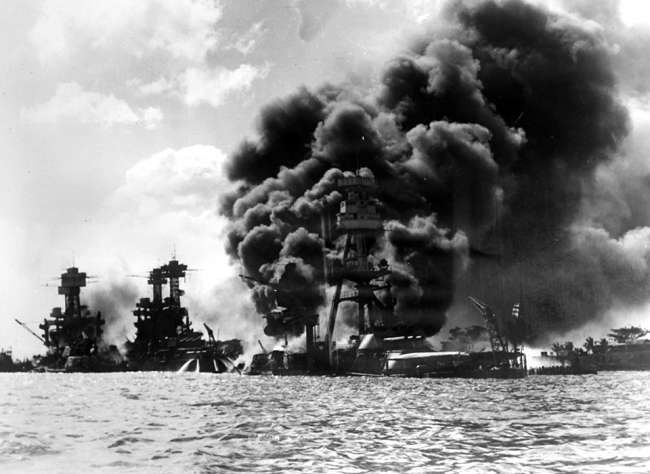
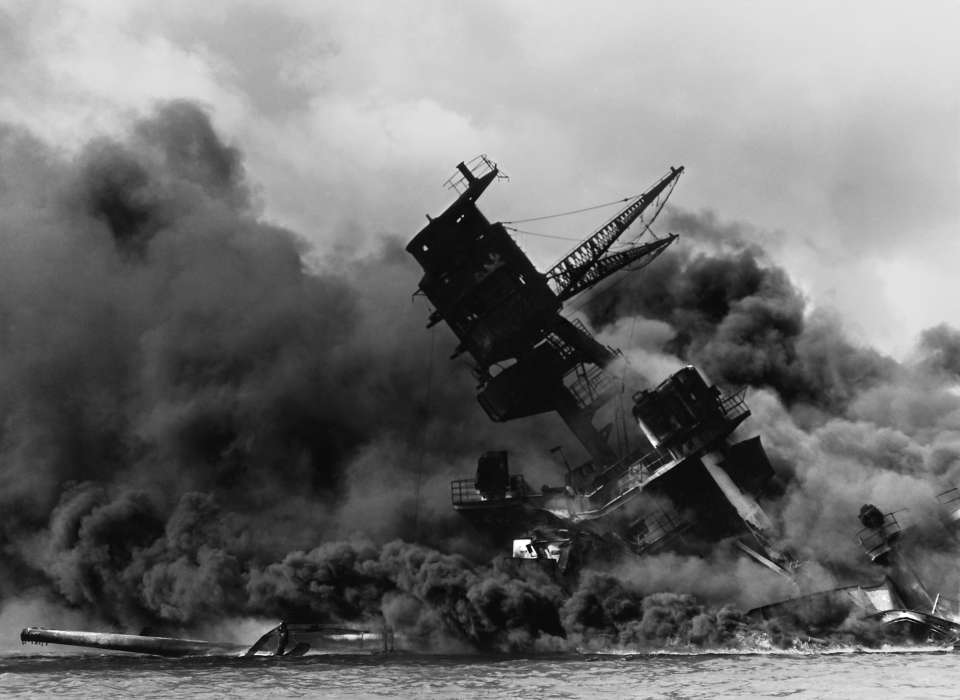
It's Sunday morning, December 7th, 1941. At around 7:15 AM, Admiral Husband E. Kimmel, Commander-in-Chief of the US Pacific Fleet, is informed that USS Ward has fired on an unknown submarine near Pearl Harbor. At 7:55 AM, Kimmel is standing in a building overlooking the harbor when a wave of Japanese planes appear in the skies, unleashing a shocking and relentless attack. Minutes later, Kimmel himself is hit by a spent bullet in the chest. It turns out to be a minor wound, but according to a later account, Kimmel remarks, quote, "It would've been more merciful had it killed me." Meanwhile, Japanese torpedo bombers and dive bombers are hitting American battleships and other vessels hard. Explosions rip across Pearl Harbor. In a shocking crescendo, at around 8:06 AM, an armor-piercing bomb strikes USS Arizona near Turret No. 2. Seconds later, the forward magazine's deck. An ear-shattering explosion marks the death of more than 1,000 Americans. In this oral history from the National World War II Museum, USS Arizona survivor Donald Stratton describes that terrible morning.
Donald Stratton
But some sailors were yellin' on the bow of the ship, so I go up and check it out and sure enough, when the planes peeled away and I could see the big red Japanese insignia and I knew it was the Japanese right away and they were bombing. I could see the torpedo planes coming in and torpedoes in the water. I could see just everybody was getting hit and the dive bombers and the strafers and the high-altitude bombers is what was hurting us. We couldn't... We had to train our guns up 90 degrees to try to hit the high-altitude bombers, and the Arizona caught this hit and it blew up and shook the ship, and knocked 33,600 ton or something like that. Just shook it like a dog would shake a rat or something, you know? And it blew 110 foot of the bow of the ship off. Well, we got caught in that ball of fire with no place to go. It was a horrible day. I was burned between 60 and 70% of my body. I lost 1,177 men on the Arizona.
Bradley Hart
But the attack is not over yet. Around 8:40 AM, a second wave of Japanese planes appear on the horizon and more Americans are about to lose their lives in a surprise attack. In today's America, we are familiar with the concept of large-scale surprise aerial attacks. But for Americans at the time, an attack of this scale against US territory and armed forces had never happened before. And the punishment is swift for the commanders on the ground. Less than two weeks after Pearl Harbor, Admiral Kimmel and General Short are relieved of duty. In this podcast, which is made possible by the support of the Dale E and Janice Davis Johnston Family Foundation, I'm joined again by Nicholas Reynolds and also Michael Bell, Vice President of Research and Education here at the National World War II Museum. So, December 7th, 1941, a date which will live in infamy, as FDR will say, the following day. But Nick, take us through the events of that morning.
Nick Reynolds
So, it's a beautiful day. It's Sunday. A lot of people are taking the day off or plan to take the day off. That includes our hero, Joe Rochefort, who is gonna go on a picnic with his family. And between 7:00 and 8:00 AM, he's loading the car. They got the steaks in the cooler. They're gonna go out and grill. And before they can leave the house, the news comes, "Hey, you gotta get back to the base." And you see that with a couple other of the officers like Eddie Layton who think this is gonna be a little bit more relaxed day than some of the others. Admiral Kimmel is working seven days a week, by the way. So, for him, it would be a regular work day and he is in his office on Sunday morning. He does not bring his family to Oahu because he thinks that would be a distraction for him. So, he's focused. On the ships in the harbor, between 7:30 and 8:00 in the morning, what they're doing is getting ready for morning colors. So, you have the bandsmen of the various ships getting ready to sound colors. So, they're gonna play a little naval music, military music as they raise the American flag, which is scheduled for eight o'clock. And then, just before eight o'clock is when the first Japanese planes appear over Pearl Harbor. Initially, people looking up think, "Well, boy, this is some kind of drill. Boy, there's a lot of them." And then, they start firing and the realization sinks in that this is an attack.
Bradley Hart
So, Mike, let's go to Washington DC. So, this is happening seven o'clock in the morning. It's a bit later in DC because of the time zone difference. How does FDR find out about what's going on in Pearl Harbor?
Mike Bell
So, FDR is, you know, kind of relaxing. He and Eleanor are supposed to have dinner that evening with the Murrows. Secretary of the Navy will call him, and, you know, the initial piece is that FDR appears to be in shock, but then very quickly have a resolve about, you know, "What do we do about this?" He doesn't have dinner with the Murrows. They have dinner with Eleanor. You know, he'll continue to coordinate with Secretary Henry Lewis Stimson, Frank Knox, Secretary of the Navy, you know, ultimately have a call with Churchill that evening, you know, as you're kind of preparing for, you know, what's next, and, you know, begin drafting the message to Congress, you know, that he'll deliver the next day. So, a fairly rapid adjustment from kind of the shock over the attack and the news and according to his physician, you know, how quickly he really sets about, "Here's what needs to be done in this process."
Bradley Hart
I mean, both of you have worked in government service for much of your careers. Put yourself, I guess it's a tough question, put yourself in the perspective of somebody who's there, right, somebody who's working in a place like the White House or the Department of War in this period. What do you think is going through their minds when this news is sort of, when it's breaking news, effectively?
Mike Bell
Used to have a saying, you know, the first report's always wrong, you know, at least, you know, in a calvary squadron. And in this case, you know, what is it that you don't know? What's the full magnitude, the extent? Is this the first of a follow-on attack? You know, there was suspicions in Kimmel's headquarters that, you know, there would be, you know, some type of landing, there was reports of parachutists. What else is involved here? You know, there's talk in the media that, you know, will the cities be bombed next? You know, Los Angeles and New York. And so, I think you've got to kind of sort through what you know with the almost, you know, wild suspicions as you try to sort that out. And then, where does it not fit? In many people's minds, they're waiting for Japan to break diplomatic relations first, you know, and that would be the prelude to war. You know, what doesn't fit in this and how do you make sense of that, I think, is the big challenge.
Nick Reynolds
And I think that's exactly right. So, the commander's response should be, "What's going on here?" You know, "Get me more information." We see that both in Pearl Harbor and in the White House. I've always been struck by FDR's attitude, which almost seems to be one of relief. So, we've been leading up to war. There's been all this uncertainty and now, finally, we got it. And he almost seems relieved as... And Churchill is openly relieved, you know, "Thank God you guys are gonna be on the same side as us." Roosevelt, that seems to be almost his initial reaction. He is upset that the Navy, his Navy, that he takes a personal interest in from having served as assistant secretary of the Navy. Kimmel and Short are kind of in the same boat. An interesting tidbit in Eddie Layton's book where Kimmel's looking out of the window in his office more or less in disbelief, and an almost spent 50 caliber round comes through the window and strikes him right here across the chest, tears his uniform, leaves a little bit of a welt there on his chest, and he says, "Boy, wouldn't have been so bad if it had killed me."
Mike Bell
You know, a couple other things I think with Kimmel that I found interesting. You know, initially, you know, there's reports you know, how he's kind of staring and he's doleful, but by 10:30, 10:20, he's already directing the task forces out at sea to intercept the Japanese carriers, destroy them. And so, even though, you know, he may wish that spent round had gotten him, I think there's a point at which, you know, he also pulls it together and they're also predicting the future. Will this be, you know, these reports of sampans and troop ships and parachutists? What's the next step? But certainly, I think there's some, you know, belief that, you know, the Chicago, the Yorktown, that task force will be able to intercept, you know, the Japanese carriers and at least salvage something out of this.
Bradley Hart
But in fact, they don't intercept the Japanese carriers. I mean, they never find Kido Butai, at least at this moment.
Nick Reynolds
They're looking in the wrong direction, in part. So, the intel guys get a reading, a direction finding, but it could be 180 or 360, right? Because they don't have a second reading. So, could it be north or south of the island? And I think they go looking, memory serves, they go looking in the wrong way. They go looking south, right?
Mike Bell
Yeah, the Yorktown initially starts heading north, and then Halsey directs them 200 miles south. And so, the view is that the Japanese carriers are trying to, you know, retrograde to the Marshalls and if we go south, we'll get 'em, and, you know, that's really the last of it in terms of... And there's not a lot of reconnaissance that could validate it. You know, there's a little reconnaissance, but it's not particularly robust to validate which of these two azimuths, you know, they should focus on.
Nick Reynolds
It's probably just as well they didn't catch 'em, right? Because it would've been one American carrier without a lot of its air crew, and they would've been challenging six Japanese carriers.
Bradley Hart
Massively outgunned.
Nick Reynolds
Massively outgunned, not to mention the surface, the escorts, the heavier ships, the cruisers, and the battleships that are also along. You know, that's always been Rochefort's thing, is to tell his commander where the Japanese fleet is. And so, that's what they're trying to do. You know, what do you do immediately in the battle? So, you know, we've seen that Kimmel's kind of dejected and looking out his window and then he recovers, and it's sort of the same with Rochefort and his crew. They have an initial, like, I think there's a description of somebody down in Rochefort's dungeon being sick to his stomach that this had happened, that they had failed to predict it and they failed in their job. And then, they turn around. They pull themselves together and they do the best they can. They're trying to direction find, as I said, and they want that second reading, but one of the sensors is out, and so they've only got the one. Then the radio, I don't know, did the Japanese fleet start transmitting once they attack Pearl Harbor? Were they talking to each other over the radio? So, they'd be looking to do their traffic analysis as they had before.
Bradley Hart
Yeah. I mean, let's talk through Rochefort first of all. I mean, so what does he do in the immediate aftermath of this attack?
Nick Reynolds
Work harder. He felt that he had let the country, the fleet down by not being able to tell where the Japanese were. And up until sometime in November, he really had done a superb job of keeping his admiral informed about Japanese locations. He can't really do intentions, right? The operator on the Akagi is one who crops up a lot in the literature because he has such a heavy fist. They used to say it was like he was kicking the Morse key. And so, whenever they heard that, they said, "Okay, that's Akagi." And so, they had done a good job up until sometime in November of keeping the Admiral informed.
Bradley Hart
Now, didn't they change their code on the 1st of November and then again on the 1st of December, which I would think each time, Rochefort really has to go through a huge drill to try to get into that code, and then... It sounds like he had a pretty challenging November here.
Nick Reynolds
Yep.
Bradley Hart
Mike, let's talk about, you know, one of the many fascinating things about Pearl Harbor is the story of the USS California band who will actually play a different role, a non-musical role in the war. Tell us about the USS California band.
Mike Bell
So, you know, California's one of the battleships there. Rochefort, of course, after the attack is gonna look to augment his piece, and what better way than to take these bandsmen, there's no ship for 'em to go on.
Bradley Hart
They've lost their instruments.
Mike Bell
The instruments are gone. There's this notion that crypto analysis and musical ability go hand in hand along with language ability. And then, you know, frankly, just to have more people committed to the task down in the dungeon, I think, is an essential piece as well. And, you know, very quickly they'll move 'em in, begin to obviously read them on. I think that takes... Probably you know better than I would, but probably a few months to really get them full contributors, but certainly to have extra hands. And then, some of them will be quite talented.
Nick Reynolds
That's what I read. So, some of the tasks that they need doing are not that sophisticated, right? They just need more manpower and other tasks are quite sophisticated. And I read that some of the members of the band excel at working the IBM machines, which help in the code breaking side of things.
Bradley Hart
So now, the US and Japan are at war officially, this sort of protracted, you know, escalation, I guess, of tensions between the countries come to an end. What I'm curious about, Nick, and you know, you've written extensively on this, human intelligence is still an incredible challenge with Japan. We really don't develop any human intelligence there.
Nick Reynolds
I agree. So, we never get to the point where the Soviets, for instance, who have this wonderful spy, Richard Sorge, who is sending them messages from Japan, right, on what the German and Japanese intentions are, just amazing, top-level access. We have nothing like that at any time in the war. As the war goes on, we get a little better at especially prisoner interrogation. There are various stratagems that work with Japanese prisoners, and you know, they'll talk under certain circumstances. We were talking a little earlier about the engine crew of one of the aircraft carriers that was damaged, Japanese aircraft carriers damaged at midway, abandoned ship went, the call was put out, but they forgot to tell the engine crew. The engine crew comes up and says, "Boy, it's mighty quiet here," and then they find a lifeboat, they get off the ship. And then, when they're rescued by the US Navy, the US interrogators are able to use their resentment about being left behind, and so they get information from these guys. So, that's the way it works with some Japanese prisoners who do provide valuable intelligence. But no, we never get great human or hardly any human... I hate to over generalize, but I could probably say no human in the sense of well-placed spies at any time in the war against the Japanese target.
Bradley Hart
So, I think the question that a lot of our listeners and viewers will be left with is, you know, is this preventable? Is this something that the US could have prevented from taking place? Is this an intelligence failure? Or is this an instance where the adversary's decided on a course of action and all you can do is mitigate against it? What's your view, Mike?
Mike Bell
So, I think the Japanese attack, it's incredibly bold and it's quite masterful, and it's well executed in terms of operational security. You know, and I think several things add to this piece, you know, the effectiveness of their torpedoes and our own belief that the, you know, Pearl Harbor is too shallow for the torpedoes to be effective. On one level, it looks like almost a fixation with the fifth column and sabotage, particularly in the army headquarters, General Short, 25th and 24th divisions are, you know, actively patrolling against saboteurs. So, on one level, it's like, yes, you know? They know a war's coming, but they can't envision this war. They can't envision this type of attack. You know, you expect the Japanese fleet might be out in the Marshalls to protect their flank as they move south or they're waiting for the great sea battle with the American fleet, but not that they would have this attack in this way. You know, you have to give credit to how adeptly it's executed, understand the perspectives. And then, you know, there's a joint challenge that, you know, Kimmel and Short are not coordinating effectively. They don't share intel. The Army's responsible for air defense of the Navy base and is much more focused on counter sabotage. And so, I think there's things like that, you know, that matters in mitigation that would have made the attack less effective, but ultimately, it's hard to imagine how it would not have been successful.
Nick Reynolds
Well, the one thing I keep thinking of is what's the short-term, low-cost thing that you could have done, and that would have been to get your fighters up fast and sort of have 'em on standby. You don't want 'em flying around endlessly because crews get tired, gasoline is wasted, but maybe if you'd had them dispersed and you'd had the pilots waiting in the... But you still, I'd have to ask myself how fair that is because the information is not that precise. It's a war warning, right? It's not, "They're coming to Pearl Harbor on Sunday morning." So, it's really hard to know. You know, there's two levels that you can answer this. The strategic level, how could Roosevelt have mitigated it? And that goes back as we talked to in the 1930s, the Japanese attacks against China. And then, you know, in the short term on the other level, sort of on the tactical level, you can talk about things they could've done at Pearl Harbor at relatively low cost. But is it... I don't think there's any really clear-cut answers on either level that you can give. So, it's sort of a fog of war. It's a murky situation. To me, it's unfair to hold Kimmel and Short, to find them guilty of dereliction of duty. So, yeah, find 'em short, maybe lack of imagination, could have done a little more brainstorming, could have had more contingency plans, that sort of thing. But dereliction of duty, hmm, I tend not to think so.
Mike Bell
Yeah, if I could... I'll jump in. I think there's some shared responsibility all the way around, and I was fortunate enough after Gulf War to meet with Red Newman. He retires as a general officer in the army in 1941, as a company commander in the 24th division. Ultimately, he had his company out on the beaches of Oahu all of November, guarding against saboteurs coming by a little submarine to meet with the fifth columnists. On the 6th of December, they got home. They turned their weapons in and heaved this huge sigh of relief, like, "Now, I'm gonna be home." And so, I think, you know, to your point about having guys on strip alert, I could imagine after, you know, 10 days or so, they would say, "Hey, no war warning message." It's a huge relief. It's a Saturday. Everybody gets to get home. They get to turn their weapons in and relax. And it was an interesting piece 'cause you never think about what they're doing before other than, you know, going to church or whatever, but these guys are actually, you know, infantry come to camp out on the beach isn't quite, you know, what you expect, but, you know, it's clearly about the world of sabotage and saboteurs linking up with fifth columnists and carrying out these, you know, these sabotage attacks.
Bradley Hart
And I think if we look at the Japanese side of this too, I mean, Yamamoto is personally present for this. I mean, he's planned it, this is his idea. He actually executes it as well, which is pretty remarkable to have a Yamamoto present in the fleet.
Nick Reynolds
This really is his baby. The Japanese military is fragmented and there's the naval staff, there's the army staff, and then there's personal centers of influence like Yamamoto, and Yamamoto's personality and vision are what have caused this to happen. So yeah, he gets the satisfaction of seeing, you know, seeing this happen and being on the scene. One of the sources I read recently said that must have been one of the most amazing visual moments in the history of warfare, to see the six Japanese carriers launch, and then the aircraft circle form up and fly off.
Bradley Hart
It's a remarkable moment in so many ways. So, Mike, as we sort of, you know, think about December 7th, how would you respond had you been there? I mean, what do you think is going through the mind of any American policymaker at this moment?
Mike Bell
You know, I think in Washington, you know, the biggest task I think on a Sunday would have been to pull in a critical mass of folks that either understood the problem or could do something about it. You know, in the world before cell phones and computers, just trying to assemble everybody is probably no mean task. And then, you know, what are the essential pieces that have to go forward? There is no intel community as we think of today, you know? So. how do you even understand the full magnitude I think would be the challenge. I'm always amazed on Pearl Harbor itself, how quickly they're able to bust out the ammunition and do something with it. You know, you'd like to think that you'd be that adept in responding, but I suspect quite a few people are literally over-awed by what just happened and, you know, and in some cases, unable to respond immediately and, you know, require people to kind of, you know, motivate them and get them out of that haze moving forward. So, that's why, you know, even, you know, Admiral Kimmel, you know, you don't know what's next, but, you know, to begin issuing orders, I think, will give the subordinates a sense of confidence that this is terrible, but it could be a lot worse, that, you know, we have reasoned adult leadership in charge.
Nick Reynolds
And we have to do something, you know? Just the very act of taking matters into your own hands and responding is going to be a morale booster as opposed to just woe is me.
Bradley Hart
But Mike makes a great point. There is no intelligence community the way we understand it today. So, who can FDR call up at this moment to get a sense of the overall picture?
Nick Reynolds
Well, Frank. Frank Knox, who is... Roosevelt has these series of meetings on the 7th and at one of them, Knox is present. There's a great... I think Frances Perkins, the Secretary of Labor, has left us a great description of him getting all excited and red-faced and raising his voice and displaying agitated body language. And he says, "I'm going to Pearl Harbor." In 1941, is really a big deal to fly in winter from Washington over the Rockies, and then onto Pearl Harbor.
Bradley Hart
It's a perilous journey.
Nick Reynolds
It's a perilous journey! And Knox says, "I'm gonna go and get the report for you, Mr. President." And Roosevelt says, "No, you don't have to." And Knox says, "No, I'm the Secretary of the Navy. I have to, sir. I'm off." And so, he goes off and he makes it. He gets there and he's there on the ground for about 32 hours. There's an army delegation at a slightly lower level, not Marshall, not Stimson. And those poor guys crash in the Rockies and don't even make it to the West Coast. So yes, it was a perilous undertaking. And he comes back with a, you know, for a 32-hour report, and he's on the ground for only, you know, a little more than a day and a half, to come back and give a report is quite something. And his report is along the lines of what we're saying now, we were taken by surprise, but he gives both... He talked to both Kimmel and Short, and he gives some good marks for being honest, for saying, "Yes, Mr. Secretary, we were absolutely caught by surprise."
Bradley Hart
So Mike, what happens to Kimmel and Short?
Mike Bell
So, you know, Kimmel's going to last, you know, 10 more days. They're both gonna be relieved of their commands. Admiral Kimmel will retire early '42 and he'll revert back to his permanent rank, a two star. About the same time, they're gonna issue joint commands, joint command in Hawaii, joint command in the canal zone, you know, to try to overcome, you know, the lack of full coordination transparency between, you know, the Army and the Navy in this case, and those will be the kind of first joint commands that we'll have. And those become the centerpiece, then, for the kind of war fighting commands afterwards.
Nick Reynolds
Kimmel and Short, they got what looked to me like really crummy jobs during the war. Short goes to work at the Ford Motor Company. Kimmel goes to work at a shipyard kind of as an advisor on shipbuilding. So, you go from being the commander-in-chief of the US fleet and the Pacific Fleet to, "No, I think there should be a railing over there." And Short is sort of an advisor on war production in, it must have been Detroit, right? Ford Motor Company. It's a tough world for, you know, for senior officers. It's not as bad as Russia or Germany, but it's, you know, it's really hard on both of these guys.
Bradley Hart
So Mike, I think overall, Kimmel and Short, badly scapegoated for this? Or, how much responsibility and blame should be put on these two?
Mike Bell
There's a tradition, and you see it very strong in the Navy, that the commander has responsibility, you know, that no matter what happens, even if you weren't culpable, that you'd give up command after this. And I think that's understandable, you know, understanding the service traditions and how they would see that. You know, some of this is kind of the vicissitudes of the war, you know? You're not gonna to talk about magic and code breaking early on. You know, someone's gotta be responsible for this and, you know, the president's gonna direct the first investigation, which kind of, you know, clears away maybe the Washington side a bit. And then, later, you know, when magic's revealed and those other pieces-
Bradley Hart
Decades later, in some cases.
Mike Bell
Yeah, and I mean, there's a bit in war time, but I think that'll start to fuel the Admiral Stark and General Marshall, the cabinet leaders, and even FDR himself had some, you know, responsibility for this as well, shared responsibility. But, you know, ultimately for Kimmel and Short, you know, they're the commanders and I think the commander's responsible for everything on their watch.
Bradley Hart
So, Mike, take us through. I mean, I think all of our listeners and viewers will have heard FDR's speech declaring war on Japan, but it's only actually a declaration of war against Japan initially on December the 8th. So, take us through how this becomes a really global conflict the US is involved with versus a war only in the Pacific.
Mike Bell
Germany and fascist Italy have no responsibility to enter the war against the United States, which presents a conundrum for American strategic planners. If you resolve that Germany first is your approach to the war, and Japan has attacked you and you're not at war with Germany and Italy, there's a bit of a challenge there, and, you know, Hitler will kind of square that. I think in many ways, he's still flush with success, you know, sees what would have been the mission of the next generation against the Western hemisphere is a task he can achieve in his lifetime. You know, the Japanese fleet gives you some of this and-
Bradley Hart
Well, German army's outside Moscow in December of '41.
Mike Bell
Yeah, and the results of that are not known yet and not what Hitler's going to anticipate. And so, I think in that moment, you know, he's gonna issue orders for unrestricted submarine warfare along the East Coast and into the Gulf as a prelude to then, you know, declaring war, really believing that the United States will never be able to mobilize. You know, its inherent contradictions and kind of, you know, mongrel nation, you know, will never amount to much. And, you know, I think that really, one, turns us into a global war, you know, ensures that the European War and the Pacific War that are the way the State Department tracks the two separately throughout, you know, suddenly our one large war. But, you know, certainly could have come out differently if Hitler and Mussolini had not declared war on the United States.
Bradley Hart
So, Nick, how bad does it look for the US on December 8th, 1941?
Nick Reynolds
It's not quite as bad as it looks for Britain in the summer of 1940 where Churchill says, "We're gonna keep fighting. We have no idea how we might possibly win, but we're gonna keep fighting." So, we are not in that bad a position. It looks pretty bad at Pearl Harbor. It's a little bit like what we said about the commanders. There's this sense initially of denial, disbelief, grief, and then, slowly, we pull ourselves together. One of the things I think I saw on a World War II museum website, one of the carriers that had been out of the harbor on the 7th comes in a couple, three days later, and the sailors from the ships that have been damaged or sunk are standing on the shore cheering and just enormously buoyed by seeing, "Yes, we still have forces. Yes, we can go get them." So, there's this determination to keep fighting. And we see that especially in the Pacific initially. In the Atlantic, I think it's fair to say we'll be following the British lead for quite some time.
Bradley Hart
Well, and I think the other part of Pearl Harbor that we often forget is that it's actually a one-two punch. The Philippines are attacked only hours later. So, take us through what happens to the Philippines and the incredible human tragedy, of course, becomes things like the Bataan Death March.
Mike Bell
Yeah, now, this is where I think culpability would come in if I had to be pretty blunt, you know? MacArthur, for some reason, seems to believe that it'll be six months before the Japanese attack. And literally, you know, you've got Philippine divisions that are mobilizing, you know, literally as the Japanese are attacking with the belief that he had much more time to do this. With the war warning message, it always seems to me, why aren't the Philippines better prepared for a Japanese advance, you know? All the sources have detected the Japanese invasion, amphibious fleet moving south.
Bradley Hart
It seems more likely as a place of attack than Pearl Harbor, in a lot of ways.
Mike Bell
Absolutely, yeah, and the Philippines are on the flank and the Japanese, historically, would protect their flank as they move. You know, why the Philippines? And they're specifically mentioned in the war warning message, so that you would've thought that when that attack comes... There's also a lag after the Pearl Harbor attack before the initial aircraft strike, you know, Clark Field and Subic Bay, which also raises a question in my mind. You know, why wasn't there an alert that immediately, you know, as Nick was saying, you know, put aircraft up in the air and are prepared to respond? So, I think that'd get a D minus probably at best. And then, I think MacArthur's confused as to what he's gonna do. He's got a war plan and ignores it at first, and thinks he's gonna defeat the Japanese forward. He's kind of strung his forces out. Now, they've gotta withdraw back to Bataan. A whole series of challenges there. The assumptions behind the old Orange war plan is you'd be able to, you know, resupply and reinforce the Philippines within six months. And, you know, are you relying on that? If you had to rate the commanders, I think Kimmel and Short come out with higher marks than MacArthur does on the 7th and 8th of December.
Bradley Hart
Everybody agrees.
Nick Reynolds
I read some speculation that perhaps the reason MacArthur didn't act was that he received some pressure from Quezon, who's the Philippine leader who has been working with MacArthur for years, and has the hope that, "If we don't annoy the Japanese, they won't come here." So, that's sort of advanced speculation with a couple of footnotes, but it's not... You know, MacArthur, I think that's ongoing research. But that would explain a little bit because you do have commanders, American commanders in the Philippines saying, "Hey sir, we gotta do something." General Brereton says, "Let's launch an airstrike against Formosa," which is where some of the Japanese planes are coming from. MacArthur's going, "Oh, I don't know. Not so fast." I think Brereton, if memory serves, Brereton has trouble even getting through to MacArthur. You know, "The general's in his smoking jacket now, he's resting." You know, "Excuse me, there's a war on." And finally, he does get through and the answer is, "Well, you know, let's not do anything to make the situation worse."
Bradley Hart
Well, of course, MacArthur's lived in the Philippines for years. I mean, he's literally been on the Philippine government payroll, as I understand it. So, you know, a very different perspective than perhaps strategic decision makers, place like Pearl Harbor, let alone DC in that sense.
Nick Reynolds
Yeah, he retires, then he's on the Philippine payroll, and then he's called back to duty sometime in 1941. So, he's a US general again, but yes, there's the influence of having been, essentially, a Philippine employee for a number of years. He's sort of the major domo or whatever the right word is, and he gets a bonus, a huge bonus for his work as this generalissimo of the Philippine army.
Mike Bell
So, you can think, in that case, you know, why if President Quezon says something, you would take that quite seriously. Whereas we tend to think, well, MacArthur's an army general, you know, your host nation interlocutor says something, but if this is actually, you know, your boss and the boss that you hope to revert to, you're gonna, you know, add a different level of respect to that.
Bradley Hart
So, I think one aspect of this part of the war is that Hawaii is not necessarily not gonna become a target again, and that actually affects the overall US strategy in the Pacific. So, what's happening in Hawaii in the aftermath of Pearl Harbor, Nick?
Nick Reynolds
There's a sense that we have to be on alert for possible Japanese counter attacks, landings, probes, sabotage and whatnot. And it's almost as if the Japanese know that this is the American mindset and they wanna play into that. And so, there's a small attack in March 1942, two planes, I believe sea planes, come in at night, drop a few bombs, and leave on out of there, which reinforces the American mentality that, "Hey, we could be hit anytime." And as you say, Pearl Harbor is still on the front lines.
Bradley Hart
As many of our listeners know, I'm from California originally. And certainly, growing up, I heard stories from my grandparents about what it was like to be in places like San Francisco or Los Angeles during the war, and there was this very real palpable concern that the Japanese were going to attack either by air or even by land in these places. So, Mike, what's it like on the West Coast in Hawaii, places like this in the aftermath of Pearl Harbor?
Mike Bell
Yeah, so, you know, as I mentioned earlier, you know, General Short is believing in these fifth columnists that, you know, somehow, the population, the Japanese have sources within that that are enabling them. This will set up, you know, as you mentioned, either a landing or raids, air attack. I think initially it's kind of a period of hysteria. You know, you see the kind of, you know, sense of crisis. You know, on the 8th of December, after the address to Congress, Eleanor Roosevelt and Mayor LaGuardia are gonna fly to the West Coast. Somewhere around Kansas City, they're gonna get a report that San Francisco has been bombed, and should we turn back? And ultimately, Eleanor Roosevelt, I think it's an incredible moment, she decides that if the report is true, it's all the more important that we go to San Francisco and continue on. But, you know, here you are literally in the aftermath, what appeared to be credible reports. I guess in the end, it was the army with its anti-aircraft artillery drills had set off the report that the city was being bombed. And so, I think anything could touch off this kind of sensitive piece that army preparations, maneuvers suddenly are perceived by the local population as, you know, some type of response to a Japanese attack or the fear of those in this process.
Bradley Hart
That raises an interesting question that I actually get a lot, which is why do the Japanese not attack San Francisco, San Diego, Los Angeles?
Mike Bell
Their focus is south for the resources they need. The distance is incredibly long. And you have to ask, you know, within their frame of reference, what would that achieve? Would that ultimately, you know, drive the United States deeper into the war? I suspect it's already deeper than they imagined at this point. But even the operation against Hawaii is incredibly long range by 1941 standards, and I'm not sure what strategic benefit they would have from that. You know, again, their idea is that if they can hunker down and improve the defenses of this outer and inner ring of violence, you know, they'll be impervious to the Americans and they'll have the resources under their control that they need. I think their vision of victory is really set on that.
Nick Reynolds
I remember reading about Japanese balloons loaded with explosives being floated across the Pacific
Bradley Hart
Yeah.
Nick Reynolds
and then dropping, causing small fires in Oregon, and that speaks to the Japanese sort of desire to hit back any way they can, it speaks to what a feeble gesture it was. But at the same time, it speaks to the hypervigilance on the part of the American population. And this would've been a huge news item, "Holy moly, there's Japanese balloons dropping bombs on forests in Oregon." So, you know, there's so many moving parts here.
Mike Bell
And one, just to cut in, one of 'em actually makes it to Omaha.
Nick Reynolds
Makes it to Omaha! I didn't know that.
Mike Bell
Yeah, yeah,
Nick Reynolds
Wow.
Mike Bell
And you know, imagine, in middle America, you know, the kind of shock to the system, you know, bringing the war home in that sense.
Nick Reynolds
It's sort of the Doolittle raid in reverse.
Mike Bell
Mm-hm.
Bradley Hart
While the ramifications of the deadly attack at Pearl Harbor are still reverberating, Joseph Rochefort and his team are doubling down on their efforts to break Japanese codes, and they're about to make a major breakthrough that will change the course of the entire war in the Pacific.