
About the Episode
Many WWII spies carried out their missions behind enemy lines with no support. Other intelligence agents provided advanced research and analysis that helped make covert operations possible. In this bonus episode, you’ll hear stories of American operators’ training for clandestine duty—told by these men and women themselves.
These firsthand accounts are a part of The National WWII Museum’s Oral History Collection.
Topics Covered in This Episode
- Office of Strategic Services (OSS)
- William “Wild Bill” Donovan
- D-Day
- Jedburghs
- Detachment 101
-
 Learn More
Martha Erickson
-
Learn More
John Singlaub
-
Learn More
Helias Doundoulakis
-
Learn More
Herbert Auerbach
-
Learn More
Steve Pisanos
-
Learn More
Hal Leith
-
Article Type
Secret Agents, Secret Armies: The D-Day Misfit Spies
Operation FORTITUDE involved a group of double agents feeding disinformation to the Germans but the group was an odd collection of criminals, playboys, party girls, and a woman obsessed with her dog.
-
Article Type
Secret Agents, Secret Armies: The Short Happy Life of the OSS
In 1942, the Office of Strategic Services (OSS) became the first independent US intelligence agency. It only lasted for three years and three months but it became the basis for the modern Central Intelligence Agency.
-
Article Type
Secret Agents, Secret Armies: Who Was the Real James Bond?
Before he became famous as the creator of James Bond in the 1950s, Ian Fleming (1908-1964) was an officer in the Royal Navy’s Naval Intelligence Department. He devised a number of wartime schemes worthy of a Bond novel. Some were successful and some were too wild to carry out.
Special thanks to The Dale E. and Janice Davis Johnston Family for their generous support of this series.
Bonus Episode: Voices of the Secret WWII
Sponsor Read
This podcast series by the National World War II Museum is made possible by the support of the Dale E and Janice Davis Johnston Family Foundation.
Bradley Hart
Welcome to a special bonus episode of "Secret World War II: Spies and Special Ops." Here at the National World War II Museum in New Orleans, we're especially proud of our oral history collection. These are the voices of the men and women who experienced, served in, and survived the largest war the world has ever seen. I'm Bradley W. Hart, senior historian at the National World War II Museum and the host of "Secret World War II." If you haven't heard our first season, it's available now, so please check that out. In this bonus episode between our seasons, we are going to hear from some of the people who were trained and became spies or covert operators. Many performed their duties behind enemy lines with no support. Others provided advanced research and analysis that helped make those operations possible. The OSS, Office of Strategic Services, was the US intelligence equivalent of the British Secret Intelligence Service, commonly known to you as MI6. OSS was headed by William J. Donovan, known affectionately by the distinctive nickname Wild Bill. Donovan had his work cut out for him when the US entered World War II. OSS needed to build up quickly. And among the new additions to the OSS team was a young woman named Martha Erickson, then known as Martha Roberts, from the town of Richland Center, Wisconsin.
Martha Erickson
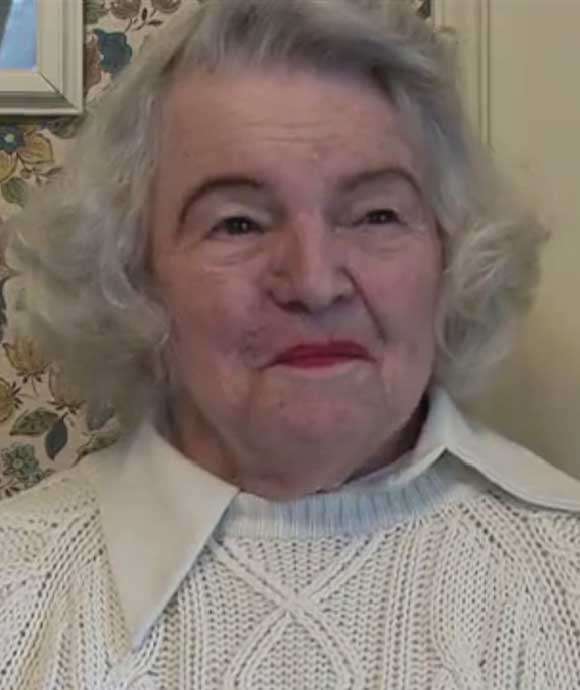
I received the first notice from OSS in Washington. I didn't even know what it was. But that was the way we all were. When we got there, we discovered that when we received appointments, we didn't even know what it was all about. I loved Washington, and it was wonderful to have a secure job and one that I could learn on and felt I could handle. But I had no idea when I went what it would involve. And I think the biggest shock of all was that we could not talk, we could not tell anyone. We could not tell our families about our work. It was restrictive, when we had never been restricted before in what we said. And it was like we'd start talking and, "Be quiet, Martha. You cannot talk." And we had to learn a new way of being secretive.
Bradley Hart
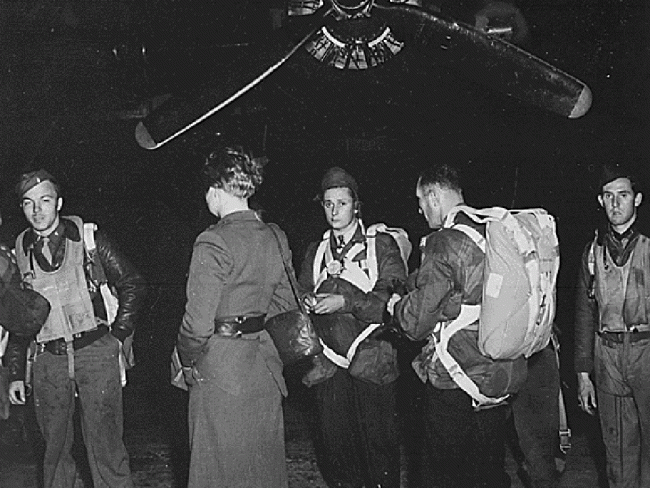
Martha Erickson worked in the map division of the OSS Research and Analysis branch in Washington DC. Maps, especially maps that had been captured from the battlefield, became a key source of intel that would become vital to other teams operating behind enemy lines, like the Jedburghs. Martha Erickson went on to recall that late in the war some of the maps they received were covered in mud, and she remembered later wondering whether men had died in that very mud. Martha Erickson passed away the age of 94 in 2013. The work that Martha Erickson and the Research and Analysis team were doing in DC provided critical support for OSS operations in the field. But before they could launch those operations, Bill Donovan and his team had to find the personnel who would actually take part in these incredibly dangerous missions. Among them would be John Singlaub, who enlisted in the US Army but was quickly discovered by OSS talent spotters as a potential recruit. He'd have to make it through OSS training before he'd go on any of these special missions.
John Singlaub
But while serving as a platoon leader and a parachute infantry platoon leader, I was a regimental demolition officer for a parachute regiment, a recruiter came through from the OSS. I had no idea what OSS was and he wasn't prepared to tell us, but he had authority to look over our records in that parachute regimen by the adjuvant. And he selected people that he wanted to interview. Well, it turned out that because of, as he said, "You have a language capability that we are interested in, and we would like to know if you would volunteer for hazardous duty behind enemy lines." Well, that's where I thought I was. I was a parachute infantry battalion, and that's the only thing that we were scheduled to do. But he says, "No, it's more dangerous than being in a unit that has a lot of support by it." But they wouldn't tell us what it was all about. But I said I would like to try that. And we trained initially in the Congressional Country Club in Maryland, and then went into Maryland to an area that was referred to as Area B1. And Area B1 is now called Camp David. Actually, the time at the Congressional Country Club was basically a determination if we had an evaluation, psychological evaluation. And you never knew at the end of the week training whether you were accepted or rejected. It was just we were lined up and the first sergeant would say, "The following officers will get over in that truck," he'd point to it, "And the rest of you will get into that truck." You don't know whether you've been selected or rejected at that point, but that's the way they liked it, I guess. And then in December of 1943, we got on a troop ship and sailed for Scotland. And it was interesting that, as we pulled into the port and anchored, a British officer came aboard and the senior American officer saluted him and turned over a big package of our files to the British officer. And from that moment on, we were under British command. That was the British SOE. Started really intensive training at that point, weapons training. We had been introduced to British weapons, but we really had to know them inside and out. And for the first time, we were subjected to live fire. And from then on, we had a lot of that live fire in the bombed-out parts of London. For example, we did a lot of action-type training for city warfare, urban warfare. And if you got too near a window to look out, they would fire around into a sandbag that was just outside the window. And you knew that that could have been you that it was hitting instead of that sandbag. The program that we were working toward was called the Jedburgh. And Jedburgh is the name of a town in Scotland. And my inquiries were about, "Why Jedburgh? What's this got to do with the..." "Oh, it's just a name taken out of a glossary of a map. It's a town in Scotland someplace." Well, when I eventually was doing some schemes as a Jedburgh, it happened to be near a castle at Jedburgh. So, I made a point to go by it and look at it. And eventually I found a Britisher that was willing to admit to me that it was that Jedburgh castle that contained the main resistance to the Scottish takeover in Scotland. And so, somebody who was a Scotsman undoubtedly decided that that was a good name to take, and that was our name. In our training, we had to take several couple of weeks to go up to the British Parachute School to learn British parachute equipment as well as their means of jumping and use their parachutes. They had great confidence in their parachutes, apparently more than the Americans did, because they didn't have any reserves. And the fact is that they were jumping so low their reserve parachute was excess. If your chute didn't open, why, you had it. When I asked the RAF sergeant about that not having a reserve, he says, "Oh, our parachutes always open, and if yours doesn't, bring it back and I'll give you a new one."
Bradley Hart
The OSS didn't just recruit operatives from the United States, but all around the world. In German-occupied Greece, resistance fighters were becoming a growing concern to Nazi occupation leaders. Helias Doundoulakis and his brother were part of a group feeding intelligence to the allies from occupied Crete. But the German Gestapo had orders to pick them up, which likely meant death. Tipped off to their potential fate, the Doundoulakis brothers hid out until some British allies could smuggle them out of Crete into Egypt. Once there, they approached American representatives.
Helias Doundoulakis
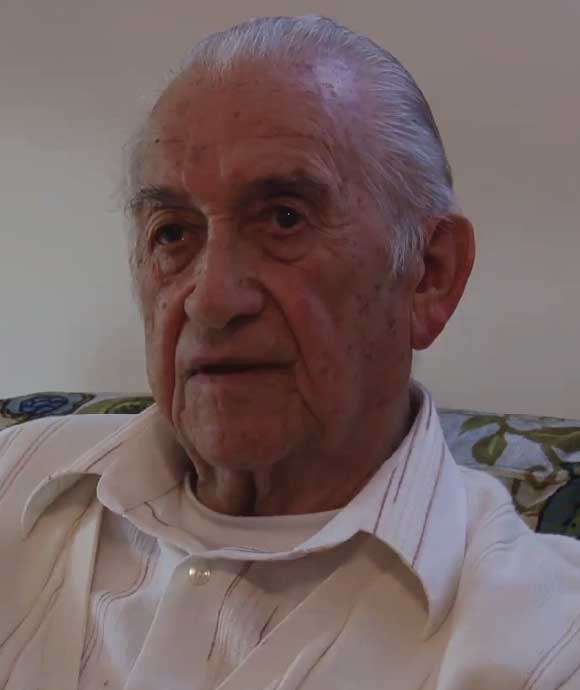
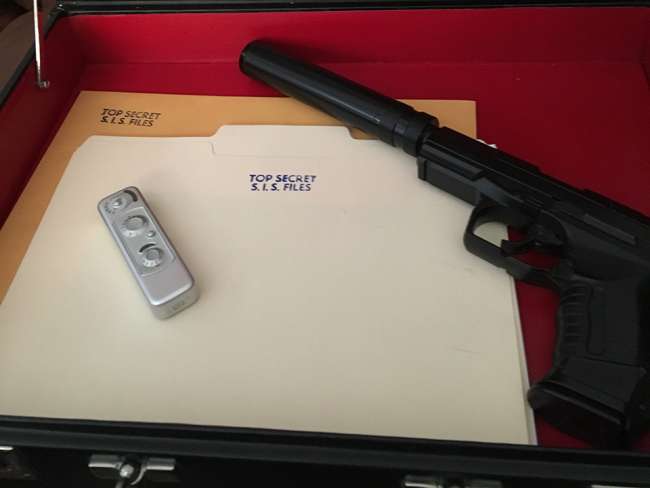
[Helias] My brother, he did not even know the name OSS. So we went with the Americans. We entered the American army. They said, "You are no..." Originally, they didn't want to put us in the American army. He says, "You cannot go in the American army. You never had the basic training." He says, "We [can't] afford to send you for basic training. We need you right now." My brother says, "We don't need the basic training. We need only intelligence lessons." And they have heard so much about us that they made my brother staff sergeant. Just like that. With no basic training, my brother was staff sergeant, and they made me a corporal. We went to a tremendous room, you know, with seats and tables and everything. And there were 13 people there, and we were the 14th and the 15th. Oi, he told everybody, he said, "Gentlemen, after six months or five months, you'll be able to convince anyone that it is nighttime though the sun will be shining [outside]." He says, "This means you are going to have the power of convincing anyone what you are talking about." They taught us how to lie, how to steal, how to open locks. It took 10 days, but in 10 days, we all learned how to open a safe. "By the way, all the things that we teaching you," he says, when you get discharged, you forget them. Because you are going to be in prison for the rest of your life." "By the way," he says, "we're going to give you also a pen gun. So suppose you are caught by a German, and there's no other German. There's a guard over there, and he sees you looking at the airplanes. He takes you with him. You are going to kill him." He says, "How? You are going to say, 'Oh, my Lord. I want to write something to you, you know.' The German says, 'Well, let's see what he's going to write.' You turn it towards his heart, you press the button, the back, and there is a bullet that will go and kill the German. If he is only by himself, you can escape." It was August, 1943 and I went to swim in the big swimming pool of the city of Salonika. They had given me a very accurate watch which was made in United States. And since it was waterproof, I went swimming with the watch on. It was stupid of me. But all around were all civilians, you know. But they were two elderly people sitting. They were German officers. They saw me swimming with this watch. They said, "Well, let me see your watch." So I take the watch, I show to them, they see "American-made." "Where did you get this watch?" Immediately, I was taught, "Oh, this watch? Two days ago a German soldier." I had to think of a possible story. "A German soldier had three of them, and he was selling them. I gave him eggs, I gave him nuts, I gave him some money, and he gave it to me." Now, I was 19 years old, and since even now I don't look like 62, I look a little younger, you know? At that time I looked like a kid, you know? So they look at me... Oh, this was possible that a German soldier at the front, you know? But it was possible that the story was true. They are holding now the watch, one looks the other. They said, "How could this kid be a OSS spy?" You know? Would never think it. So they gave me the watch and I left. By the way, from 15 students, seven got caught. Seven. Possibly eight. We don't know what happened to them.
Bradley Hart
Training was over. These agents needed to get into the action, and quickly. Fast forward to August, 1944. The Allied surprise offensive, the D-Day landings had been successful. Jedburgh teams had been deployed in occupied areas behind enemy lines. If detected, there was little chance of escape, and the only support came from the French resistance. Once again, we hear from John Singlaub, who is member of a Jedburgh team code named James.
John Singlaub
Six weeks later, we had a new mission, and that was to jump into the Massif Central, the Central Plateau of France, into the Department of Correze. So our mission was first to stop German movements to the south. The second was to stop them from going to the north, because the breakout was taking place out of Brittany and Normandy. We used a small, specially-built radio that we also had to learn the encryption. And in the event that you lost your code books or had to escape without your stuff, we had to memorize enough code manufacturing material that we could create our own encryption system. We could only transfer it for no more than five minutes at a time because of the DF-ing that the Germans were practicing. And that's how they located, a lot of the agent teams that were inside France. A lot of our transmissions to us came through the personal messages that BBC ran every night. Every night at 6:30 and again at 8:30 in the PM, they would start off with the introduction to the "Fifth Symphony," Beethoven's "Fifth." And that happens to be, "ta-ta-ta-ta," which of course is the letter V in Morse code. And then the announcer would say, in French, "Listen now for the personal messages." And he'd read off these just single sentences that had a subject and perhaps a verb, but didn't really have any connection to anything except that that was a code for someone to do something that's already been set up. You'd get it at the 1800 broadcast, and then later at the 2030 broadcast it would be repeated. But if it was something had happened, it was not repeated on the 8:30 program, you knew that it was canceled. The mission was regarded as successful because we were able to stop the movement of Germans through the area. We made it so miserable for them. We had opportunities to capture Germans, which we did. This presented a somewhat serious problem because the Germans had committed so many atrocities against the French. The French felt an obligation to give them a hard time. And the idea of German surrendering to the French was something that the Germans had made quite clear they would not do. And for that reason, I was asked to go to several places to sign guaranteeing that the French officer who signed is representing General Eisenhower.
Bradley Hart
John Singlaub, would go on to work with the CIA during the Korean War. A vehement anti-communist, he would spend his entire career around special and covert operations. In 1977, Major General Singlaub was serving as chief of staff of US forces in South Korea when he publicly disagreed with President Jimmy Carter's campaign pledge to draw down forces in the region. The president relieved him of duty, and the following year, Singlaub retired after more than three decades of military service. John Singlaub passed away at the age of 100 in 2022. Back in 1943, Herbert Auerbach was part of a battalion of Signal Corps troops that were attached to V Force, an Allied intelligence and guerrilla force operating in the CBI, the China-Burma-India Theater. But the OSS was about to enter this theater of the war, too, in the form of a special operations unit known as Detachment 101.
Herbert Auerbach
I ended up with a group called V Force, which was a combined operation of American and British. They were carrying on intelligence operations. The OSS came into the theater. They were not allowed because of personalities, I guess, between MacArthur and Donovan, who didn't get along too well. And the OSS came into being. They said all American personnel... Because V Force was a joint operation, and they said, "Anybody that wants to go back to their original unit can stay with the original unit, or you can stay into what they call Detachment 101." They never said it's OSS. First of all, I could tolerate heat, but I couldn't take cold weather. I would never survived if I went to the European Theater with the cold winters. Just couldn't do it. And I swear that in our groups, in OSS, we must have walked the length and breadth of Burma, up one mountain, there's the next one ahead. We were lucky, and we had the cooperation of the indigenous people. I was a cryptographer. They made small groups out of maybe three Americans or four Americans at the most. Our mission was just to gather as much information as we could and report back. We were able to report so that the Air Corps had... The Air Force had their targeting, and then we were able to give them results afterward, which they never were able to ascertain before. At one time, we had full strength of 10,000 natives on the ground. So we fed them, we trained them, we armed them. They were terrific in ambushing. They were tough infantry type where they couldn't take ground and hold it. That's not what they would do. But they taught us a lot of stuff about ambushing and stuff of that nature. After the war, we felt that we had a debt of honor for these people.
Bradley Hart
After the war, Herbert Auerbach was discharged, but not before signing an agreement to not reveal what he had done with the OSS. Those restrictions would be lifted only after many years. Herbert Auerbach passed away at the age of 93 in 2015. Not everyone was trained to be part of special operations. Sometimes they were simply thrust into them. Steve Pisanos was a pilot flying missions into France in 1944, before D-Day, when one of his engines went out near the coast. He had two choices, either attempt to cross the English channel and risk ending up in the icy cold waters or turn back into enemy-occupied territory. He chose the latter. After surviving the crash and being chased by a group of German soldiers, he found himself wandering the countryside before happening upon the French resistance. From there, Pisanos stayed at safe house after safe house with OSS agents, resistance fighters, and other allies, trying to avoid capture or death.
Steve Pisanos
My last house that I stayed in occupied Paris, I run into three, I will say, distinguished French patriots. They were the biggest saboteurs, you know, the French underground had. And I was staying with them. One evening we were having dinner and he said to me, "Stefan, you want to kill some Germans?" I thought, you know, he was going to say, "We'll take you to a place where there is an airplane." I said, "Avec avion?" "With an airplane?" "No, no, no, no. No avion," he said, "No airplanes. Mitraillette. Machine guns." They took me one night and we took the road to Nancy, then Nancy into Germany. Heavy German traffic. We intercepted a goddam convoy. Now, this is about the beginning of August, 1944. And mind you, about the 26th of August, the Germans had evacuated Paris. They had begun to move anything. If they were staying at a hotel or a house, they would steal the curtains. They even stole bidets from the bathrooms to take them back to Germany. This is what the Germans were doing when they were evacuating. The underground intelligence found out that there will be a convoy of about seven to eight big military trucks loaded with soldiers and stolen property. We met a group in a forest northeast of Paris, nearby the highway to Nancy. And I'll never forget this gentleman, "Ah," he said, "the Greek American!" I was introduced by my people. We waited, and I still remember to this day when the guy, the chief, of the guy that we had met, he said, "Ecoute, ecoute! Listen! Arrive, arrive! They have arrived!" So, around the bend of the road here, what the underground had done, they had put spikes across the road. They put spikes every maybe two feet, one and a half. They put it across like that, painted the color of that particular road. So then when the trucks arrived round the bend, even if they spot it, that will be too late, because one of the wheels, you know, is bound to... So here we are now, we were sitting at this forest here, watching down the road there. The first truck, you know, hit the goddam thing. The guy, the driver lost control the second truck that was behind, and they were driving with some, you know, speed. They didn't want to drive slow because they were afraid the underground guys, you know, will machine-gun them. So, keep on moving fast. So, the second truck hits the goddam first truck and fire was created. And that's when we began to unload everything. You only operate on operations like that during moonlight so you don't have to use flashlights. A bunch of goddam soldiers jumped from the other trucks to come up at the... For aid, you know, to the two trucks that had collided with each other. I used my automatic thing, and I must have brought down about seven to eight of those buggers. I mean, I can see the guys, you know, just flat down, you know, killed, period. We unloaded everything, all trucks were completely destroyed. We left the area and we went further down and we spent the night in a barn. The next day, the Paris Radio, and I don't remember the newspapers, but the announcement was, "The Gestapo will kill the saboteurs who created the catastrophe killing German soldiers and destroying German property." That's one episode I was involved with the guys.
Bradley Hart
Steve Pisanos would go on to see the liberation of Paris, later recalling flowers raining down on the Allied troops. He would be awarded the French Croix de Guerre or silver star. Even as the war was coming to a close, the job for OSS agents was far from over. Across Japanese-occupied China, POW camps still housed thousands of Allied prisoners, some of whom had actually been captured years before. American leaders, including General Douglas MacArthur himself, were particularly interested in one prisoner, Lieutenant General Jonathan Wainwright, former commander of American forces in the Philippines, who had been forced to surrender the island of Corregidor back in 1942. General Wainwright was the highest-ranking American prisoner of the entire war, and for years he'd been held in various POW camps around Asia, with only limited access to Red Cross mail and news from the conflict unfolding around the globe. As World War II entered its final weeks, the OSS launched Operation Cardinal, a daring plan to drop in teams of agents to liberate the known POW camps and to rescue the prisoners from what Allied leaders feared might be retaliation massacres by Japanese camp commanders. Finding the captured general was one of the mission's key first objectives. And among the men sent to Rescue General Wainwright, if he could be found, was Hal Leith, special intelligence officer for the OSS. Leith recalled the story.
Hal Leith
[Hal] And when I arrived in Kunming, the last part of the trip from India there was by airplane, and the airplane that I was in made it safely. And then I found out that the other airplane had tried to go over the top of the Himalayas and it crashed instead. So they didn't make it.
Historian
Was the other plane filled with OSS agents too?
Hal Leith
Yes.
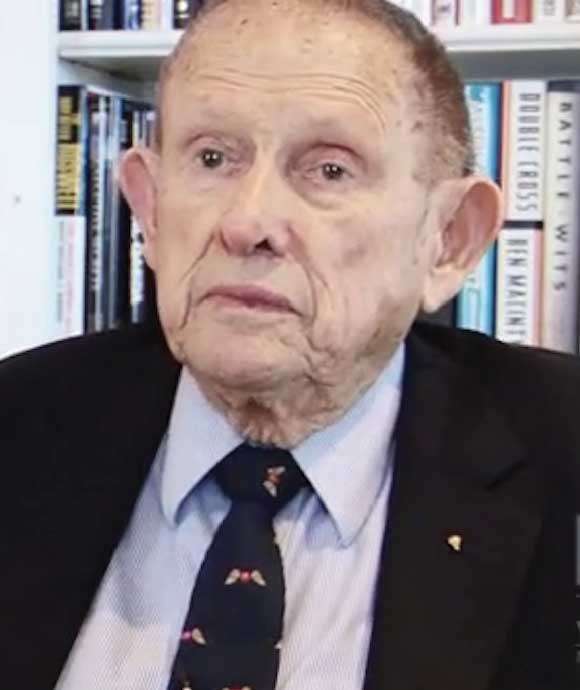
I stayed in Kunming for a while, and then when we dropped the atomic bomb, the Japanese were going to surrender. They finally asked me to go on this one to get General Wainwright, because it was in Manchuria, and I was the only OSS person there who spoke both Chinese and Russian. Well, the concern was that the Japanese would kill a bunch of them, rather than letting them go. It was a very frightening thing to think that the Japanese, they had done so many bad things, that they would kill a bunch of POWs. There were 1,600 there in the camp. We didn't want any of them to be hurt.
Bradley Hart
Tune in to the second season of "Secret World War II: Spies on Special Ops" to hear Hal Lith, in his own words, tell us the dramatic conclusion of Operation Cardinal. He'd soon become one of the first Americans to learn the fate of General Jonathan Wainwright and help facilitate one of the most iconic and moving moments of the war. You've seen the footage before, but now you'll know the story behind it. Subscribe now to get access to our episodes as soon as they drop. Season 2 of "The Secret World War II," coming in April, 2026 from the National World War II Museum.