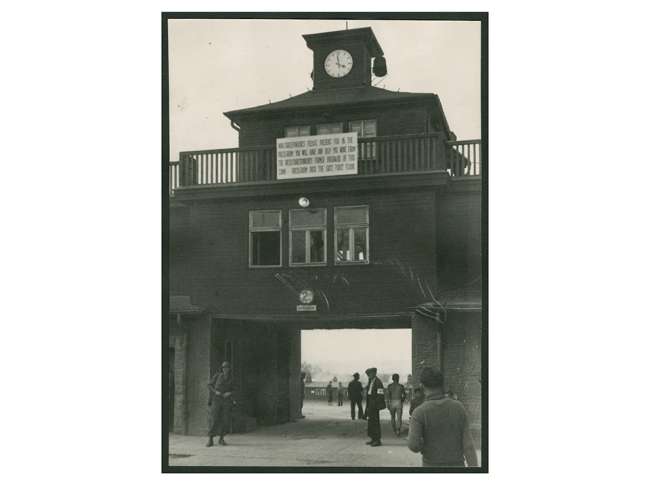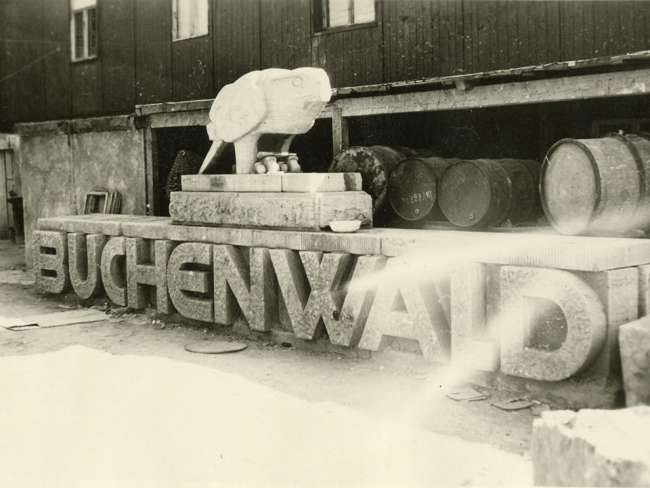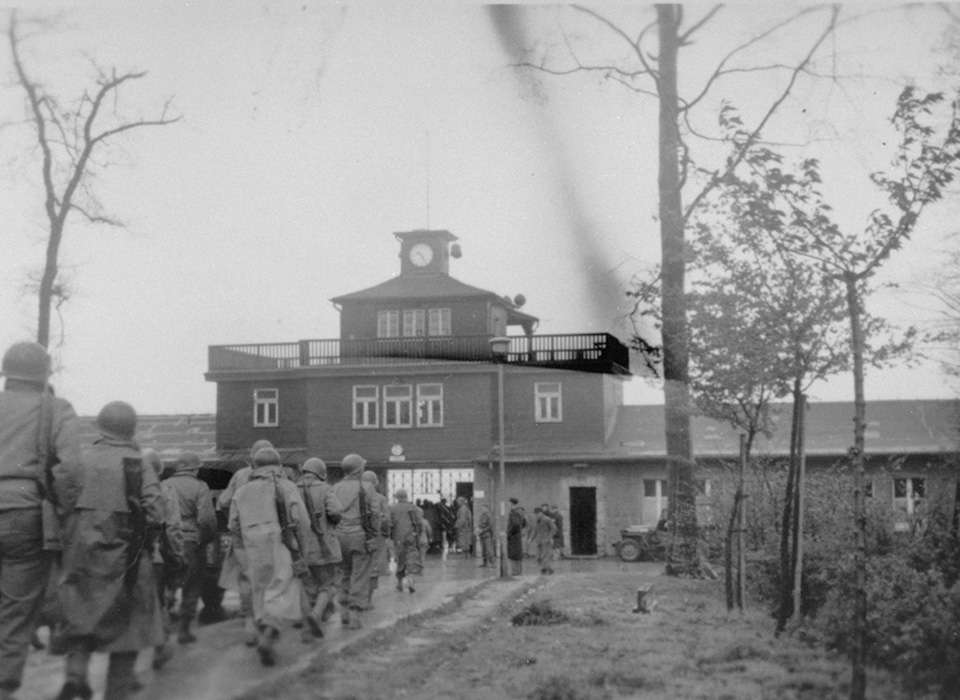
Top Photo: American soldiers march into Buchenwald upon liberation of the camp. United States Holocaust Memorial Museum, courtesy of Virginia Longest
Soldiers from the XX Corps of General George S. Patton’s Third US Army, advancing near Weimar, Germany, made a shocking discovery during the second week of April 1945. Elements of the Third Army had liberated a Nazi concentration camp at Ohrdruf on April 4, 1945, but few American leaders expected what they would continue to find. In a letter to his wife, Patton observed: “Ohrdruf was the first, and all of us prayed the last, concentration camp any of us would ever see. No such luck.”
For the soldiers of XX Corps, the first sign of something unusual came following a skirmish with German forces near Hottelstedt, Germany, on April 11, 1945. Combat Team 9, an American combined task force composed of troopers from the 6th Armored Division, had swept through the area in what official Army histories call a “spectacular drive” during the war’s final push.1 Afterwards, while mopping up resistance in the combat team’s wake, the 80th Infantry Division were fired on by a group of 15 SS soldiers before encountering about 50 disheveled men who had emerged from the forest wearing striped uniforms.2 When intelligence officer Captain Frederic Keffer asked where they were from, “in disquieting and cryptic fashion, they pointed south and said they had escaped from a terrible place deep in the woods, not far away. The place was a concentration camp. It was called Buchenwald.” 3
As Keffer communicated with the prisoners in a mixture of Russian, English, and German, he learned that as many as 21,000 prisoners remained at the nearby camp. Keffer alerted the command.
The task to investigate the camp fell on Keffer, while the remaining combat units continued their advance. Keffer selected three other men to accompany him—Tech Sergeant Herbert Gottschalk, Sergeant Henry Ward, and Private First Class James Hoyt. The four men loaded into an M8 Greyhound armored car and drove to the camp with two prisoners guiding the way.4 Unbeknownst to them, the soldiers were moments away from being the very first Americans to enter the concentration camp at Buchenwald.5
First Contact
Entering through a hole in the 12-foot-high electric fences, the four Americans were met by gracious prisoners. “I was picked up by arms and legs, thrown into the air, caught, thrown … until I had to stop it. I was getting dizzy,” Keffer recalled. “How the men found such a surge of strength in their emaciated conditions was one of those bodily wonders in which the spirit overcomes all weaknesses of the flesh.”6 After the wild celebration, the prisoners gave the Americans a quick tour, but with specific orders not to linger, the Americans saw only a small portion of Buchenwald. The men spent less than an hour at the camp before returning to inform their superiors, setting into motion a full mobilization aimed at securing the camp, which would take several days to complete.7
Ultimately, the 12th Army Group assigned responsibility for handling the camps to the Displaced Persons Executive (DPX). First Lieutenant Walter Emmons of DP Detachment 10 took charge of the camp on April 13. In addition to food and clothing, Emmons set up an emergency hospital where seventy blood transfusions from the American blood bank were given the first day. By the fifth day, the 66th Medical Battalion had established a 500-bed evacuation hospital with enough medical supplies to treat the 5,000 cases needing immediate attention.8
In those first precarious hours after initial contact, however, other American troops swept through the area. Civilian Egon Fleck and First Lieutenant Edward Tenenbaum from the Twelfth Army Group conducted a more in-depth inspection of the camp later on April 11, the day of liberation. To their astonishment, “in camp there reigned order. Meals were served. Armed guards—inmates—patrolled the somber grounds, and wildly excited groups of men calmed at a word from those in authority.”9 Fleck and Tenenbaum credited the order they found at Buchenwald with the quick action of an internal “camp committee,” which kept cooks at their posts and established about 1,500 guards carrying abandoned German arms. “Thus, instead of a heap of corpses, or a disorderly mob of starving, leaderless men, the Americans found a disciplined and efficient organization at Buchenwald,” they wrote.10
Amid the apparent calm and order, Fleck and Tenenbaum found grim conditions. The so-called “little camp” had a quarantine space for new prisoners, a permanent Jewish barracks, and an assembly area for transportation to the death camps.11 Here were the stacks of fresh corpses, the sick and dying inmates, and the horrors of the Nazi killing process. “A trip through the little camp is like a nightmare,” Fleck and Tenenbaum wrote. “On the sight of an American uniform a horde of gnomes and trolls seems to appear like magic, pouring out of doorways as if shot from a cannon. Some hop on crutches. Some hobble on stumps of feet. Some run with angular movements. Some glide ... Almost all wear striped convict suits, covered with patches, or grey-black remnants of Eastern clothing. The universal covering is a little black skull cap. They doff these ceremoniously to the visitors. Some are crying, others shouting with joy. An old man, dirty, bearded, one eye blind, totters up and introduces himself as a French general. His son is dying here. Can help be brought? Will it come in time?”12
Horror and Hellscapes
According to the official US Army history of XX Corps, “Of the remaining 21,000 prisoners … almost half of them were nothing more than living skeletons. [Visitors saw] the death cells, the incinerators which consumed as many as 600 bodies per day, the bodies of hundreds who had died during the night from disease and starvation, the children deliberately infected with typhus, and the vermin-infested barracks in which their victims were forced to live. They also saw the lamp shades and book covers made from tattooed human skin to please the fancy of the wife of a former camp commander!”13
The camp commander referred to was Karl-Otto Koch, the first SS commandant of Buchenwald from 1937 to September 1941. Koch’s sadistic treatment of prisoners is well documented, along with that of his wife, Ilse, who was known as the “Bitch of Buchenwald.”14 Both appear in Fleck and Tenenbaum’s report: “[They] satisfied their desires on the hapless inmates. The wife would walk through the camp, pick a likely partner, take him home for the night, and then invariably order him shot. She delighted in tattoos. Prisoners were regularly inspected in the hospital. Whenever a prisoner was found with a more than ordinary tattoo he was killed, his skin was stripped, and the tattooed portion was tanned. Some extraordinary objects were made from these, including a famous lamp shade.”15
In fact, lampshades and other items made from human skin were found at Buchenwald. However, they could not be definitively linked to Ilse Koch, despite many accusations that she had “a desire to own certain objects made of human skin.” Without that direct link, her initial postwar conviction and sentence by the US military was later overturned (Karl-Otto Koch was executed two years before Ilse’s trial for his role in several murders at Buchenwald).16
Other horrors of Buchenwald include the experiments performed on prisoners. In Blocks 46 and 50, Nazi “doctors,” with support from the Wehrmacht and German companies such as IG Farben, tested vaccines for diseases like typhus, smallpox, diphtheria, yellow fever, and gas gangrene on human subjects. The majority of prisoners used as involuntary test subjects—a number estimated at over 1,000 inmates—died from these brutal experiments.17
American liberators uncovered another dark aspect of the Holocaust at Buchenwald—its role at the end of the genocide. According to historian Tim Cole, “The camps that the British and American troops liberated in April and May 1945 were chaotic landscapes that were not primarily genocidal space, but post-genocidal space where planned killings had been replaced by chaotic dying.”18 As the German Reich shrank in 1944–45, plans for mass murder, as had once been carried out in death camps like Treblinka, Bełżec, Sobibór, and Auschwitz-Birkenau, devolved into death marches, where remaining prisoners were evacuated to other camps within the Reich such as Buchenwald.
These marches lasted until the final days of the war, and upwards of 250,000 people died from the brutal conditions.19 In fact, many of the survivors in the worst shape at Buchenwald at liberation had arrived at the camp after such recent marches. Thus, the image that emerged from Buchenwald in the Western media was of the depravity of Nazi mass murder. American memory of the Holocaust would be largely shaped by the image of the concentration camp and of emaciated survivors peering out from behind barbed wire at places like Buchenwald. As Time correspondent Percy Knauth wrote at the end of April 1945, “In Buchenwald today I saw death reduced to such a state of ordinariness that it just left me numb and feeling nothing, not even sickness at my stomach.”20
The Shock of Liberation
When General Patton visited Buchenwald soon after liberation, he commented on the incredibly feeble state of many who tried to cheer him but were too week to cry out: “The inmates look like feebly animated mummies and seemed to be of the same level of intelligence.”21 Far more commonplace were encounters from American soldiers who helped secure the camp. Most were profoundly disturbed; as artilleryman Sergeant Alex Kormas wrote, “Even after combat and its conditions, no word can describe it rightfully … the smell, stink, depression, remain with me and others to this day.”22
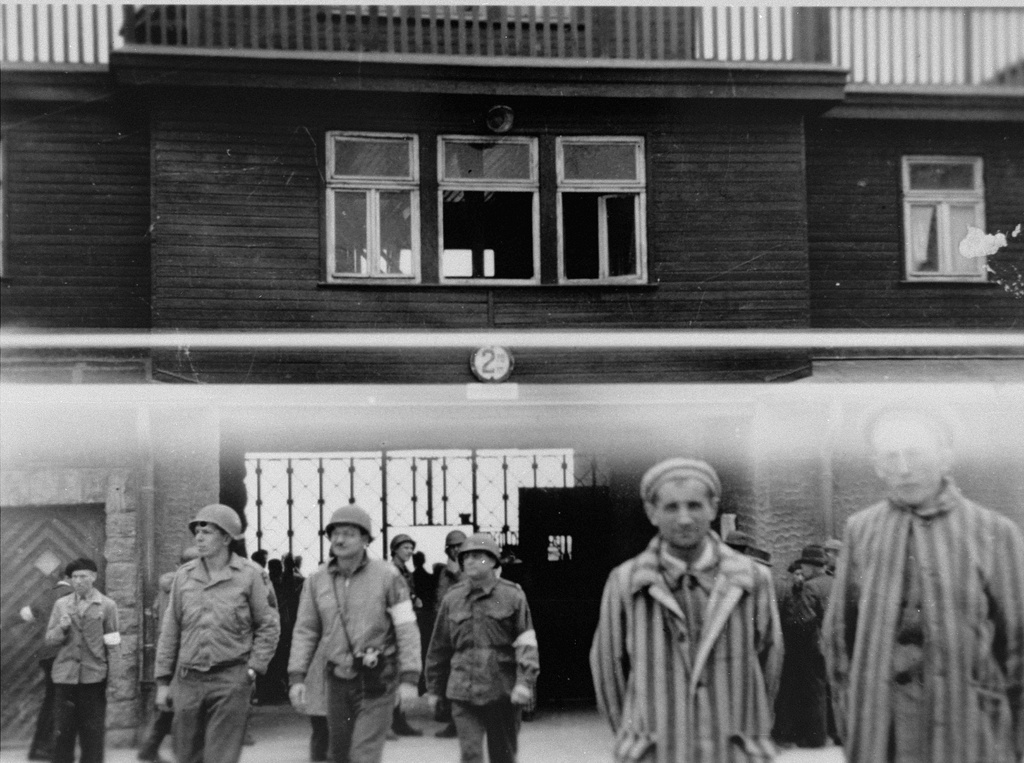
American soldiers and survivors stand by the entrance of Buchenwald. United States Holocaust Memorial Museum, courtesy of Virginia Longest
In numerous memoirs and recollections, soldiers recalled the camp’s smell and filth. Warren Priest, a member of the 120th Evacuation Hospital, which arrived at Buchenwald to begin treating inmates on April 15, recalled entering the barracks: “I remember the litter everywhere, piled one or two feet high in places, making access to several parts of the barracks impossible … Everything was covered with excrement, urine, vomit—blankets, clothing, shoes, jackets, underclothes—to call the scene indescribable is inadequate … [It was] beyond the human capacity to forget.”23
Troops arriving a day or two later recalled the sensory horror as well as the shock of what they saw. Rabbi Herschel Schacter, who served with the Third Army’s 8th Corps Headquarters, remembered: “I slowly approached the site of the huge ovens from which the smoke was still curling upward. I could smell the stench of the charred remnants of human flesh. There were literally hundreds of dead bodies strewn about … many of these bodies were not stacked nearly like cordwood. They were just scattered.”24 Fleck and Tenenbaum wrote of walking through the intact crematorium and confronting other physical remnants of the violence: “There are large poles of bone and ash, not yet concealed … On the second floor of the plant are about 1,200 sealed tin cans. These rattle when shaken. They contain the ashes of prisoners murdered in 1939 and 1940, for which there had been no claimants.”25
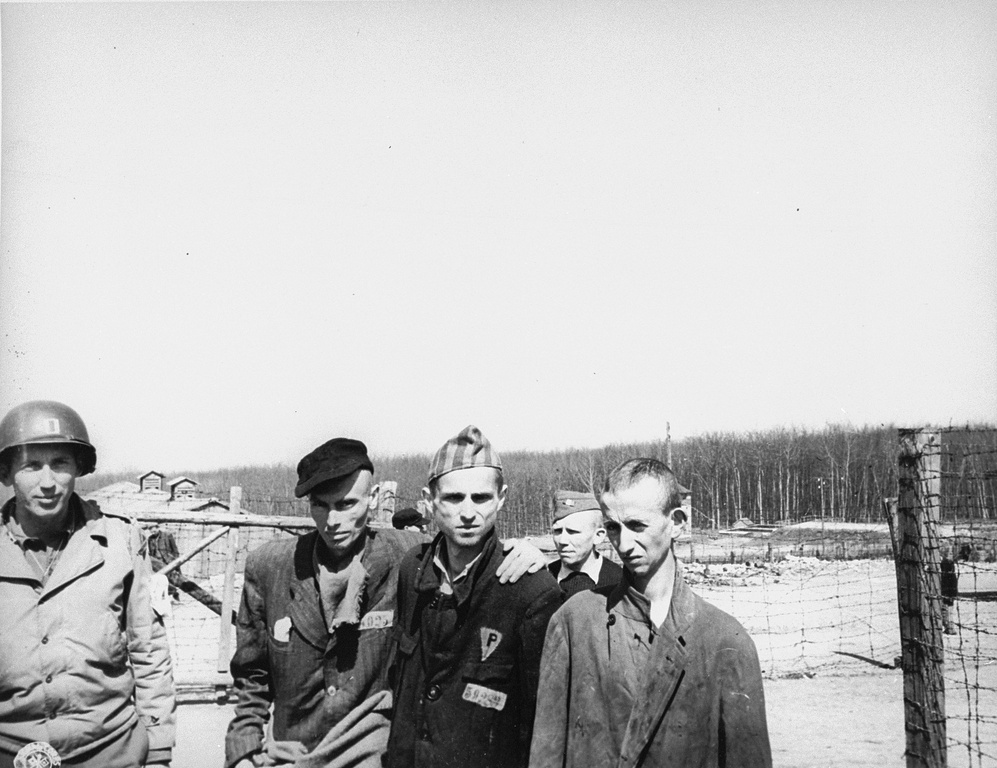
An American captain with survivors in Buchenwald. United States Holocaust Memorial Museum, courtesy of Paul Griso
CBS journalist Edward R. Murrow delivered perhaps the most memorable report from Buchenwald. He warned his listeners that he would spare no description of his encounter, telling them, “If I’ve offended you by this rather mild account … I’m not in the least sorry.” He went on to describe what he saw: “There were two rows of bodies stacked up like cordwood … I tried to count them as best I could and arrived at the conclusion that all that was mortal of more than 500 men and boys lay there in two neat piles.”26
Just as powerful were Americans’ interactions with camp survivors. American forces noted early on that survivors had to be treated with the utmost care—though some immediately ate everything in sight, many found food from American supplies too rich for their severely malnourished bodies. The American liberators had to start renourishing survivors with a thin soup before slowly augmenting it and increasing caloric intake.27 Sadly, not everyone who lived to see liberation survived in the immediate period after the war, perishing from illnesses within hours or days of being freed.
Jewish American soldiers were also deeply impacted. According to historian John McManus, when Sergeant Howard Cwick entered the camp, “tears streamed down his cheeks. He encountered a skeletal man who reached out and wiped the tears away. In German he told the man: ‘I am a Jew!’ The man’s expression turned to wonderment. ‘A Jew? You are a Jew?’ They clung to each other, sobbing and shaking. Other inmates converged on them as the word spread that Cwick was Jewish. ‘They closed in around me,’ Cwick wrote. ‘Arms came out from everywhere—to touch my uniform, my face. Several grabbed my hands—and began kissing them.’”28
Another solider, Victor Geller, who was in the camp for just a few hours, reflected: “Maybe the Jews of Buchenwald were brothers that I had never met, to whom I was linked by blood, shared and shed.”29 Indeed, for a Jewish American soldier, the bond and shock realization formed almost instantaneously.
Rabbi Herschel Schacter, a US Army chaplain, was haunted by a powerful realization: “As I saw these men—brothers, flesh of my flesh, and blood of my blood—I could not help but think of the old cliché, ‘There but for the grace of God go I.’ Alan [Rose] was so right. If my own father had not caught the boat on time, I would have been there.”30 Schacter spent two months at Buchenwald, reflecting on his role: “I must confess I paid little attention to the needs of American servicemen who really, at that time, did not need many of my services. I devoted myself—what little energies, what little ingenuity, what bit of initiative a young man could muster—to my new-found flock.” 31
Jewish prisoners liberated at Buchenwald felt equally drawn to Schacter. Baruch Gross, who had arrived at Buchenwald on a death march just the night before the camp was liberated, commented on Schacter: “The words that came out of him, that really kept us going.” In fact, Gross used the Hebrew word Mashiach (messiah) in his descriptions of Schacter, stating that “if he was not [the messiah] he was [messiah-like].” Gross remembered also that during his seven-week stay at Buchenwald after liberation, Schacter not only gave him hope, but even married people there in the former camp.32
Buchenwald’s Legacy
Between July 1937 and April 1945, the Nazis imprisoned at least 250,000 people at Buchenwald from across Europe. No exact death toll exists, but the SS murdered at least 56,000 prisoners there, of whom 11,000 were Jews.33
As he had with the camp liberated at Ohrdruf on April 4, General Dwight D. Eisenhower invited the media and high-profile individuals to visit the camp and report on what they saw. He also ensured local Germans saw what the Nazis had done in their names. According to the official Army XX Corps history, “Two thousand citizens of Weimar were ordered to Buchenwald for an inspection tour of the camp where they could see the wholesale suffering and torture that had been taking place only a few miles from the serenity of their homes!”34
American troops brought local Germans to view the horrors within a week of liberating the camp. An article from a British correspondent from April 18, 1945, noted, “Escorted by American military police, a thousand of the citizens of Weimar marched six miles through the lovely country to the Buchenwald concentration camp yesterday … It was an experience they can never forget. Most of the women and some of the men were in tears as they moved from block to block. Many were crying bitterly. Some of the women fainted and could be taken no farther.”35
But despite such reactions, many of these same people knew what happened at places like Buchenwald, and their visceral reactions sometimes raised suspicions. Eugen Kogon, a survivor of Buchenwald, later wrote: “There was no German who was not aware that concentration camps existed. No German who believed they were sanatoria. No-one who did not fear them … Quite a few who came into contact with inmates via work details. A considerable number who came across processions of wretched prisoners.”36
Eisenhower’s granddaughter Susan suggested part of the reason the supreme Allied commander made German people tour the camps was because “there were many people at the end of the war that said they didn’t know, but that Ike had very little patience for that.”37 Aside from the fact that the sights, smells, and sounds from camps went far beyond the camps themselves, other research has shown that hundreds of thousands of Germans attended public auctions of looted Jewish goods during the war. In fact, Germans were still denouncing “internal enemies” to Hitler in the form of at least 1,000 letters per week in the final weeks of the war.38
Since the camp fell within the postwar Soviet occupation zone, American forces transferred Buchenwald to the Soviet military a few months after liberation. Nonetheless, Buchenwald had a powerful impact on American perceptions of Nazi Germany and how many American GIs understood their war to defeat that regime. The liberation had a profound impact on American soldiers; in the words of John McManus: “The discovery of the camps elevated the trauma of combat to a high moral plane, a source of lifetime pride for an entire generation of soldiers.”39
- 1
Walton H. Walker, Assault Crossing of the Rhine and into Germany, XX Corps Operational Report 27 March – 17 April 1945 (United States Army: Nov. 17, 1945), 15, Ike Skelton Combined Arms Research Library Digital Library, https://cgsc.contentdm.oclc.org/digital/collection/p4013coll8/id/5709/rec/9; John C. McManus, Hell Before Their Very Eyes: American Soldiers Liberate Concentration Camps in Germany, April 1945 (Baltimore: Johns Hopkins University Press, 2015), 25-26.
- 2
McManus, 25-26
- 3
McManus, 26
- 4
McManus, 35-36.
- 5
Walker, 15.
- 6
McManus, 36.
- 7
McManus, 36-37.
- 8
Earl F. Ziemke, U.S. Army in the Occupation of Germany, 1944-1946 (Washington, DC: Center of Military History, United States Army, 1975), 238, Ike Skelton Combined Arms Research Library Digital Library, https://cgsc.contentdm.oclc.org/digital/collection/p4013coll8/id/3181/rec/13.
- 9
Egon W. Fleck and 1st Lt. Edward A. Tenenbaum, Buchenwald: A Preliminary Report (April 24, 1945), University of Warwick, MSS.154/3/PW/1/9-17, 2, https://mrc-catalogue.warwick.ac.uk/records/RHC/3/31/1/2.
- 10
Fleck and Tenenbaum, 6.
- 11
Ziemke, 237-238.
- 12
Fleck and Tenenbaum, 13.
- 13
XX Corps, US Army, The Ghost Corps: Thru Hell & High Water (US Army, 1945), 23, Ike Skelton Combined Arms Research Library Digital Library, https://cgsc.contentdm.oclc.org/digital/collection/p4013coll8/id/2971/rec/2.
- 14
Olivera Simic, “’No woman in the usual sense’: Ilse Koch, the ‘Bitch of Buchenwald’, was a Holocaust war criminal – but was she also an easy target?”, The Conversation, September 5, 2023, https://theconversation.com/no-woman-in-the-usual-sense-ilse-koch-the-bitch-of-buchenwald-was-a-holocaust-war-criminal-but-was-she-also-an-easy-target-203960.
- 15
Fleck and Tenenbaum, 11.
- 16
Simic; see also “Human Remains – Evidence of Crimes,” Buchenwald Memorial, accessed December 2, 2025, https://www.buchenwald.de/en/geschichte/themen/dossiers/menschliche-ueberreste.
- 17
“Hygiene Institute of the Waffen SS,” Buchenwald Memorial, accessed December 2, 2025, https://www.buchenwald.de/en/geschichte/historischer-ort/konzentrationslager/hygiene-institut.
- 18
Tim Cole, Holocaust Landscapes (London: Bloomsbury, 2016), 210.
- 19
Jacob Flaws, “The Nazi Death Marches,” The National World War II Museum, January 28, 2025, https://www.nationalww2museum.org/war/articles/nazi-death-marches.
- 20
“Foreign News: Buchenwald,” Time 30 April 1945, https://time.com/archive/6599774/foreign-news-buchenwald/
- 21
McManus, 43.
- 22
McManus, 46.
- 23
McManus, 52-53.
- 24
Brewster Chamberlin and Marcia Feldman, eds., The Liberation of the Nazi Concentration Camps 1945: Eyewitness Accounts of the Liberators (Washington, DC: United States Holocaust Memorial Council, 1987), 36.
- 25
Fleck and Tenenbaum, 12.
- 26
McManus, 60.
- 27
“The Horrors of Buchenwald,” The Guardian 18 April 1945. https://www.theguardian.com/world/1945/apr/18/secondworldwar.germany
- 28
McManus, 44.
- 29
McManus, 48-49.
- 30
Chamberlin and Feldman, 36
- 31
Ibid.
- 32
United States Holocaust Memorial Museum RG-50.677.0042, Oral history interview with Baruch Gross, October 29, 2018, interviewed by Henri Lustiger Thaler, 1:57:30-1:59:45.
- 33
United States Holocaust Memorial Museum, “Buchenwald,” Holocaust Encyclopedia, July 12, 2021, https://encyclopedia.ushmm.org/content/en/article/buchenwald.
- 34
XX Corps, US Army, 23.
- 35
“The Horrors of Buchenwald,” The Guardian 18 April 1945. https://www.theguardian.com/world/1945/apr/18/secondworldwar.germany
- 36
Birkbeck University of London, “The Public,” accessed December 2, 2025, https://www.camps.bbk.ac.uk/themes/the-public.html.
- 37
National Park Service, “Documenting History: Eisenhower and the Holocaust,” October 17, 2024, https://www.nps.gov/articles/000/eisenhower-and-the-holocaust.htm
- 38
John Ezard, “Germans Knew of the Holocaust Horror about Death Camps,” The Guardian 16 Feb. 2001, https://www.theguardian.com/uk/2001/feb/17/johnezard; for sensory witnessing, see Jacob Flaws, Spaces of Treblinka: Retracing a Death Camp (Lincoln: University of Nebraska Press, 2024).
- 39
McManus, 5.
Jacob Flaws, PhD
Jacob Flaws, PhD, is an assistant professor of history at Kean University and a Nonresident Fellow at the National World War II Museum.
Cite this article:
MLA Citation:
APA Citation:
Chicago Style Citation: