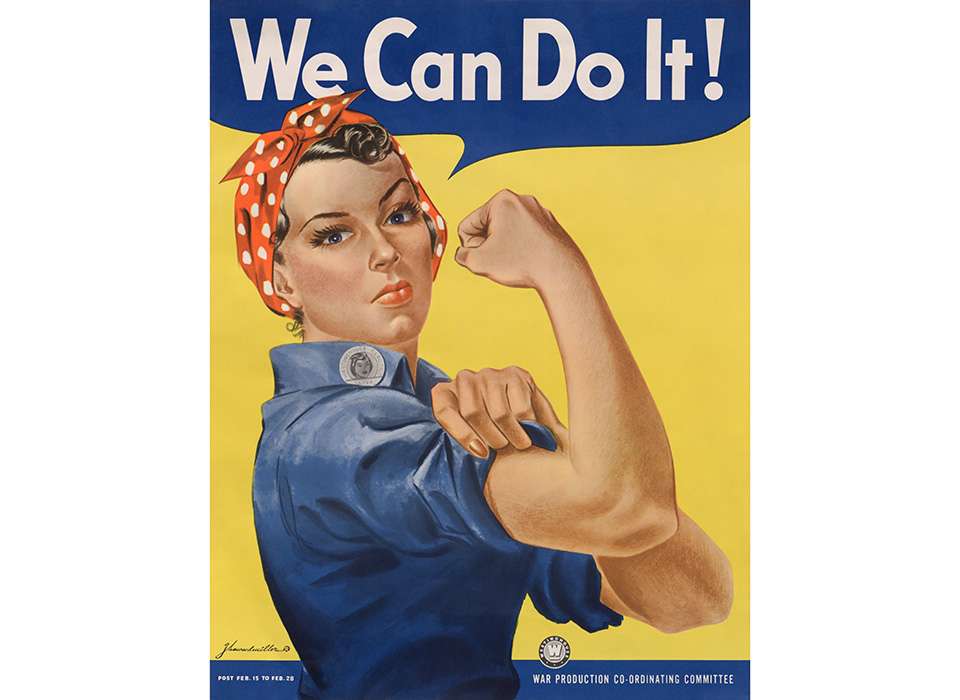
Top Photo: J. Howard Miller's "We Can Do It!", also called "Rosie the Riveter" after the iconic figure of a strong female war production worker. Office for Emergency Management. War Production Board. National Archives
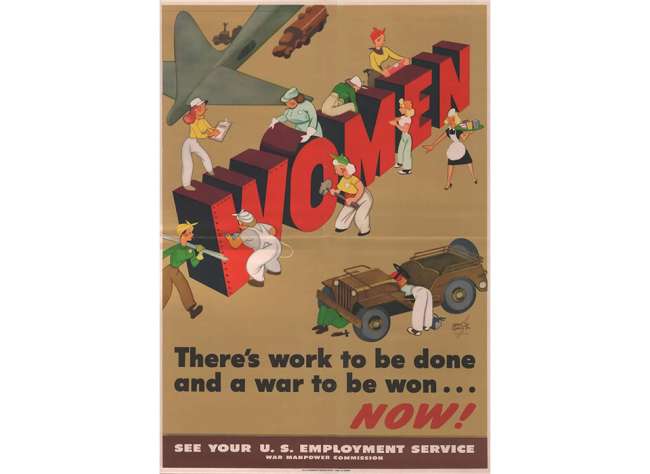
When the United States entered World War II, production of weapons, tanks, ships, planes, and other military equipment increased dramatically. As men joined or were drafted into the US Armed Forces, war industries needed to replace its workers. To do so, the government encouraged companies to hire more women in a wider variety of roles.
Women were part of the larger workforce before the formal entry of the United States into the war; however, they were mostly women who needed to work—poor women, single women, and those helping with their husbands’ or families’ businesses. President Franklin D. Roosevelt’s Executive Order 8802 banning discrimination in defense jobs facilitated many new roles for women, as did the start of the peacetime draft in 1940. Wartime production needs meant that companies were encouraged to hire women who would not normally be working, like mothers or women from wealthier families. Women also moved from clerical and domestic jobs to more technical and skilled work in factories, shipyards, and other heavy manufacturing plants. Beyond riveting, they welded, operated machines on assembly lines, tested equipment, shoveled sand at steel foundries, and produced artillery rounds, among many other critical tasks.
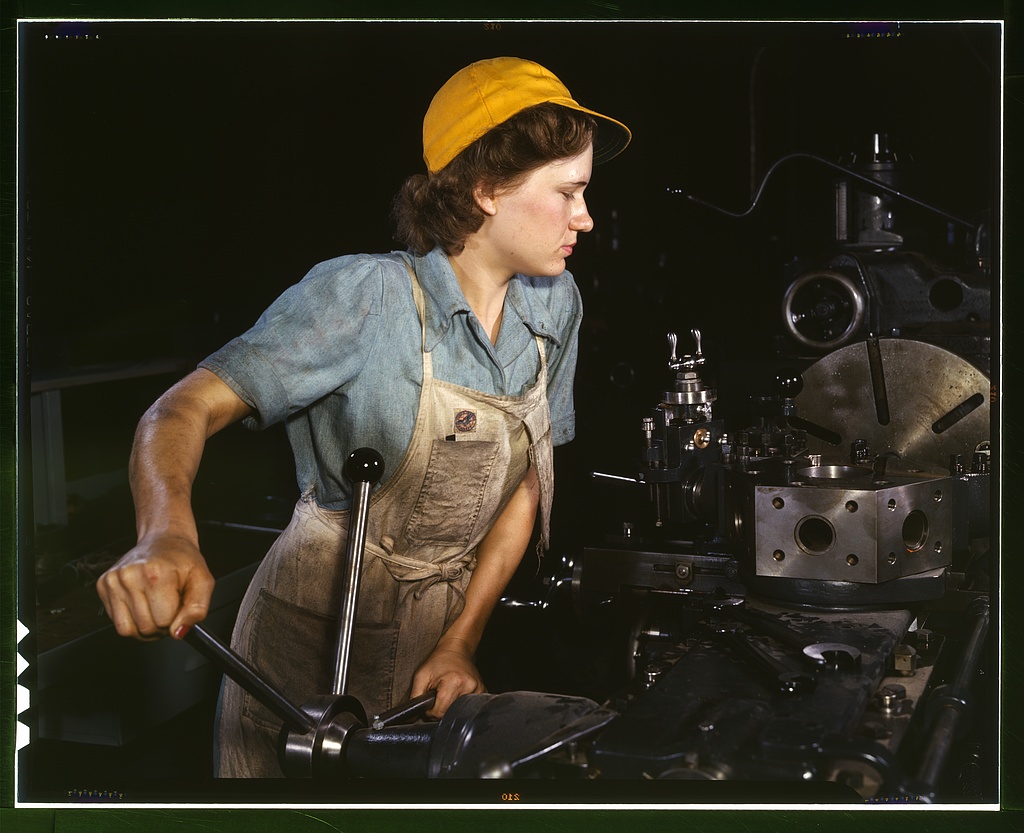
Lathe operator machining parts for transport planes at the Consolidated Aircraft Corporation plant, Fort Worth, Texas. Howard R. Hollem. Library of Congress
The name “Rosie the Riveter” originated with a popular 1942 song written by Redd Evans and John Jacob Loeb. In the song, Rosie works on an airplane assembly line, has a boyfriend in the US Marine Corps, and spends her money on war bonds. The song gained popularity with Americans, and people began using the moniker to refer to women workers in the defense industry.
Artist Norman Rockwell also invoked “Rosie the Riveter” in a painting for the cover of the May 29, 1943, issue of The Saturday Evening Post. The illustration features a woman war worker on her lunch break with a rivet gun on her lap and a lunch pail with the name “Rosie” on it, while her foot rests on a copy of Adolf Hitler’s manifesto, Mein Kampf. It was so popular that The Saturday Evening Post loaned the artwork to the Treasury Department for use in several war bond drives during the war.1
The poster many people associate with Rosie the Riveter depicts a woman rolling up her sleeve with the words “We Can Do It!” in a speech bubble above. J. Howard Miller designed the poster for Westinghouse Electric to boost worker morale. The Westinghouse poster, however, was not widely distributed during the war, and it is likely only the factory workers saw it. Miller’s poster, however, gained popularity in the 1980s after The Washington Post Magazine published the image in an article about the National Archive’s collection of posters.2
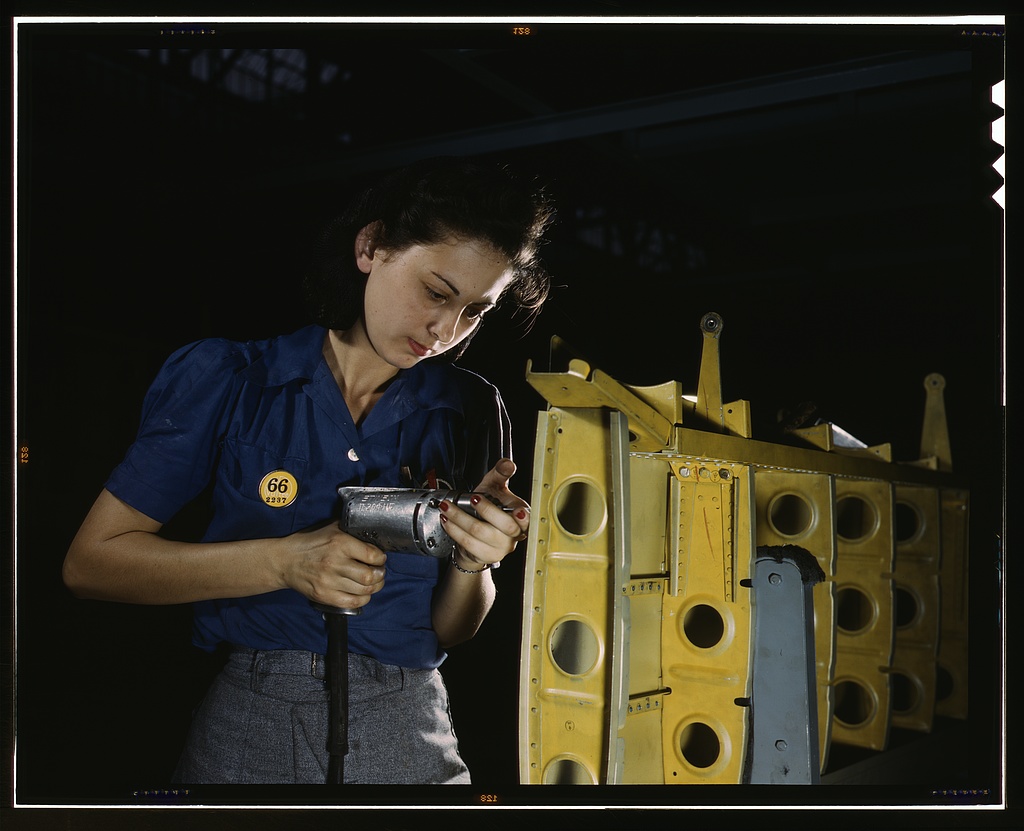
Drilling horizontal stabilizers: operating a hand drill, this woman worker at Vultee-Nashville is shown working on the horizontal stabilizer for a Vultee "Vengeance" dive bomber, Tennessee. February 1943. Alfred T. Palmer. Library of Congress
As the war ended, the US government and employers encouraged women war workers to return to their homes so more industrial jobs would be available for the returning servicemen. Some of the women workers were tired of the long hours and laborious work and planned to find different jobs after the war, while others did not need further employment and wanted to return to their homes.3 A number of women enjoyed their wartime work and the higher wages and wanted to keep their jobs.4 Although many women workers returned to traditional roles after the war, their contributions to the war industries demonstrated women’s capabilities for expanding workforce roles.
Some people ask, who was the “real” Rosie the Riveter? Although various modern news reports offer several different candidates, the truth is that the real Rosie is not a single person. Instead, Rosie the Riveter represents the more than six million women from a wide variety of backgrounds who entered the workforce to support the American war effort.
- 1
Doris Weatherford, American Women During World War II: An Encyclopedia, (Routledge, 2009), 899.
- 2
Patricia Brennan, “Poster Art for Patriotism’s Sake,” Washington Post Magazine, 23 May 1982, 35.
- 3
Frieda S. Miller, “What’s Become of Rosie the Riveter?” New York Times, 5 May 1946.
- 4
Doris Weatherford, American Women and World War II, (Castle Books, 2008), 187.

Brittany A. Huner, PhD
Brittany Huner joined the Jenny Craig Institute for the Study of War and Democracy as a Research Historian in June 2025.
Cite this article:
MLA Citation:
APA Citation:
Chicago Style Citation: