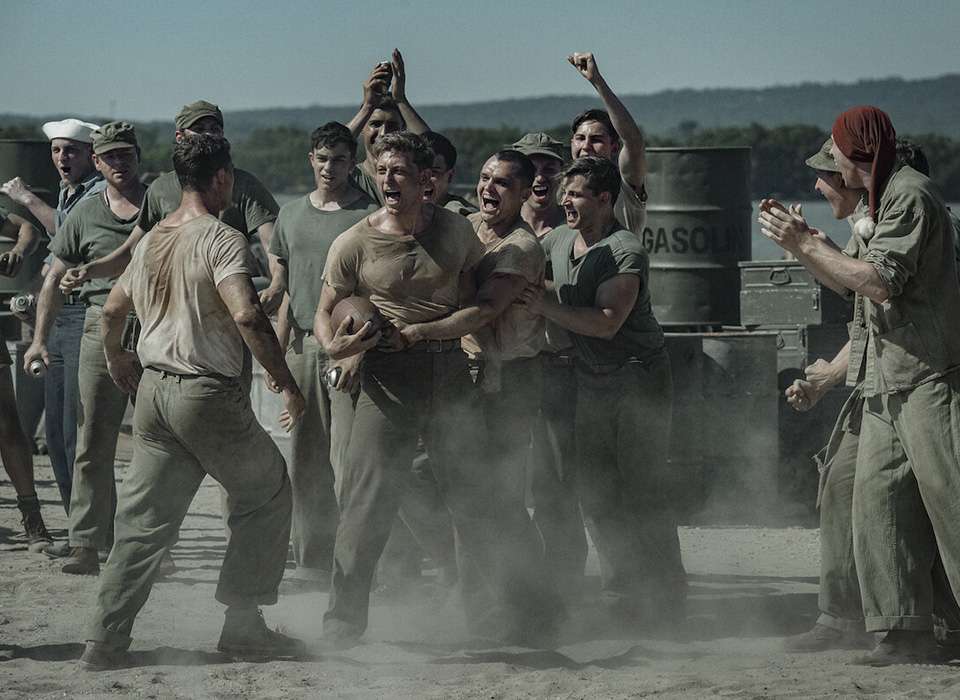
Top Photo: Tom Francis as Dave Schreiner and Ray Nicholson as Tony Butkovich in The Mosquito Bowl. Photography by Kane Skennar / Netflix
Armies reflect the populations they serve and protect. The ideals, values, and cultural traditions that shape a nation are often embodied by those who are sworn to defend it. As a result, servicemembers frequently carry reminders of home that reinforce what they are fighting for and whom they are protecting. These connections often take the form of popular culture, including music, movies, art, and sports.
During World War II, American GIs serving overseas brought elements of American culture with them, from jazz, bebop, and swing music to pin-up illustrations by artists such as Alberto Vargas and Gil Elvgren. Magazines and periodicals like Life, Collier’s, and Look offered familiar glimpses of home; Hollywood films and stars provided another connection to American life. Sports also played an important role in maintaining morale and fostering camaraderie. Military units frequently organized or sponsored sporting events, particularly baseball and football, reflecting the pastimes beloved by Americans back home.
As the war demanded an increasingly large American military, men from every walk of life soon found themselves in uniform. Hollywood stars, political figures, socialites, miners, farmers, soda jerks, and even sports heroes all answered the call. Baseball and football players, including professional athletes and collegiate All-Americans, found their way into the US Armed Forces, either through the draft or by volunteering.
For some, military service meant putting promising athletic careers on hold. Among them were John McLaughry of Brown University, Dave Schreiner of Wisconsin, Tony Butkovich of Purdue, and George Murphy, a team captain at Notre Dame. All four enlisted in the US Marine Corps, deploying to the western Pacific and eventually joining the newly activated 6th Marine Division on Guadalcanal.
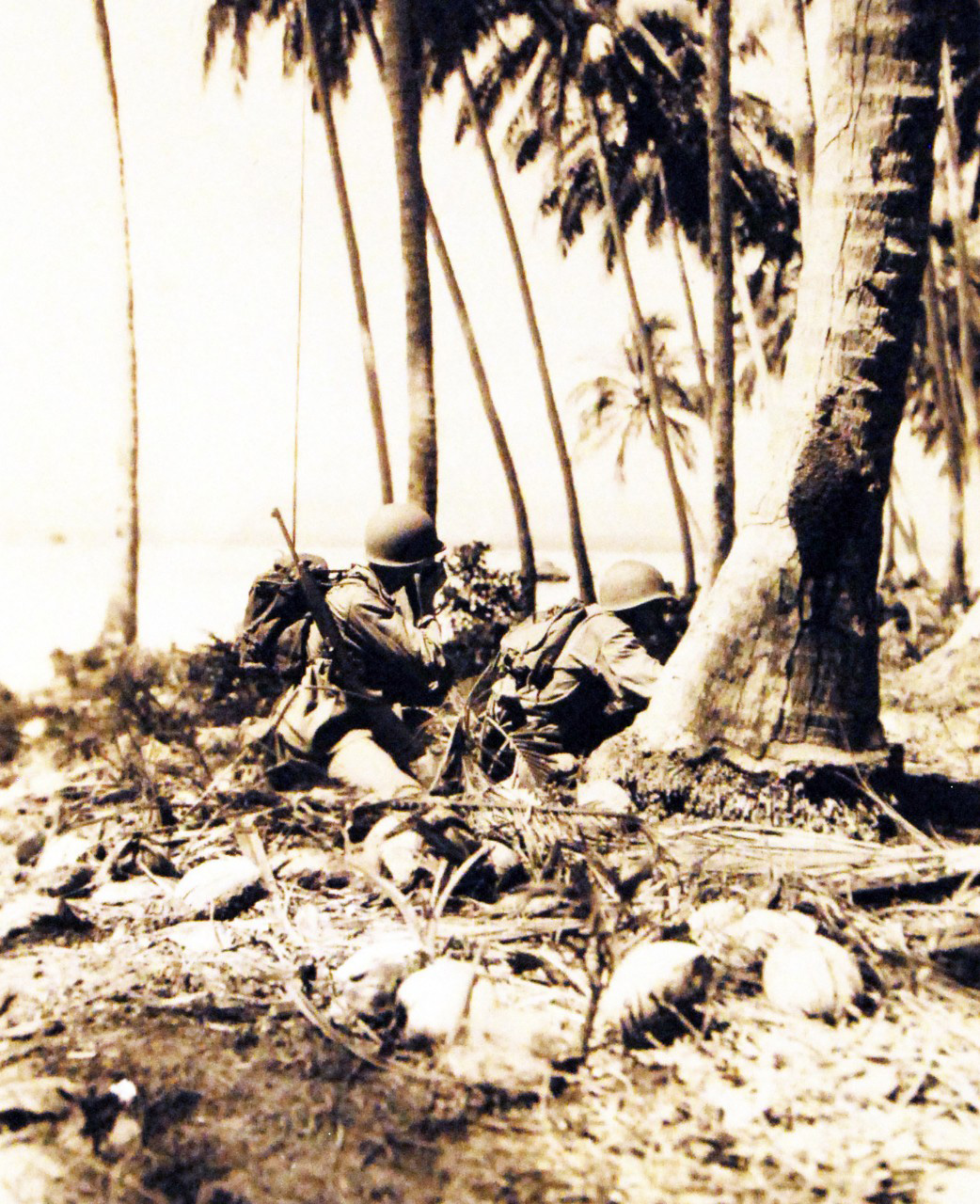
Guadalcanal Campaign, August 1942-January 1943. Advancing inland observing any enemy activity. Photographed by Private First Class W.H. Hall, March 10, 1944. U.S. Marine Corps Photograph, now in the collections of the National Archives. (2016/09/13).
In wartime, servicemembers can often spend seemingly endless stretches of time training or waiting to receive orders. Weeks and months may pass by without anything interesting to fill the void, with boredom sometimes giving way to melancholy. This was no different for the men of the 6th Marine Division’s 4th, 22nd, and 29th Marine Regiments. Stationed on the remote, jungle-covered island of Guadalcanal, they prepared for future combat while awaiting their next orders. As 1944 drew to a close, the Marines’ thoughts increasingly turned to home: their families, the approaching Christmas season, and familiar holiday traditions, including the annual college football bowl games.
As it happened, the 6th Marine Division had no shortage of football talent of its own. Of the division’s three regiments, the 4th and 29th collectively had 56 college and professional ball players on their rosters. Recognizing an opportunity to escape the boredom and bring a little bit of America to this remote part of the world, McLaughry began planning a Christmas Eve football game featuring the unit’s talented players—a 6th Marine Division all-star classic.
The game gave the two regiments a welcome break from their normal training schedules. Both began building rosters, developing plays, and holding practices in preparation for the matchup. Although each team included professional and college players, the 4th lacked depth in many of the positions. Given this disparity in talent, the 29th was heavily favored. And much like bowl games back home, the matchup sparked considerable betting among the men, with some wagering a day’s, week’s, or even a month’s worth of pay.
The Armed Forces Radio Service (AFRS), dubbed “The Mosquito Network,” planned to broadcast the game live to servicemembers unable to attend. The network’s nickname soon migrated to the football game, which became known as “The Mosquito Bowl.”
Played on the makeshift Pritchard Field parade deck of the 29th Marines, the Mosquito Bowl’s gridiron was no manicured pitch. The playing field was hard ground devoid of grass, with pieces of coral still imbedded in the surface despite efforts to clear away the hazards. There were no stadium bleachers, little equipment, and none of the usual football gear: no pads, cleats, or uniforms. The teams had only a well-used pigskin with which to play. With no uniforms to identify the teams, the two sides decided that the 4th Marine players would wear full-length dungaree trousers, while those from the 29th would wear cut-off shorts.
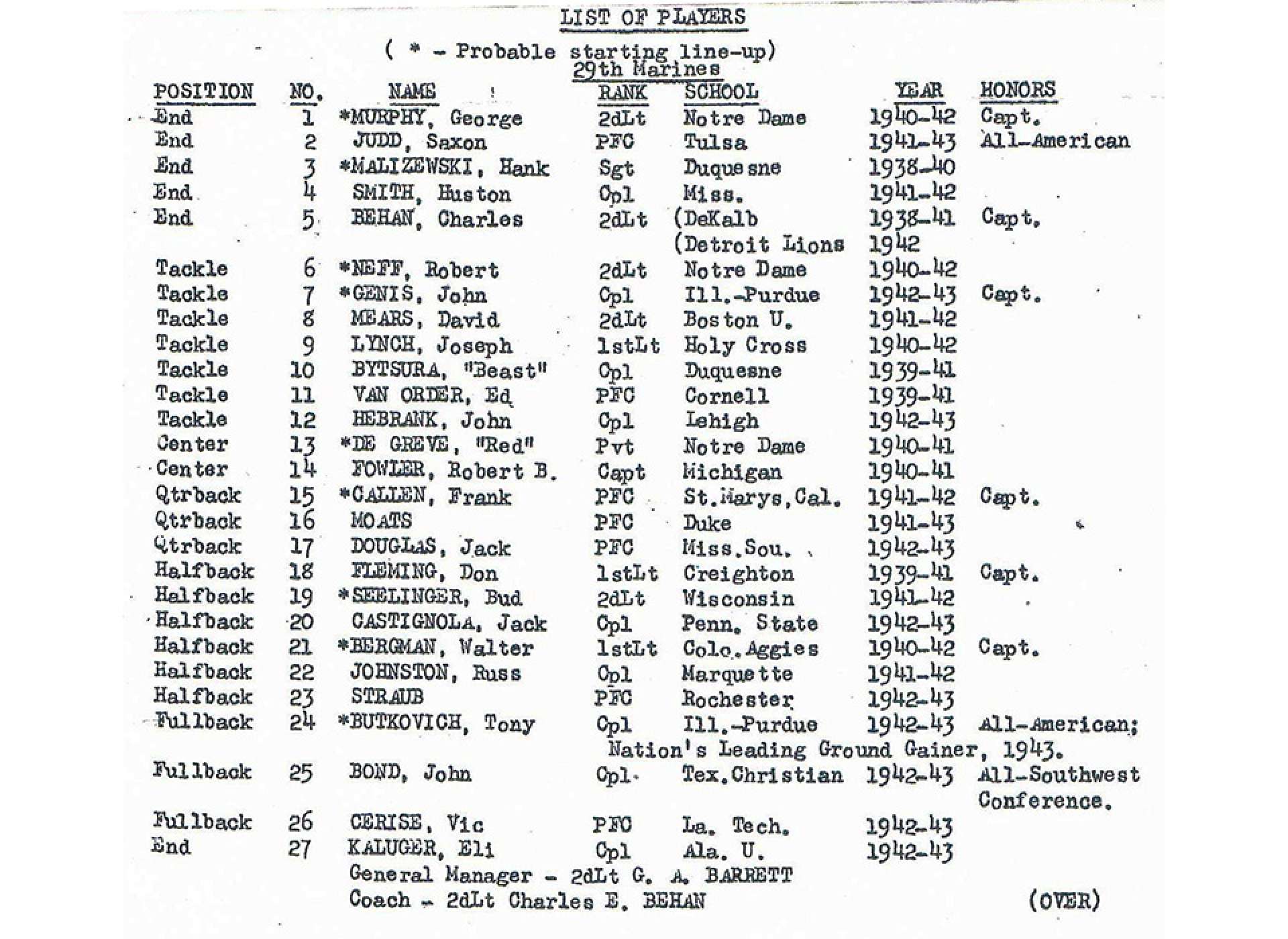
Printed programs outlined the day's events and included rosters for both regiments. Although the rosters listed individual player numbers, the uniforms lacked identifying marks, making it difficult to determine who was on the field. Each regiment provided a referee to officiate the contest, which was scheduled to kick off at 2:15 p.m. on Christmas Eve. Pregame, halftime, and postgame music came courtesy of the regimental bands.
-

Printed programs for the Mosquito Bowl outlined the day's events and included rosters for both regiments.Photo courtesy of the U.S. Marine Corps Association
-
Printed programs for the Mosquito Bowl outlined the day's events and included rosters for both regiments.Photo courtesy of the U.S. Marine Corps Association
-
Printed programs for the Mosquito Bowl outlined the day's events and included rosters for both regiments.Photo courtesy of the U.S. Marine Corps Association
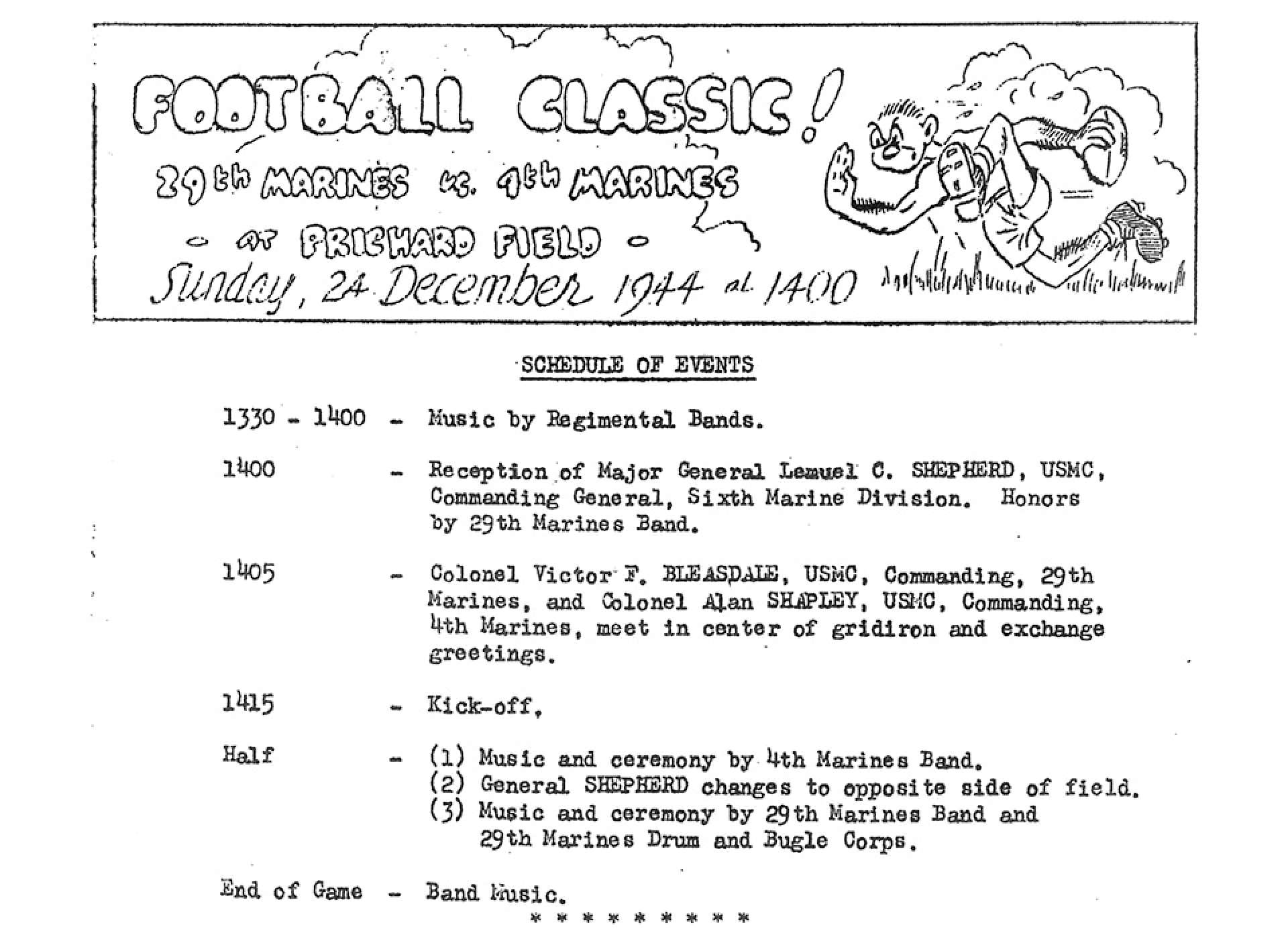
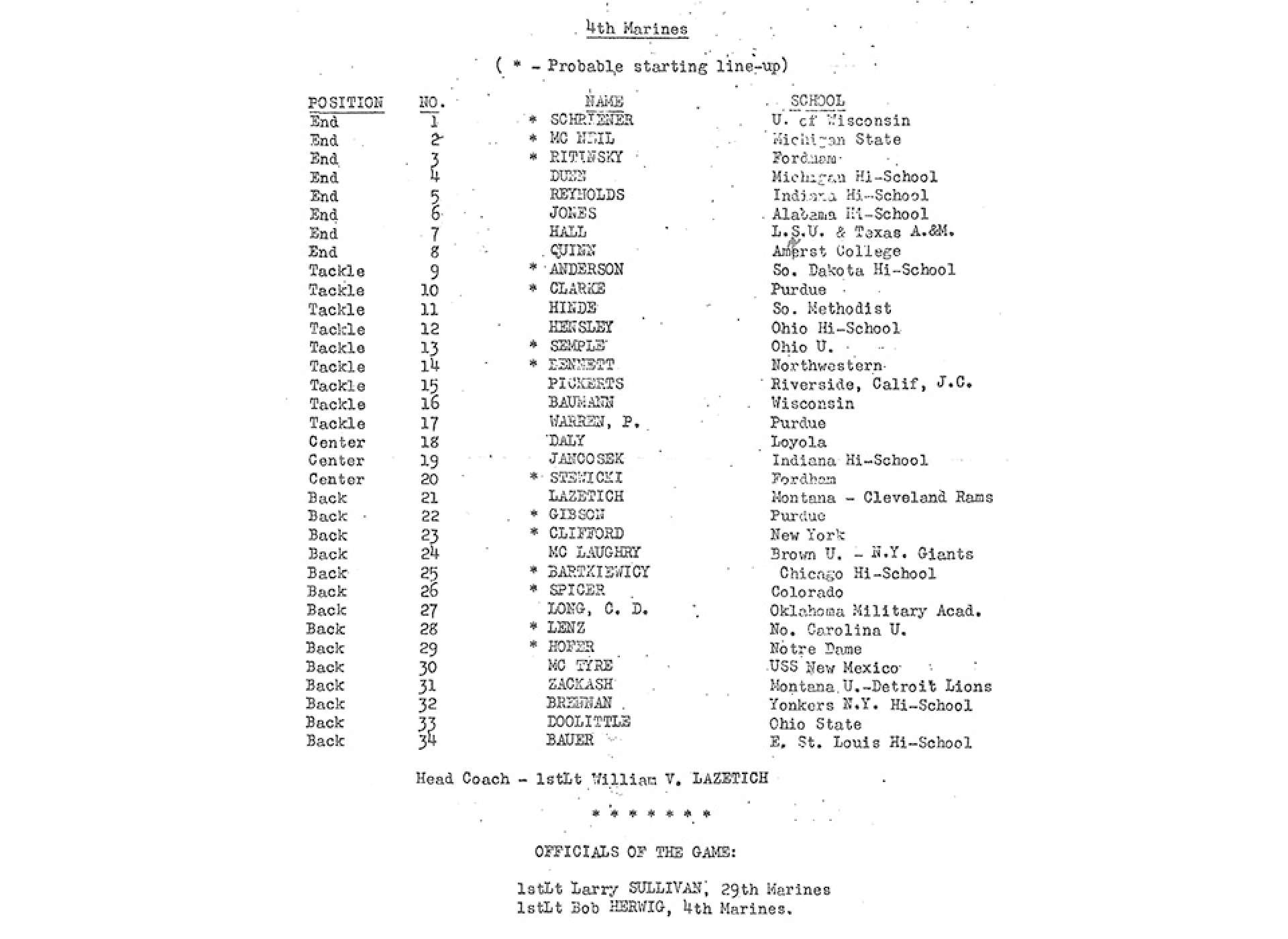
Among the crowd was the 6th Marine Division commanding general, Major General Lemuel Shepard. Before kickoff, regimental commanders Colonels Alan Shapley and Victor Bleasdale met at midfield to shake hands. In a diplomatic move, Shepard initially watched the game from a specially made coconut-log bench on the 4th Marines’ sideline, switching to the 29th side at halftime.
Given the tropical climate and the seasonal celebration, tepid beer was provided for the estimated 10,000 spectators in attendance. What was intended to be a two-hand-touch game, with contact limited to above the waist, quickly evolved into a full-contact contest of blocking and tackling, much like any hard-fought college bowl game back home. Afterward, McLaughry wrote a letter home to his parents:
It was really a lulu, and as rough hitting and hard playing as I’ve ever seen. As you may guess, our knees and elbows took an awful beating due to the rough field with coral stone here and there, even though the 29th did its best to clean them all up. My dungarees were torn to hell in no time, and by game’s end, my knees and elbows were a bloody mess.
Although no official statistics or individual player records were kept, the game lasted the full 60 minutes. Despite the 29th being heavily favored, the contest became a defensive struggle, ultimately ending in a 0-0 tie. Regardless of the scoreless outcome, the game was a welcome reprieve from the Marines’ boredom and a reminder of home, if only for a few hours.
Unknown to the men who took the field that Christmas Eve, 15 of them would never make it home. On April 1, 1945, the 6th Marine Division landed on Okinawa as part of XXIV Corps, tasked with securing the invasion force’s northern right flank. Hitting the island’s Hagushi shoreline (near modern-day Kadena Air Base), two of the division’s regiments came ashore at “Red” and “Green” beaches, moved inland, and soon secured the Yontan Airfield. Afterward, the division quickly headed north to the Motobu Peninsula, clearing out Japanese units from the 44th Independent Mixed Brigade.
After three weeks of operations in the north, the division turned south toward the main defenses of the Japanese 32nd Army along the Shuri Line. From May 5 to 30, the 6th Marine Division fought its way along the island's western coast, battling for control of key terrain features known as Sugar Loaf, Half Moon, and Horseshoe Hills. These battles cost the division 200 Marines for every 100 yards gained. The taking of Sugar Loaf Hill alone accounted for some 3,000 casualties. Among those lost in these brutal engagements were several of the men who had taken part in the Mosquito Bowl.
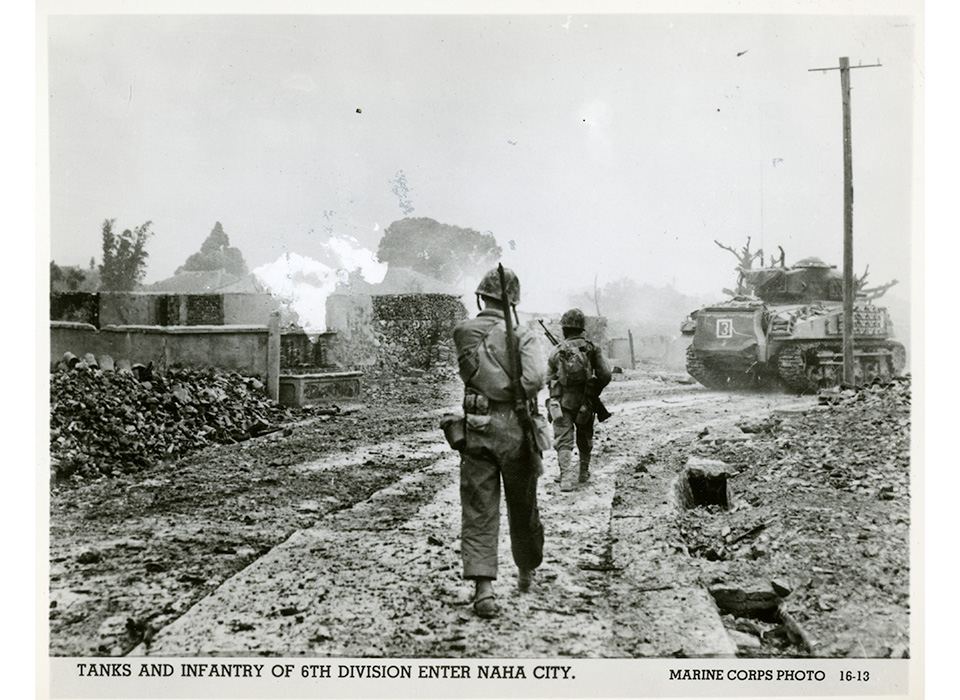
Two armed United States Marines following a tank down a street covered in mud and surrounded by debris; war damaged buildings border both sides of the street. Official caption on front: "Tanks and infantry of 6th Division enter Naha city. Marine Corps Photo 16-13." Naha, Okinawa, Japan. 1945. 2013.495.233
Although some of the men who took part in that Christmas Eve game would never see their families again, their stories—and those of the Marines who survived the Okinawa campaign—illustrate the enduring connection between servicemembers and the homes they leave behind. Their love of country is reflected not only in their service and sacrifice but also in the traditions they preserve, the things they carry, and the values they hold dear. Even in the most remote corners of the world, servicemembers find ways to bring a little piece of home with them.
The story of this remarkable event is now featured in the Netflix film The Mosquito Bowl, directed by Peter Berg and based on Buzz Bissinger's best-selling book of the same name. The film follows four players from the game and their experiences fighting in the final campaign of the war on Okinawa. Through its gritty depiction of both the game and the war, the film offers a glimpse into how servicemembers far from home found comfort and camaraderie in the traditions that are uniquely American.
References:
- Buzz Bissinger, The Mosquito Bowl: A Game of Life and Death in World War II, (New York, 2026: Harper Books)
- Allen C. Bevilacqua, “The Football Classic,” in Leatherneck Magazine, December 2015 Issue, Marine Corps Association.

John Curatola, PhD
John Curatola is the Samuel Zemurray Stone Senior Historian at the Jenny Craig Institute for the Study of War and Democracy.
Cite this article:
MLA Citation:
APA Citation:
Chicago Style Citation: