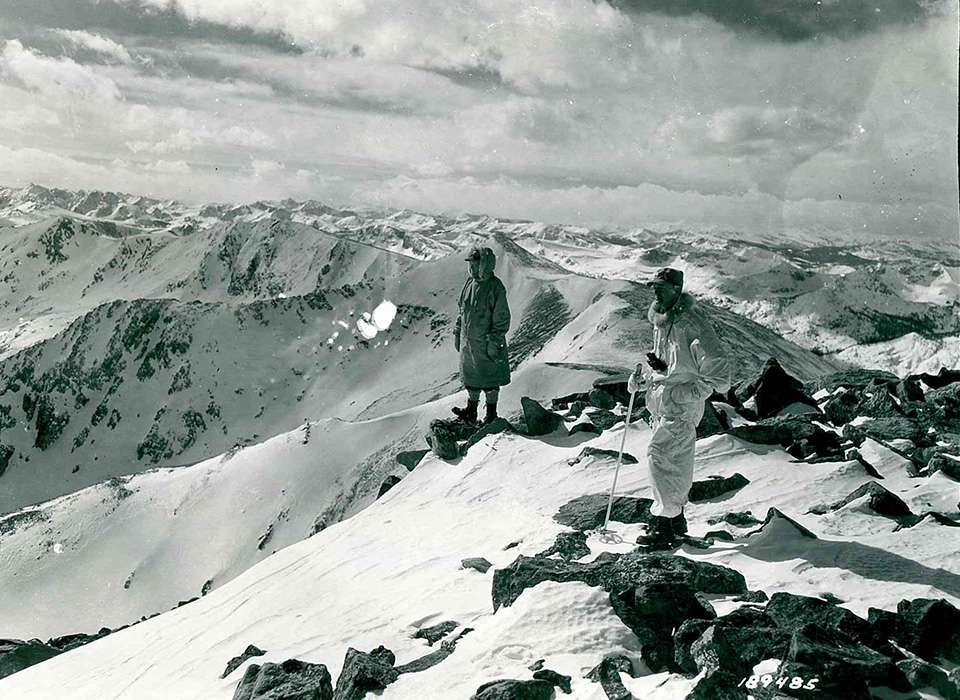
Top Photo: Members of a mountain troop witness springtime in the Rockies at 13,000 feet near the timberline at Camp Hale, Colorado. Original negative received from Commanding General, Seventh Service Command, Headquarters, Omaha, Nebraska, December 1943. National Archives
In 1942, the US Army constructed Camp Hale, a new training facility for the country’s first ski and mountain troops, near Leadville, Colorado. The 10th Mountain Division would play an important role in the Italian Campaign of World War II and leave a lasting legacy on mountain warfare and the postwar civilian ski industry.
Mountain warfare was familiar topic in the media with the Russo-Finnish War of 1939–40, also known as the “Winter War.” Although Finland lost territory, their ski troops were very effective against the Soviet Union and inspired Americans with their stealth, winter tactics, and resilience.1 At the same time, Charles Minot “Minne” Dole founded America’s National Ski Patrol system in 1938 to promote ski safety and rescue skiers from accidents. He saw the need for such an organization after the death of a friend on a mountain trail and being stranded on a slope himself with a broken ankle.2 The War Department used the National Ski Patrol to help recruit members for the new mountain warfare division.3 While the 10th Mountain Division initially looked for trained skiers and mountaineers in 1942, wartime manpower needs meant that many of the later recruits had never even seen snow, much less skied.4
Although news articles referred to the men as “ski troopers,” their training included mountaineering and winter survival skills. Soldiers learned how to move and fight in various winter conditions and how to handle the mule and sled dog teams at Camp Hale. The men participated in numerous training exercises in the cold Colorado weather, including miserable three-week maneuvers known as the D-Series during which temperatures dropped to 35 degrees below zero.5 Despite the difficulties—and the occasional complaints in the camp newspaper—the men learned their skills, and some even spent their free time hiking and skiing in the nearby mountains.6 In August 1943, the 87th Mountain Infantry Regiment were able to utilize their new knowledge when they reported to Kiska, Alaska, to help recapture the Aleutian Islands after Japan invaded in June 1942. Although the Japanese troops had secretly evacuated Kiska shortly before the Allies arrived, the combination of fog, booby-traps, and friendly fire incidents led to casualties among the Allied troops, including 17 men killed from the 87th Mountain Infantry Regiment.7
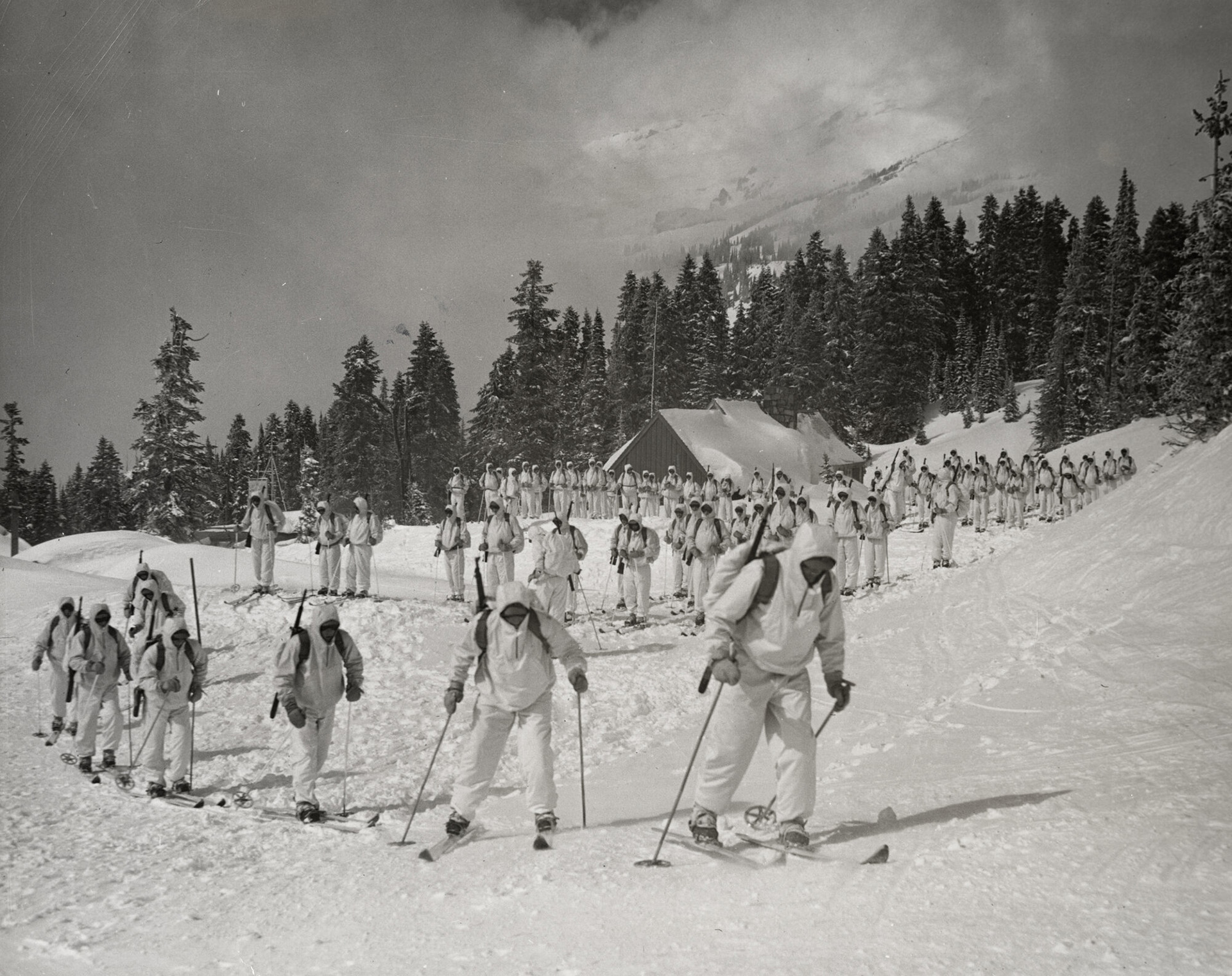
A large group of 10th Mountain Division soldiers prepares for an activity. They are all wearing their camouflage “Whites,” wearing skis, holding ski poles, and carrying rifles and backpacks. A few soldiers in the foreground appear to be starting to ski in a line. The roof of a cabin is visible just behind the group. A mountain range enshrouded by clouds is behind them. Denver Public Library
At the end of 1944, the men of the 10th Mountain Division left the United States to join the Italian Campaign. Their goal was to help capture the heavily fortified Mount Belvedere to allow the Allies to break through the German Gothic Line across the Italian Peninsula in the Apennine Mountains. Previous Allied attempts to capture Belvedere failed, so the 10th Mountain Division used a different tactic. Utilizing their mountaineering training, they launched a surprise attack on the steep cliffs of the nearby Riva Ridge on the night of February 18, 1945.
While the members of the Division’s 86th Mountain Infantry Regiment repelled counterattacks on Riva Ridge, the 126th Engineer Mountain Battalion constructed an 1,800-foot-long aerial tramway, which cut the time to evacuate casualties from the mountain from three hours to five minutes.8 The tram was also used to resupply the men on the ridge.
After securing Riva Ridge, the soldiers of the 10th Mountain Division moved to Mount Belvedere for another nighttime attack, supported by allied soldiers from the 1st Brazilian Division of the Brazilian Expeditionary Forces. Allied casualties on Mount Belvedere were high at 923, with 192 killed in action, 730 wounded, and one taken as a prisoner of war.9 The 10th Mountain Division had achieved its objective though: they captured Mount Belvedere and held off several counterattacks for the Allies to continue their drive through Italy.
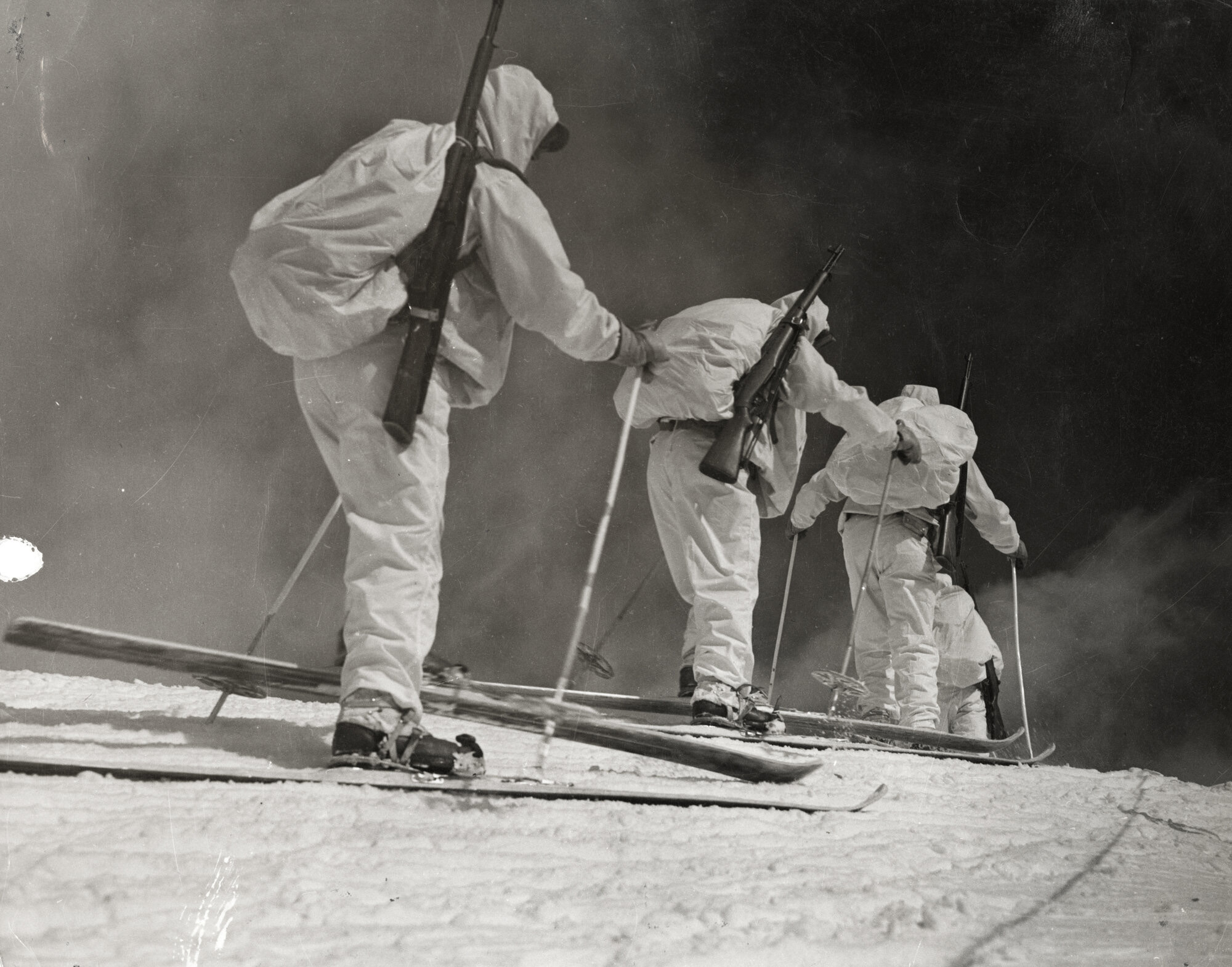
Four 10th Mountain Division soldiers cross-country ski through snow, photographed from behind. They are wearing their camouflage Whites, wearing skis, and using ski poles. Guns are strapped to their right shoulders. Denver Public Library
With the Gothic Line broken, the 10th Mountain Division moved east to capture staging areas for the Allied push out of the Appennine Mountains. They captured a series of nearby hills in four deadly days of fighting known as the “March Offensive.” After a four-week break to recover and integrate replacement soldiers, the men of the Division participated in the “Spring Offensive” to help clear the area between Bologna and Modena for the continuing Allied push north. Unfortunately, poor weather conditions delayed their attack, giving the Germans time to prepare their defenses. Casualties were higher than on Mount Belvedere: three men were taken prisoner, 1,047 were wounded, and 286 were killed in action, including Private First Class John D. Magrath, who was posthumously awarded the Medal of Honor for his actions in the Spring Offensive.10 Among the soldiers seriously wounded was Lieutenant Robert “Bob” Dole, a future presidential candidate who would also serve in both the Senate and House of Representatives for Kansas in his political career.
The Division’s mission to capture retreating German troops continued as they moved through the farm fields and olive groves of the Po River Valley. They secured a bridgehead on April 23 and prepared for the final assault into Northern Italy. On April 27, the Division reached Lake Garda, where the men faced intense fighting in the nearby mountain tunnels and lakeside towns. They also captured the symbolically significant Villa delle Orsoline, which had previously housed Italian dictator Benito Mussolini.
Shortly after securing the Lake Garda area, the German forces in Italy surrendered to the Allies. Five days later, on May 8, the war in Europe ended. The men of the 10th Mountain Division briefly remained in Italy for occupation duties before returning to the United States in mid-July to train for a possible invasion of Japan.11 By the time their transports landed in the United States, Japan surrendered and the war in the Pacific was over.
After the war, the members of the 10th Mountain Division greatly influenced the American ski industry. Many of them became ski instructors, managed ski resorts, ran equipment shops, or created publications about snow sports. Former members helped found ski areas like Whiteface Mountain Ski Resort in New York, Sugarbush Resort in Vermont, and Vail, Arapahoe Basin, and Aspen in Colorado. The Division’s connection to winter sports also extended to the Olympics with 19 Olympians—16 athletes and three coaches—who competed in seven Olympic Games, both before and after the war.12
In 2025, the U.S. Ski & Snowboard team partnered with the Army to honor the 10th Mountain Division's legacy. As part of the partnership, athletes will wear an Army/10th Mountain Division patch on outerwear during the 2025-26 season, including at the Milano Cortina Olympic and Paralympic Winter Games in Italy in February 2026.
The Division has monuments and memorials dedicated to them in Italy, Washington, and Colorado, including the defunct Camp Hale, designated as a national monument in 2022. “Climb to Glory,” the modern motto of the 10th Mountain Division, truly reflects their actions and sacrifice in the Italian mountains and beyond.
- 1
History Colorado Exhibition Team, Winter Warriors: The 10th Mountain Division in World War II, (History Colorado, 2023), 9-10.
- 2
History Colorado Exhibition Team, Winter Warriors, 11.
- 3
Lance R. Blyth, Ski Climb Fight: The 10th Mountain Division and the Rise of Mountain Warfare, (University of Oklahoma Press, 2024), 22-23.
- 4
“Ave Atque Vale,” Ski-Zette, 30 September 1944.
- 5
“Short History of Camp Given as Hale Closes,” Ski-Zette, 30 September 1944.
- 6
“Un-Springlike ‘Springtime in Rockies’ Makes Test of Tenth Division’s Mountain Operations a Real ‘Blitzkrieg’ Affair,” “Hale Skiers: Pikes Peak Meet Beckons,” Ski-Zette, 7 April 1944.
- 7
History Colorado Exhibition Team, Winter Warriors, 36.
- 8
“Casualties Evacuated by Tram,” Blizzard, 22 February 1945.
- 9
Maurice Isserman, The Winter Army: The World War II Odyssey of the 10th Mountain Division, America’s Elite Alpine Warriors, (Houghton Mifflin Harcourt, 2019), 180.
- 10
History Colorado Exhibition Team, Winter Warriors, 54-55.
- 11
Isserman, The Winter Army, 239.
- 12
“2026 Olympic Winter Games,” 10th Mountain Division Foundation, 26 October 2025, https://10thmountainfoundation.org/latest_events/2026-olympic-winter-games/

Brittany A. Huner, PhD
Brittany Huner joined the Jenny Craig Institute for the Study of War and Democracy as a Research Historian in June 2025.
Cite this article:
MLA Citation:
APA Citation:
Chicago Style Citation: