-
Article Type
The Great Debate
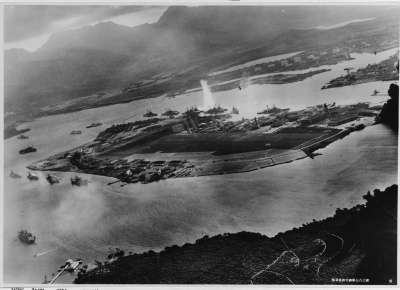
Learn MoreFrom our 21st-century point of view, it is hard to imagine World War II without the United States as a major participant. Before the Japanese attack on Pearl Harbor in 1941, however, Americans were seriously divided over what the role of the United States in the war should be, or if it should even have a role at all. Even as the war consumed large portions of Europe and Asia in the late 1930s and early 1940s, there was no clear consensus on how the United States should respond.
-
Article Type
Rationing
Learn MoreWorld War II put a heavy burden on US supplies of basic materials like food, shoes, metal, paper, and rubber. The Army and Navy were growing, as was the nation’s effort to aid its allies overseas. Civilians still needed these materials for consumer goods as well. To meet this surging demand, the federal government took steps to conserve crucial supplies, including establishing a rationing system that impacted virtually every family in the United States.
-
Article Type
Japanese American Incarceration
Learn MoreAt the time of the Japanese attack on Pearl Harbor in 1941, about 120,000 persons of Japanese ancestry lived on the US mainland, mostly along the Pacific Coast. About two thirds were full citizens, born and raised in the United States. Following the Pearl Harbor attack, however, a wave of antiJapanese suspicion and fear led the Roosevelt administration to adopt a drastic policy toward these residents, alien and citizen alike.
-
Article Type
The Home Front
Learn MoreWhen we think of World War II, the first images that enter our minds usually involve battle: armies fighting their desperate struggles on land, huge navies patrolling the oceans, and aircraft soaring sleekly overhead.
-
Article Type
Innovating for Victory
Learn MoreThere’s an old saying that necessity is the mother of invention. That sentiment was definitely the case during World War II, a massive global conflict that presented the United States with a variety of tactical and logistical challenges. At every turn Americans seemed to need more of everything—more supplies, bigger bombs, faster airplanes, better medical treatments, and more precise communications.
-
Article Type
Gender on the Home Front
Learn MoreWartime needs increased labor demands for both male and female workers, heightened domestic hardships and responsibilities, and intensified pressures for Americans to conform to social and cultural norms.
-
Article Type
The Double V Victory
Learn MoreDuring World War II, African Americans made tremendous sacrifices in an effort to trade military service and wartime support for measurable social, political, and economic gains. As never before, local black communities throughout the nation participated enthusiastically in wartime programs while intensifying their demands for social progress.
-
Article Type
Becoming the Arsenal of Democracy
Learn MoreEarly on in World War II, Reichsmarschall Hermann Göring, one of Adolf Hitler’s top lieutenants, said that Americans could only make refrigerators and razor blades—they would never be able to produce the military equipment and supplies necessary to defeat Nazi Germany. Hitler took the same view in his public speeches, but privately he knew the clock was ticking. Germany would have to achieve victory fast, before American production had time to ramp up.
-
Article Type
Should the United States Keep Troops in Germany?
Learn MoreHow the looming Cold War convinced Americans to keep troops in Europe after the war.
-
Article Type
V-J Day
Learn More“It was too much death to contemplate, too much savagery and suffering; and in August 1945 no one was counting. For those who had seen the face of battle and been in the camps and under the bombs—and had lived—there was a sense of immense relief.”
-
Article Type
Surviving the Sinking of the USS Indianapolis
Learn MoreHundreds of the ship's crew floated on the Pacific for days. Their location and fate were unknown to the US Navy.
-
Article Type
American Indian Code Talkers
Learn MoreThe idea of using American Indians who were fluent in both their traditional tribal language and in English to send secret messages in battle was first put to the test in World War I with the Choctaw Telephone Squad and other Native communications experts and messengers. However, it wasn’t until World War II that the US military developed a specific policy to recruit and train American Indian speakers to become code talkers.