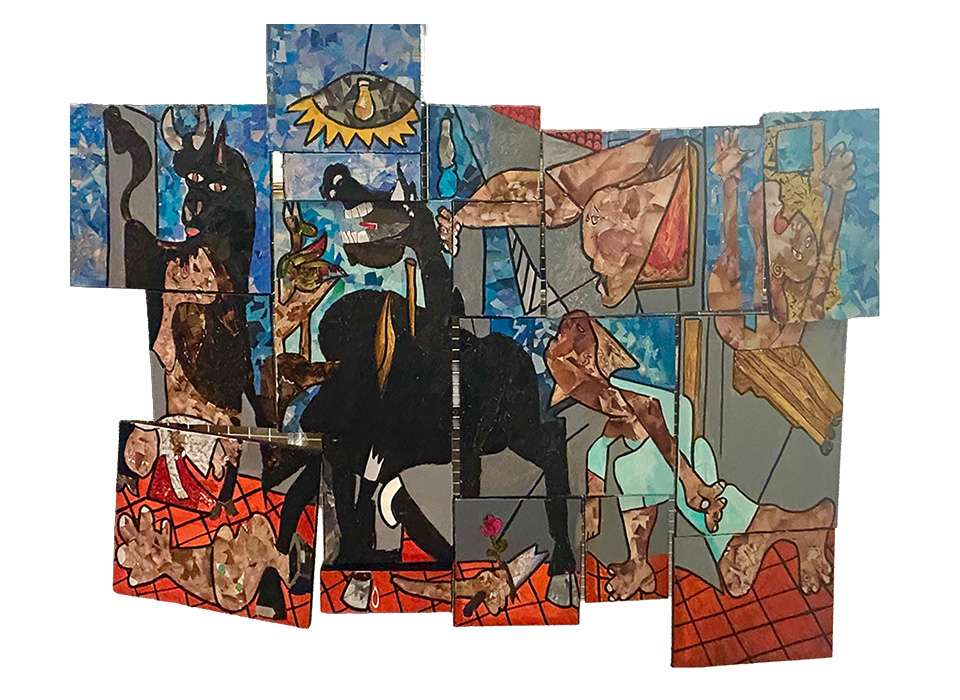
Top Photo: This collaborative artwork, inspired by Picasso’s Guernica, is a collaboration by students from New Orleans-area schools—Gretna No. 2 Academy, William Hart Elementary, George Cox Elementary, and Frederick Douglass Elementary—who were learning about ‘degenerate’ art. This work was featured in the Jefferson Parish Public Schools student art show at The National WWII Museum.
In the years leading up to World War II, while the Nazis focused on territorial expansion and militarization, they also set their sights on a different type of war: a culture war. The Nazi Party, infamous for an ideology of racial purity, adopted an aesthetic rooted in realistic classicism, with heroic muscular figures and sweeping landscapes—connecting such idealized images to eugenics and the strict racist, antisemitic hierarchy they endorsed.
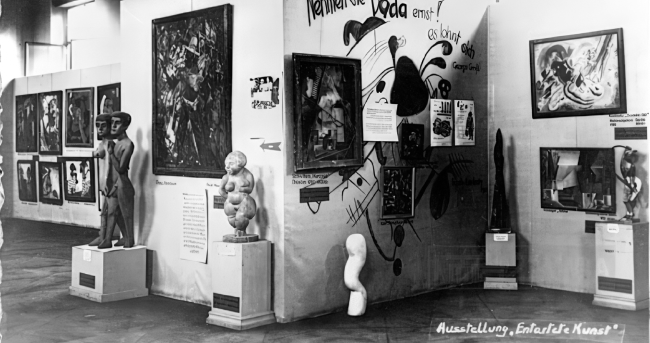
The idea for a category of “degenerate” art has its own history, with roots in the 1892 book Degeneration by Max Nordau, based on theories of eugenics from Italian phrenologist Cesare Lombroso. At the time, Nordau criticized the Impressionists and even the musical composer Richard Wagner, of whom Hitler was later a great fan. But by the time the Nazis opened their infamous Entartete Kunst (Degenerate Art) exhibit in Munich in 1937, the term had come to encompass artworks that the Nazis wanted to censor.
For this reason, we have developed a lesson plan to introduce students to the Nazis’ war on modern art that frames the issue with these questions:
- Why did the Nazis decide that certain kinds of art were “degenerate”?
- How can artwork be used to convey values that are economic, social, political, and cultural?
In investigating these questions, students can learn about this history while also developing an understanding of the dangers and impacts of the Nazis through a more visual lens.
While the Nazis’ Degenerate Art Exhibit Guide shows that their framework for criticizing modern art was a counterpoint to the Aryan ideals they valued, the “degenerate” label also conveniently ostracized their adversaries. Political dissidents like Otto Dix, George Grosz, Paul Klee, and Ernst Kirshner fled Germany; Jewish artists like Marc Chagall, Max Liebermann and Felix Nussbaum were targeted. Additionally, many collectors who bought or sold modern art had political beliefs that sharply contrasted with the Nazis—and could have their valuable collections confiscated or be considered enemies of the state as a result.
The original Degenerate Art exhibit, which you can view through this video from the United States Holocaust Memorial Museum, ran for four months and attracted more than two million people who visited mostly to mock and laugh at the works. Many of the artists featured fled Germany and ended up destitute, stateless, distraught, or even imprisoned. Some of their artwork was burned or destroyed. Other artists, able to reestablish themselves, ironically profited from censorship. After 1937, Reich Minister of Propaganda Joseph Goebbels had the idea to auction artworks to fund the Nazi war effort. As the banned artist Otto Dix wrote in a letter to an acquaintance from 1939, “My bust of Nietzsche is valued at 400 English pounds. The interesting thing is that I gave this sculpture to Dresden city museum in 1919, but now because it’s ‘degenerate’ it’s being flogged abroad for a top price. Ultimately I’m glad about it, because these things aren’t safe from destruction here anymore.”
For more information, explore The National WWII Museum’s Degenerate! Hitler’s War on Modern Art special exhibit highlighting the Nazi campaign against modern art on display until May 10, 2026. Additionally, the Minneapolis Institute of Art and the Musee Picasso have both produced excellent educator guides on respective exhibits addressing this topic. You can also listen to the World War II On Topic podcast about this subject or tune in to this special teacher webinar.
Highlights from The National WWII Museum's Collection
When you visit The National WWII Museum, be sure to see the scale model of the Führermuseum, Hitler’s unrealized plans for an art museum that would display the Third Reich’s idealized artworks. Just as the Nazis were confiscating the art they deemed “degenerate,” they were also stealing the artworks they liked and planning to house them in this monumental building. The Führermuseum model, located in the Museum’s Liberation Pavilion, further highlights the artistic styles and cultural ideals deemed “acceptable” by Nazi ideology, underscoring the role of art as a tool in Hitler’s fascist regime. Designed in a grand neoclassical style and inspired by Hitler’s visits to museums in Rome and Florence, such as the Uffizi Gallery, the planned museum was meant to overshadow Vienna and project the supposed glory of the Nazi regime. The model ultimately creates a stark contrast between Hitler’s definitions of “degenerate” and “acceptable” art.
A Closer Focus on Specific Topics
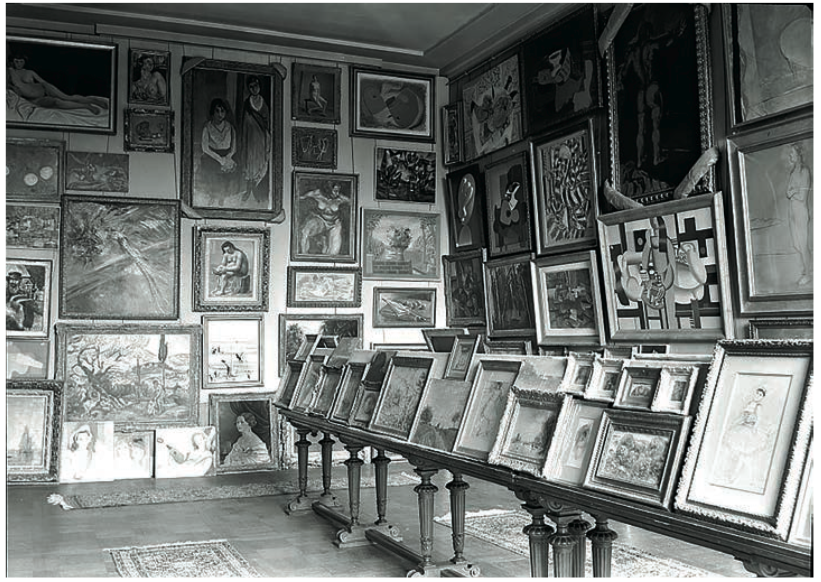
The ‘Salle des Martyrs’ at the Museum of the Jeu de Paume in Paris displays paintings stolen by the Nazi Reichsleiter Rosenberg Taskforce, circa 1940. Wikimedia Commons
Women Who Rescued Modernism
Some of the most influential figures in saving and safeguarding important modern art works were women. As the Third Reich moved through Europe, confiscating and destroying modern art, these women learned to be strategic, daring, and at times opportunistic.
German artist Hilla Von Rebay moved to the United States, met philanthropist and art collector Solomon R. Guggenheim in 1927 and became art adviser to the eponymous founder of New York City’s Guggenheim Museum. She encouraged collection of abstract art (they called it “Non-Objective Painting”), including a series of purchases in 1939 of “degenerate” art from the German government-sponsored sale in Switzerland. This purchase prevented these precious works from destruction and facilitated their transfer and protection in New York City, where many remain to this day.
Peggy Guggenheim, Solomon’s niece and a self-described “art-addict,” protected her artworks by shipping them to America, labelling them as “household goods” and changing her last name to evade antisemitism. She developed a new American network and art market for the European avant-garde, and her beautiful collection can still be viewed at her former palazzo in Venice.
Meanwhile, Gertrude Stein, a famous American writer living in Paris, was an avid Picasso collector and supporter of Modernism. Her story offers an insight into the complexities of this era: despite being a queer Jewish woman, Stein supported the French Vichy government, which collaborated with the Nazis, and even translated speeches for them. She is known to have benefitted from the protection of her close friend, suspected Gestapo agent Bernard Faÿ, and thus was able to save much of her art collection. Her Picasso paintings were almost all donated to the Metropolitan Museum in New York upon her death in 1946.
Lastly, we can thank the brave French curator Rose Valland for quietly documenting the Nazi looting and confiscation of art from the Jeu de Paume museum in Paris. Valland’s advocacy for art restitution earned her the Légion d’Honneur, and her copious notes included information on the fate of tens of thousands of masterworks stolen from French collections, including information about the “degenerate” art located in the “Salle de Martyrs” at the Jeu de Paume.
Recovering and Repatriating Degenerate Art
It is difficult to account for all the art purged by the Nazis, but the Victoria & Albert Museum has made a copy of the original Nazi inventory from 1937 available. In 2001, many museums in the United States committed to the American Association of Museums (AAM)’s April 2001 Guidelines, and in 2016, the Holocaust Expropriated Art Recovery (HEAR) Act was signed in to law “to revive claims otherwise barred by the statute of limitations so that victims of the Holocaust atrocities and their heirs could seek justice and recovery of the property from which they were unlawfully and inhumanely separated.”
These developments have led to complex legal battles and the repatriation of art confiscated by the Nazis. In one such case, Maria Altman, the niece of collectors and art patrons Ferdinand and Adele Bloch-Bauer, sued the Republic of Austria and Austrian National Gallery. Her goal was to recover six paintings by Gustave Klimt, including portraits of Altman’s aunt Adele, after the works were confiscated by the Nazi regime. Altman engaged in a decades-long legal battle that eventually concluded with the restitution of the paintings in 2006.
Entartete Musik
If you visit The National WWII Museum’s Degenerate! exhibit, you can also see how the concept of “degenerate” culture extended into music (Entartete Musik).
Indeed, the Nazi exhibit entitled Entartete Musik was displayed in 1938 and derided the music of Jewish composers such as Felix Mendelssohn, Gustav Mahler, and Kurt Weill. Additionally, jazz music, which became popular in Germany during the Weimar Era, was largely censored by the Nazis due to its African American roots. However, jazz continued to thrive underground throughout the Third Reich. In the exhibit, you can view records, sheet music, and instruments from jazz musicians of the era—including a tenor saxophone played by Eddie Powers and a clarinet played by George Lewis. The resilience of this beloved music is a fascinating story that you can read more about on the website Music and the Holocaust, which contains important research about the topic.
Teaching and Learning Tips
Visual Thinking Strategies—sometimes referred to as VTS—is an inquiry-based approach to teaching. Students are encouraged to use intention and reflection while they observe an image or artifact then answer a question like What’s going on in this picture? This is followed by evidence-based thinking that can be encouraged through questioning, like
What do you see that makes you say that? Or What more can you find?
While the lessons around degenerate art tell a very important social studies story, they also give teachers the opportunity to help students approach “images as text” and to develop their skills in interpreting images such as paintings and other works of art. By using these thinking questions as scaffolds, students can draw their own conclusions about how shape, color, and composition work in various Modernist works, and teachers can go from there to help students make connections to how certain types of imagery were rejected by the Nazis.
Student Work
This year, The National WWII Museum’s Student Writing Contest asked students to write an essay on the importance of freedom of expression in the arts and to use the lessons from the Degenerate! Hitler’s War on Modern Art exhibit in their argument.
The following essay* is from Junior Division Winner Callie Tang, a 9th grader at D.W. Daniel High School in South Carolina.
“The Power They Feared: Why Artistic Freedom Matters”
Art is at once a refuge and a weapon. It gives voice to emotions words cannot fully express, yet throughout history, those in power have feared its influence enough to silence it. While language can describe concepts such as happiness or beauty, it often fails to capture the depth and individuality of human experience. Art, by contrast, communicates through form, color, and sound, inviting interpretation and reflection. This influence extends beyond individuals, shaping culture, identity, and shared values within society. Because of this power, governments have often attempted to control artistic expression, using it for propaganda while suppressing independent voices that challenge authority. Nowhere was this more evident than in Nazi Germany, where the regime censored modern art and music to enforce Nazi ideology and eliminate dissenting cultural voices (The National WWII Museum). This systematic control of artistic expression demonstrates why freedom of expression in the arts is essential to a free society.
During the 1930s, the Nazi regime made the suppression of artistic freedom a central part of its effort to control German society. Modernist movements such as Expressionism, Dadaism, Cubism, and abstract art were labeled Entartete, or “degenerate,” and thousands of works were confiscated from museums and private collections (Anderson). In 1937, the regime organized the infamous Degenerate Art Exhibition in Munich, deliberately mocking these artworks to discourage public appreciation (US Holocaust Memorial Museum, “‘Degenerate’ Art”). Approximately 650 works from 32 German museums were displayed in a chaotic manner meant to portray modern art as dangerous and inferior (German History in Documents and Images, “Guide to the ‘Degenerate Art’ Exhibition (1937)”). Music was also targeted. Classical German works by composers such as Beethoven and Wagner were used to promote Aryan cultural superiority, while compositions by Jewish musicians or those suspected of sympathy were banned. Jazz, associated with African American culture, was condemned as “non-Aryan” and musicians were required to join the state-controlled Reichsmusikkammer to perform publicly. Even in ghettos and camps, music functioned as both resistance and cruelty: prisoners composed to express resilience, while camp orchestras were forced to play as inmates were sent to their deaths (Music of the Holocaust). These actions reveal that censorship was not about taste, but about controlling thought and culture.
The Nazi assault on modern art reveals a broader truth about the role of artistic freedom in society. In Nazi Germany, art and music were viewed as dangerous because they encouraged emotional expression, critical reflection, and interpretations that could not be fully controlled by the state (The National WWII Museum). Rather than delivering a single, approved message, free artistic expression invites independent thought. This openness becomes especially vital during periods of conflict or uncertainty, when people turn to art for understanding, comfort, or resistance. When governments restrict creative expression, society loses not only innovation and beauty, but also an essential space for emotional and intellectual freedom. The censorship practiced in Nazi Germany demonstrates that silencing creativity limits the human capacity to think and feel freely.
Some argue that governments have the right to regulate art to preserve moral values, national unity, or social stability. From this perspective, censorship may appear necessary during times of crisis. However, the experience of Nazi Germany exposes the dangers of this reasoning. What began as the regulation of so-called “undesirable” art escalated into widespread censorship, persecution, and the replacement of creativity with propaganda. By deciding which ideas were acceptable and which were labeled “degenerate,” the Nazi regime eliminated opportunities for dissent and independent thought (Anderson; US Holocaust Memorial Museum). Rather than protecting society, state control over art concentrated power and reinforced oppression, proving that artistic freedom is a safeguard, not a threat.
An examination of authoritarian censorship reveals that restrictions on art are rarely about taste alone, but about control. Art challenges authority by fostering emotional depth, independent thinking, and alternative perspectives—qualities that threaten systems built on conformity and fear. The suppression of modern art and music in Nazi Germany illustrates how dangerous free expression can be to those who seek absolute power. Art is not merely decoration or entertainment; it is a form of memory, resistance, and truth. History shows that when art is silenced, freedom soon follows, making the defense of artistic expression as vital as remembering the past itself.
*Please note: The National WWII Museum does not edit or censor student contest entries based on content. Any views and opinions expressed in student entries are those of the students and/or the sources cited in their projects and do not represent the views or opinions of The National WWII Museum, its donors, sponsors, supporters, partners, or affiliates.

Annie Preziosi
Annie Preziosi is the Curriculum Development Specialist at The National WWII Museum.

Caroline Mehno
Caroline Mehno is a teacher programs intern with the Tulane Public History Service Learning Internship at The National WWII Museum in New Orleans.
Cite this article:
MLA Citation:
APA Citation:
Chicago Style Citation:





![Max Fuchs, New York City cantor, sings as Rabbi Sydney [sic] Lefkowitz, Richmond, VA, conducts the first Jewish services from Germany.](/sites/default/files/styles/max_650x650/public/2025-10/image1.jpg)