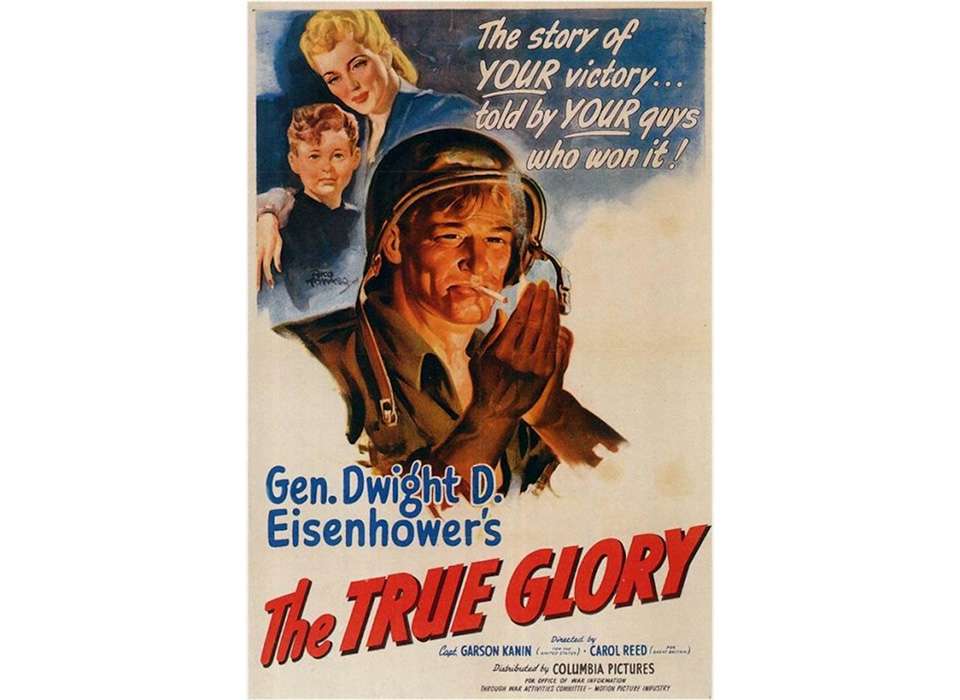
Top Photo: The True Glory (1945) movie poster. IMDb
When the Academy of Motion Picture Arts and Sciences awarded its prize for best feature documentary to The True Glory on March 7, 1946, they recognized a new kind of war documentary. From the start of World War II, films about the conflict dominated the Oscars’ nonfiction categories, and the winning entries combined dramatic voiceovers and reenactments with real combat footage shot by military cameramen. While previous winners such as The Battle of Midway (1943) and Desert Victory (1944) focused on specific battles, The True Glory was something different.
Featuring an introduction by Supreme Allied Commander Dwight D. Eisenhower, The True Glory chronicles the Allied liberation of Western Europe, from the preparations for Operation Overlord to the fall of Berlin. With minimal input from an omniscient narrator, the film primarily tells the story through the voices of ordinary Allied servicemembers, journalists, and civilians.
Instead of staged battle reenactments, The True Glory is composed almost entirely of footage shot by Allied combat cameramen, often during heavy fighting. The result is, in the words of New York Times film critic Bosley Crowther, “a brilliantly composed screen tribute to the courage and perseverance of our fighting men, as rich in its verbal narration as it is true in its visual images.”1
Building a Military Movie Infrastructure
During World War II, the US military turned to Hollywood for experts in making movies. Fortunately for the American government, the United States was home to one of the largest and most successful film industries in the world.
When the US military began recruiting filmmakers following America’s entry into World War II in December 1941, some of the most talented filmmakers of the 20th century eagerly answered the call. Among them were directors Frank Capra, John Ford, John Huston, George Stevens, and William Wyler. According to journalist Mark Harris, filmmakers could not win the war, but “they had already shown that they could win the people.” 2
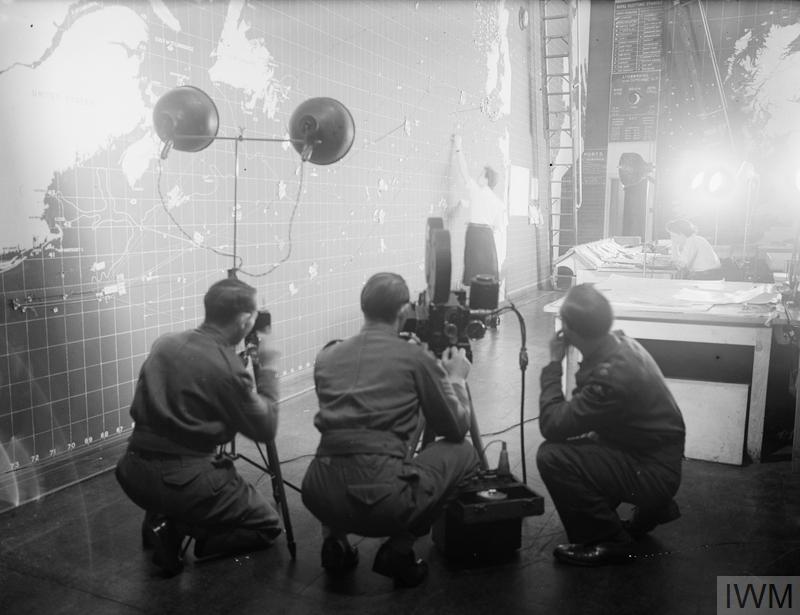
Army Film Unit cameramen filming a Wren marking a position on the chart in the Atlantic Battle Operations Room at Derby House, Liverpool, for use in "The True Glory", January 1945. The location is genuine, though a later caption says "The report on the board was an imaginary one". Imperial War Museums
The US military also trained and deployed thousands of combat photographers to war zones across the globe. These men served on the front lines alongside combat troops to capture scenes of battle and the daily lives of American servicemen and women, and many were killed or wounded by enemy fire. In his history of combat cameramen in World War II, historian Peter Maslowski estimates that the US Army and Navy each deployed more than 3,000 photographers and technicians in all theaters of the war.3 In September 1945, The New York Times reported that of more than 1,400 Allied cameramen on the Western Front, more than 130 were killed or wounded collecting footage that ended up in The True Glory.4
With so many cameramen recording the Allied war effort, they inevitably captured the most brutal and horrific aspects of combat, including the deaths of American servicemembers. In early September 1943, after meeting with Elmer Davis, director of the Office of War Information (OWI), President Franklin D. Roosevelt announced that the military would loosen restrictions on what battlefield images could be shown in the media.5 The Washington Post celebrated this decision to treat the American people as adults who “must be given the truth without regard to fears about how we may react to it.”6
Americans did not have long to wait before this decision brought home the realities of combat. In their September 20, 1943, issue, the editors of Life magazine printed a photograph of three American soldiers lying dead at Buna on the coast of New Guinea. Their reasoning, the editors wrote, was that words were never sufficient to convey the horrors of war: only images could show “the reality that lies behind the names that come to rest at last on monuments in the leafy squares of busy American towns.”7
A few months later, Americans saw an even more brutal vision of combat in the Pacific theater in the short documentary With the Marines at Tarawa. The film chronicles the assault by the 2nd Marine Division on the island of Betio in the Tarawa Atoll. Shot entirely by US Marine Corps combat cameramen, it includes numerous images of dead and wounded Marines and sailors. More than a thousand Americans died fighting to secure the island, including two Marine cameramen. Praised by one critic for recounting “in vivid detail and with full measure of the ugly, brutal facts the blistering and bloody two-day battle to wrest control of the tiny sand strip from the Japs,” With the Marines at Tarawa received the Oscar for best short documentary at the 1944 Academy Awards.8
Controversy Behind the Scenes: The Making of The True Glory
The project that evolved into The True Glory began as a smaller, much less ambitious film under the auspices of the Joint Anglo-American Film Planning Committee (JAAFPC). As American and Allied troops massed in Great Britain for the invasion of Europe, Allied commanders ordered JAAFPC to make a film that would chronicle Operation Overlord.
The film would be a joint American-British production, but tensions within the Western alliance quickly delayed the project. Like the broader pre-invasion military buildup, the American film operation in Great Britain grew larger and faster than its British counterpart. British officials feared that any film produced by JAAFPC would disproportionately reflect the American perspective and downplay Britain’s contribution to Allied victory.9
In October 1944, as Allied troops pushed into Germany, JAAFPC decided to shift its focus from Operation Overlord to the months-long campaign to liberate Europe from Nazi control. To underscore that the new film was a truly joint endeavor, Allied commanders tapped a British director, Carol Reed, and an American one, Garson Kanin—both experienced filmmakers—to produce the final product. In addition to changing the film’s scope, JAAFPC also decided to shift away from a standard command-level view to the perspective of the soldiers themselves. 10
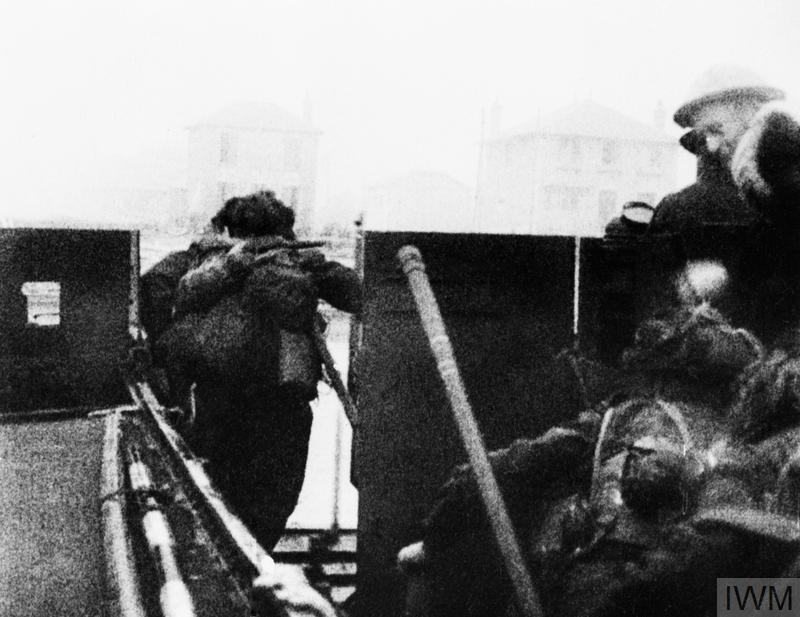
The Normandy Landings: Excerpts from "The True Glory". Operation NEPTUNE. Canadian infantrymen of the North Shore (New Brunswick) Regiment disembark from a Landing Craft Assault [LCA] onto 'Nan Red' Beach, JUNO Area, at la Rive, near St Aubin-sur-Mer, at about 8.05 am on 6 June 1944, while under fire from German troops in the houses facing them. Imperial War Museums
In addition to navigating delicate alliance politics, Reed and Kanin also had to assemble the film from millions of hours of footage shot by American, British, and other Allied combat cameramen along with testimonies from thousands of Allied servicemen and women interviewed for the project. As historian Frederic Krome notes, “In these circumstances it was truly a credit to their combined talents that Kanin and Reed were able to produce such a coherent and brilliantly edited film as The True Glory.”11 The film was completed in August 1945, just weeks before the end of World War II in the Pacific.
An Oscar-Worthy Achievement
In his introduction to the film, General Eisenhower lays out the scope of The True Glory. Instead of a tale of “brass hats” like himself, its focus would be on the ordinary soldiers, sailors, and airmen of the Allied Expeditionary Forces. Its thesis could be summed up in three words: “Teamwork wins wars.” “I mean teamwork,” Eisenhower continues, “among nations, services, and men.”
Eisenhower’s voice briefly reappears later in the film, but aside from him and a British narrator who periodically reminds viewers of the big picture of the war and its stakes, the bulk of the dialogue in The True Glory comes from the men and women who fought to achieve Allied victory. They ranged from American, British, and Canadian enlisted men and officers to US Army nurses and French civilians. Co-director Kanin and Sergeant Guy Trosper told The New York Times that they interviewed more than 3,000 Allied fighting men and produced more than 200,000 feet of sound, only 8,000 feet of which made it into the final cut of the film.12
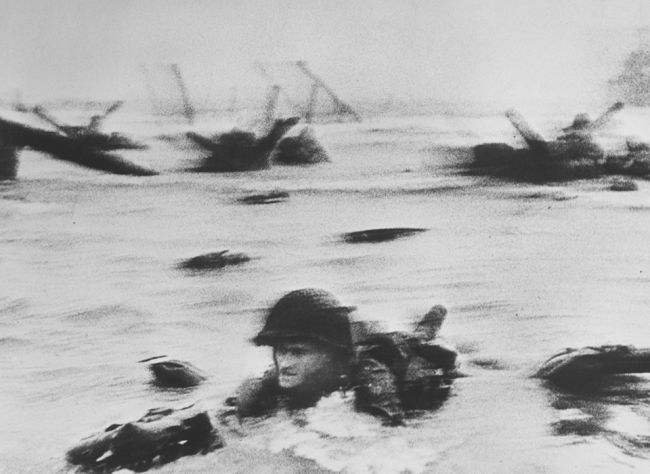
Like With the Marines at Tarawa, The True Glory features combat footage shot by American, British, and other Allied cameramen. In one of the film’s most shocking and memorable scenes, an American soldier is killed by enemy fire on Omaha Beach, a rare instance in which an American soldier’s death during World War II is captured on film.
Throughout the film, there are reminders that men and white Americans were not the only ones fighting the Nazis in Europe. Despite the Army’s policy of racial segregation, several shots capture African American soldiers operating trucks, tanks, and artillery. Others show American and British women as typists, tracking U-boats in the Atlantic Ocean, and working as nurses in the field. At one point, over footage of medics and surgeons treating wounded soldiers under fire and in a field hospital, an American nurse describes how hearing a radio report of a battle where American casualties had been “surprisingly light” contrasted sharply with her experience of trying and failing to save the life of a young American soldier badly wounded in the same engagement.
Some of the most shocking footage in The True Glory was taken by British cameramen at the Bergen-Belsen concentration camp. They captured scenes of rail-thin survivors thanking their liberators and dead bodies being thrown into a mass grave. A British voice describes how he had never seen anything like it in either his civilian life or past military service.
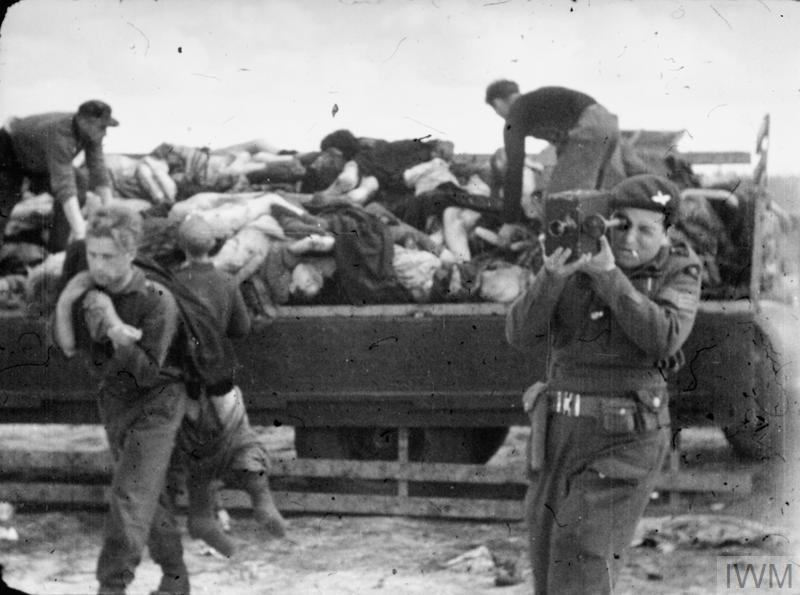
In a frame from the film THE TRUE GLORY, a British Army Film and Photographic Unit cameraman and photographer, Sgt Mike Lewis, is caught on camera as he films the burial of the dead following the liberation of the concentration camp at Bergen-Belsen. Imperial War Museums
For all its disturbing imagery, The True Glory ends on an optimistic note. In its final minutes, an American soldier states that no country could have won the war alone, and anyone who wanted to claim sole credit for victory over Nazi Germany was “nuts.” The last participant voice is another American soldier saying that, in the end, the victors have won “a chance to build a free world, better than before, maybe the last chance. Remember that.”
The True Glory ends with a recitation of the prayer that gave the film its title. Attributed to the English explorer Sir Francis Drake, it reads in part: “Grant us also to know that it is not the beginning, but the continuing of the same unto the end, until it be thoroughly finished, which yieldeth the true glory.”
Eight decades later, The True Glory remains a compelling documentary. To commemorate the 70th anniversary of D-Day, experts from the National Archives methodically restored it to preserve this important account of the final months of World War II in Europe.13
- 1
Bosley Crowther, “Epic Allied Victory Over Germany Detailed in Film ‘The True Glory,’” The New York Times, September 7, 1945.
- 2
Mark Harris, Five Came Back: A Story of Hollywood and the Second World War (New York: Penguin, 2014), 11.
- 3
Peter Maslowski, Armed with Cameras: The American Military Photographers of World War II (New York: The Free Press, 1993), 305.
- 4
Leonard Spinard, “They Also Served: How the Army’s Anonymous but Intrepid Combat Camera Men Filmed the War,” The New York Times, September 2, 1945.
- 5
“Davis at Work: U.S. Public to Get More War News,” Washington Post, September 1, 1943.
- 6
“War Information,” The Washington Post, September 11, 1943.
- 7
“Three Americans. Where These Boys Fell, A Part of Freedom Fell: We Must Resurrect It in their Name,” Life Magazine, Vol. 15, No. 12 (September 20, 1943), 34-35.
- 8
“Marines’ Own Film of Tarawa Is Shown: Two-Reel Documentary Depicts Vividly Battle for Sand Strip,” The New York Times, March 3, 1944.
- 9
James Chapman, “‘The Yanks Are Shown to Such Advantage:’ Anglo-American rivalry in the production of ‘The True Glory,’” Historical Journal of Film, Radio, and Television, Vol. 16, No. 4 (1996), 540.
- 10
Frederic Krome, “The True Glory and the Failure of Anglo-American Film Propaganda in the Second World War,” Journal of Contemporary History, Vol. 33, No. 1 (January 1998), 29-31.
- 11
Krome, “The True Glory and the Failure of Anglo-American Film Propaganda in the Second World War,” 32.
- 12
A.H. Weiler, “Voices of ‘Glory’ and Other Items,” The New York Times, September 16, 1945.
- 13
“The Unwritten Record: Restoring The True Glory,” National Archives, May 29, 2014. (URL: https://unwritten-record.blogs.archives.gov/2014/05/29/restoring-the-true-glory/). Accessed 2/13/2026.

Sean Scanlon, PhD
Sean Scanlon is a World War II Military Historian at the Jenny Craig Institute for the Study of War and Democracy.
Cite this article:
MLA Citation:
APA Citation:
Chicago Style Citation: