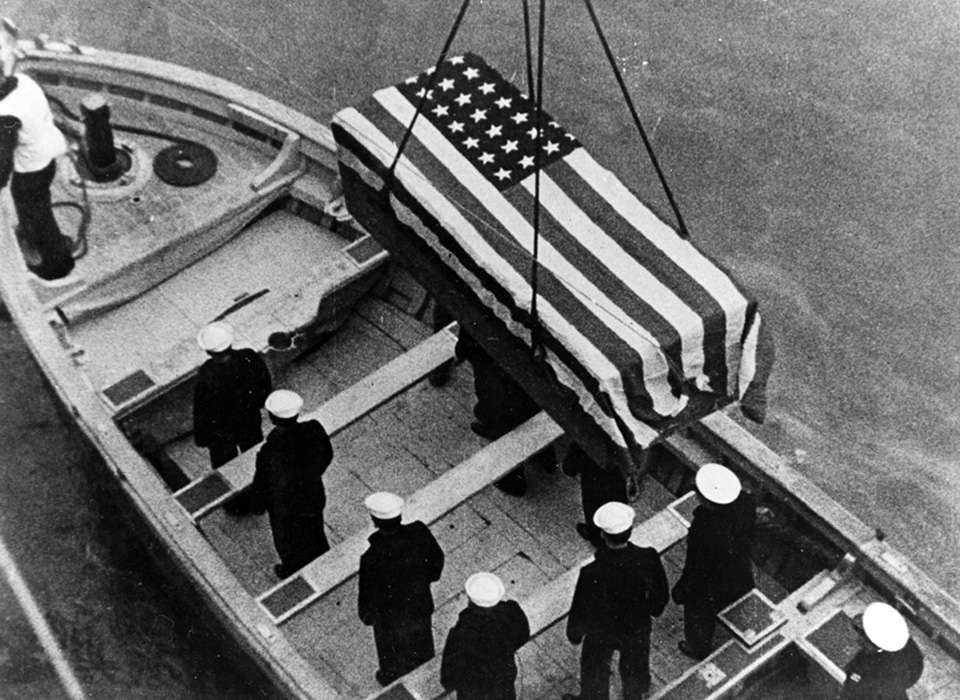
Top Photo: View of the coffin of an American sailor killed in the Japanese bombing of USS Panay on December 12, 1937, being hoisted aboard the Asiatic fleet flagship, USS Augusta (CA-31), Shanghai, China, December 17, 1937. Naval History and Heritage Command
On August 30, 1937, Secretary of State Cordell Hull sent a message to Joseph Grew, the US ambassador to Japan. American diplomats in Nanking, China, warned that Japan’s intensifying war in China endangered American military personnel and civilians in that unstable country: “Sooner or later,” they predicted, “some incident is going to happen resulting in the death or injury to American citizens going about their legitimate occupations within the interior of China where such dangers should not exist.”1 Hull urged Ambassador Grew to convey the US government’s concerns to Japanese leaders.
After meeting with Japanese Foreign Minister Koki Hirota the following day, Grew told his superiors in Washington that he “felt a daily dread that some serious incident might occur in China arising out of the indiscriminate bombing operations of the Japanese forces which might result in the injury or death of American citizens.” Such an incident, Grew observed, “would exert a most unfortunate effect on Japanese–American relations because it could not fail to enflame public opinion in the United States.” According to Grew, Hirota tried to reassure the Americans that Japanese forces only attacked military targets but also warned that “sometimes the bombs failed to reach their precise objectives and accidents happened.”2
Just over three months later, Grew’s fears became reality when Japanese aircraft attacked and sank the USS Panay, an American gunboat from the Yangtze Patrol squadron. The events leading up to this attack illustrate the long and complicated relationship between the United States and China since the 19th century and rising tensions between America and Japan in the years before the outbreak of World War II.
The Origins of the Yangtze River Patrol
In the early 20th century, Americans felt a deep attachment to China. From diplomats and soldiers to missionaries and businessmen, many Americans had close ties to the country. In the words of historian Gordon Chang, many Americans “believed that China’s destiny lay very much in the hands of America. It was America’s destiny, many believed, to be China’s friend, protector, benefactor, and savior.”3 Policymakers saw America’s role as guaranteeing China’s sovereignty and maintaining an “open door” for the United States and others to trade with China.
With thousands of Americans and foreign nationals living in and traveling around China, the United States stationed hundreds of military personnel around the country to provide security and ensure that US interests were protected. An important contingent of those forces was the Yangtze Patrol, a squadron of gunboats operating along the Yangtze River, the longest river in Asia and the third-longest in the world. Known informally as YangPat, the unit’s roots stretched back to the mid-19th century, but the Yangtze Patrol was formally established in 1919 as part of the US Navy’s Asiatic Fleet. In 1928, the Yangtze Patrol received six new gunboats, including the USS Panay. Built in the Kiangnan Shipyard in Shanghai, each flat-bottomed boat was lightly armed and carried a standard crew of at least 50 officers and enlisted sailors.4
YangPat’s duty station was far from the United States and more glamorous assignments aboard larger ships, but many Navy officers and enlisted men were eager to join the squadron. Their small salaries went further in China than in the United States, and for much of its existence, duty in China had been a relatively safe assignment. As journalist Hamilton Darby Perry put it, a transfer to the Yangtze Patrol was “largely sought after, hard to come by, [and] not easily chucked away.”5
Yet by the late 1930s, China was becoming increasingly dangerous for American military personnel. Aiming to become a major Asian land power and to seize vital natural resources for its growing economy and empire, Japan launched a new phase of its expansionist war in China in July 1937. After putting up stiff resistance for several weeks, Chinese forces withdrew from Shanghai, and the city fell in late October.
Given the deteriorating security situation, the American embassy in China advised all citizens to leave the capital Nanking. As Japanese forces advanced, the Nationalist Chinese government under Chiang Kai-shek fled the city. Throughout December 1937 and January 1938, Japanese troops committed massive atrocities against Chinese civilians. By the end of 1937, the Japanese had 16 divisions and more than 600,000 troops in China but still struggled to achieve a decisive victory over Chinese forces. 6
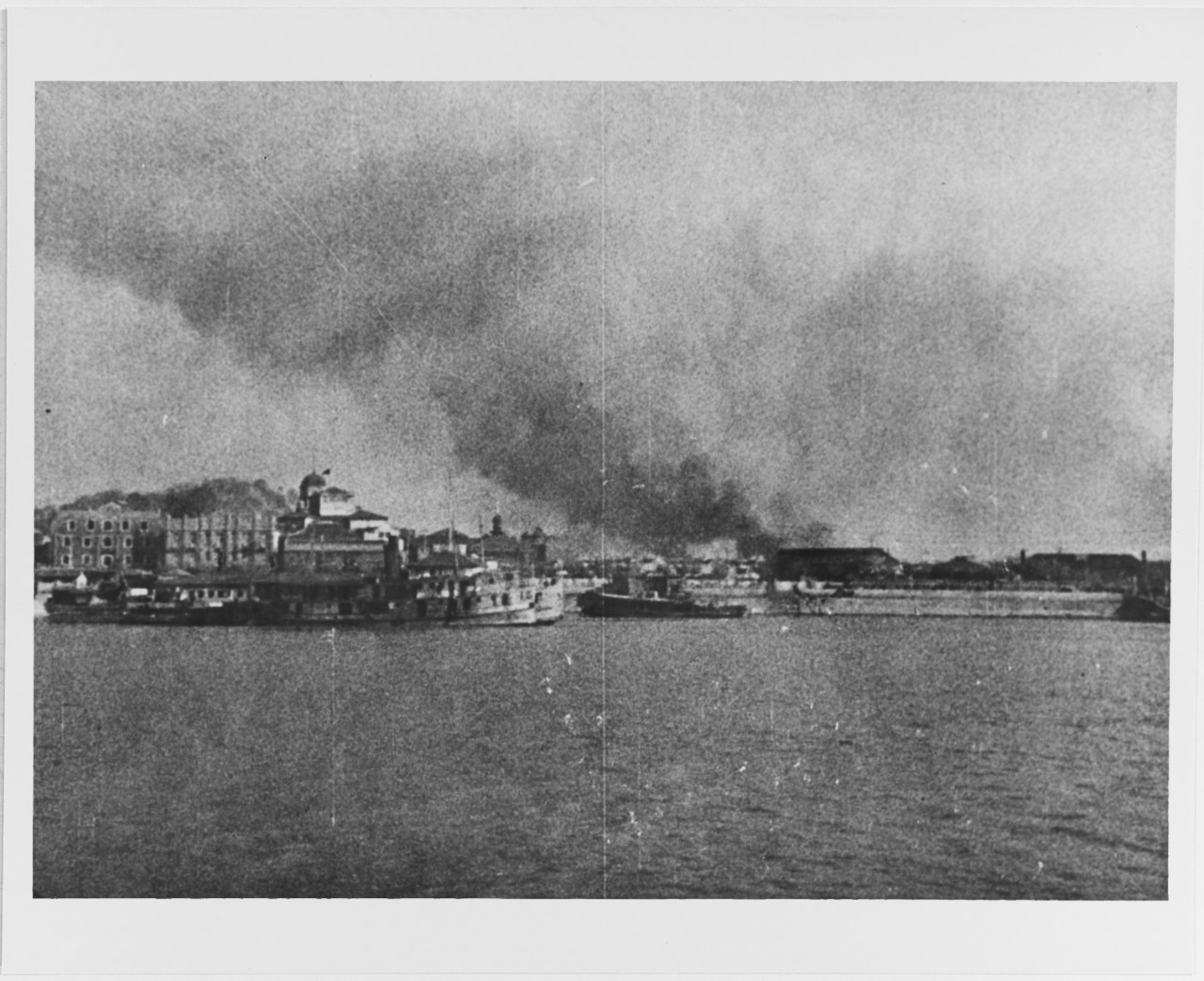
View of the Nanking waterfront on December 12, 1937, taken from the USS Panay. Naval History and Heritage Command
The Events of December 12, 1937
Early on the morning of December 12, 1937, the Panay was anchored 15 miles up the Yangtze River from Nanking. Her orders were to safeguard Americans and other foreign nationals, including diplomats and several journalists, who recently fled violence in the city. The Panay was also escorting three oil tankers from the Standard Oil Company, Mei Ping, Mei Hsia, and Mei An. According to an official report by the ship’s captain, Commander J.J. Hughes, the Panay displayed several large US flags to convey to any observer that this was an American ship.7
Around 8:14 a.m., artillery shells fell several hundred yards off the Panay’s starboard beam, and Hughes ordered his crew to move the ship to a safer location approximately 13 miles farther upriver from their previous position. An American diplomat aboard the Panay, George Atcheson, sent a message to the US ambassador in China asking him to inform Japanese authorities about the Panay’s change of position.8 He and the other Americans hoped that if the Japanese knew their position and intentions, they would be safe. However, it is unlikely that this information ever made it to local Japanese military commanders.
Less than two hours later at around 9:40 a.m., Japanese soldiers boarded the Panay and demanded to know her mission. Hughes explained to the Japanese commanding officer that the Panay was a neutral vessel evacuating foreigners and escorting American-flagged ships. Satisfied, the soldiers returned to shore and the Panay continued her mission, but this would not be the last encounter the Panay had that day with Japanese military forces.
Later that afternoon, at around 1:27 p.m., lookouts aboard the Panay spotted several aircraft; moments later, a bomb hit the American vessel. The explosion destroyed the Panay’s main 3-inch gun in the bow and badly damaged the pilot house and radio equipment. It also wounded Hughes, but he remained in command and ordered his crew to return fire and assess the damage.
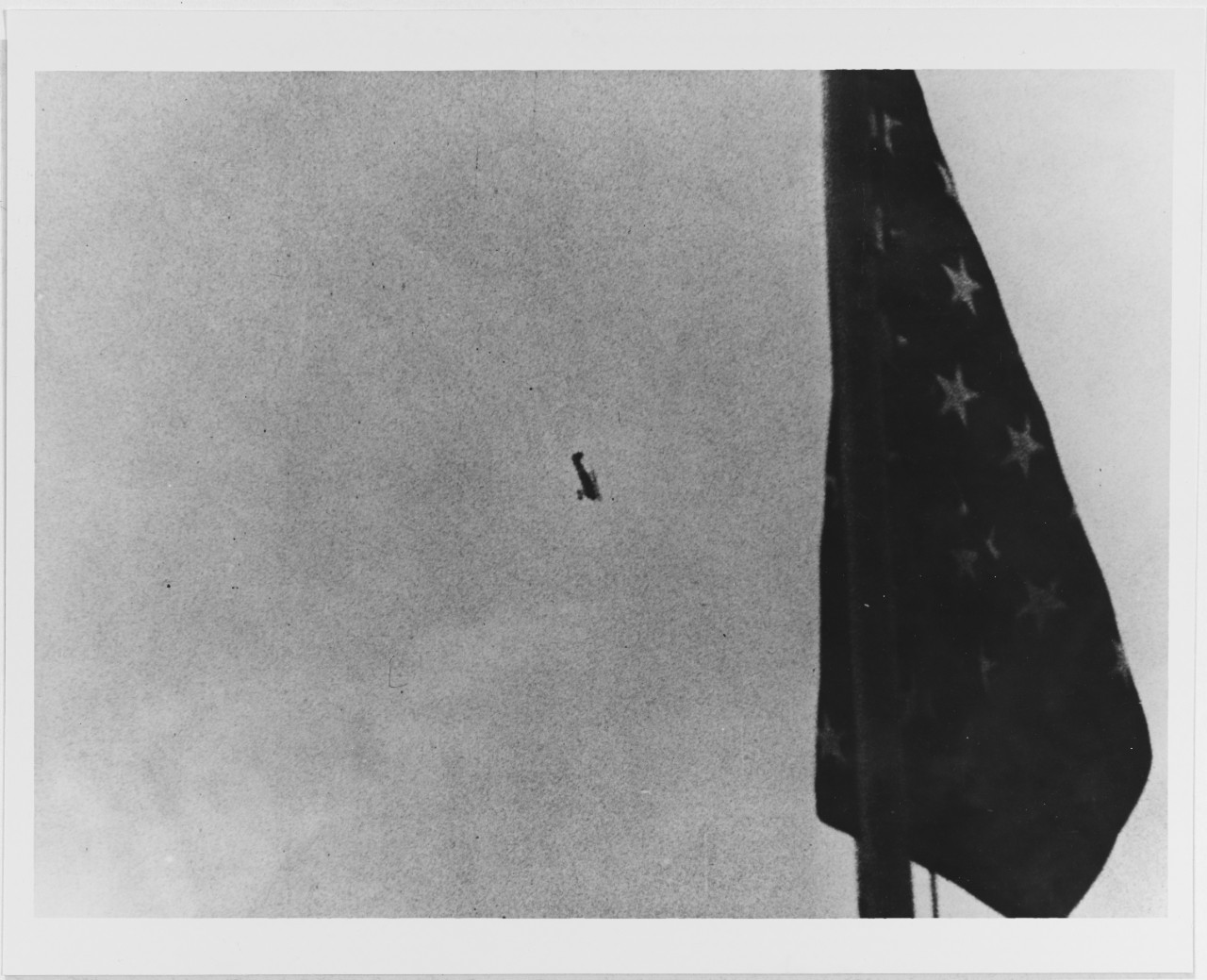
View of attacking Japanese plane off the port bow, on the Yangtze River between Nanking and Wuhu, China, on 12 December 1937, Naval History and Heritage Command
From the beginning, there was no doubt that it was Japanese aircraft attacking the Panay. The attacking force included medium bombers, flying at more than 10,000 feet, and dive bombers, who came in at a much lower level. While it was the dive bombers who were first spotted by the American lookouts, it was bombs from higher up that first struck the Panay.
One of the Japanese pilots who took part in the attack on the Panay was Masatake Okumiya. Unlike many of his contemporaries, Okumiya survived World War II, and after the war he provided a detailed description of the attack on the Panay from the Japanese perspective. In his account, which was published in the US Navy journal Proceedings, he revealed that his unit, the Imperial Japanese Navy’s 2nd Combined Air Group, arrived in China just eight days before the attack. Reports of boats carrying Chinese troops up the Yangtze reached the pilots’ base at Changchow, where rumors were already circulating among the excited pilots that a successful attack would earn them a unit citation. 9
Okumiya recalled that, despite a standing order not to strike boats on the Yangtze for fear of striking a neutral foreign vessel, they were ordered to attack a group of boats on December 12, which they believed were merchant vessels carrying Chinese soldiers. Okumiya recalled that “having complete faith in [Japanese] Army intelligence, and seeing small boats plying between the ships and a dock, I was convinced that these vessels were loaded with enemy troops and pointed them out to the other pilots of my squadron who seemed to go wild with joy.”10
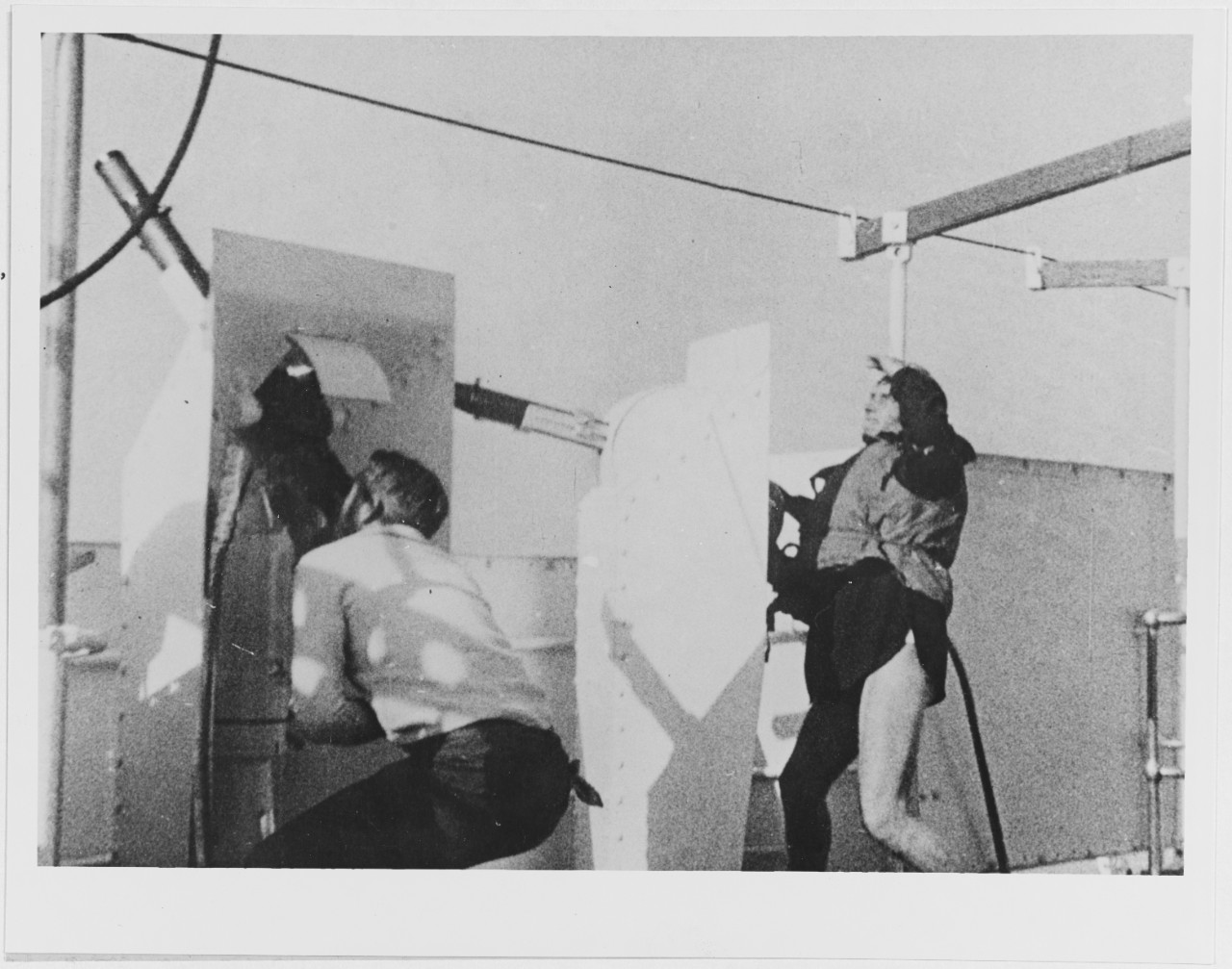
Gunners firing back at attacking Japanese planes, December 12, 1937, on the Yangtze River between Nanking and Wuhu, China. USN, Naval History and Heritage Command
Altogether, the attacks on the Panay lasted around an hour, during which her crew tried to contain the damage and treat the wounded. Several sailors fired back ineffectively at the attacking Japanese planes with the Panay’s Lewis machine guns.
Amid all this activity, American correspondent Norman Alley filmed the attack on a hand-held camera. As he recalled years later in his memoir, he kept filming because “it was a welcome something to divert my constant thought of a sudden obliteration of all of us.”11 When the attack was over, Alley’s film was rushed back to the United States, where it was shown to senior American government officials and later the American public.
At around 2:00 p.m., the wounded Commander Hughes gave the order to abandon ship. While still under attack, the crew of the Panay used their two small boats to ferry passengers and crew off the ship, starting with the seriously wounded. By 4:00 p.m., the Panay was almost fully submerged.
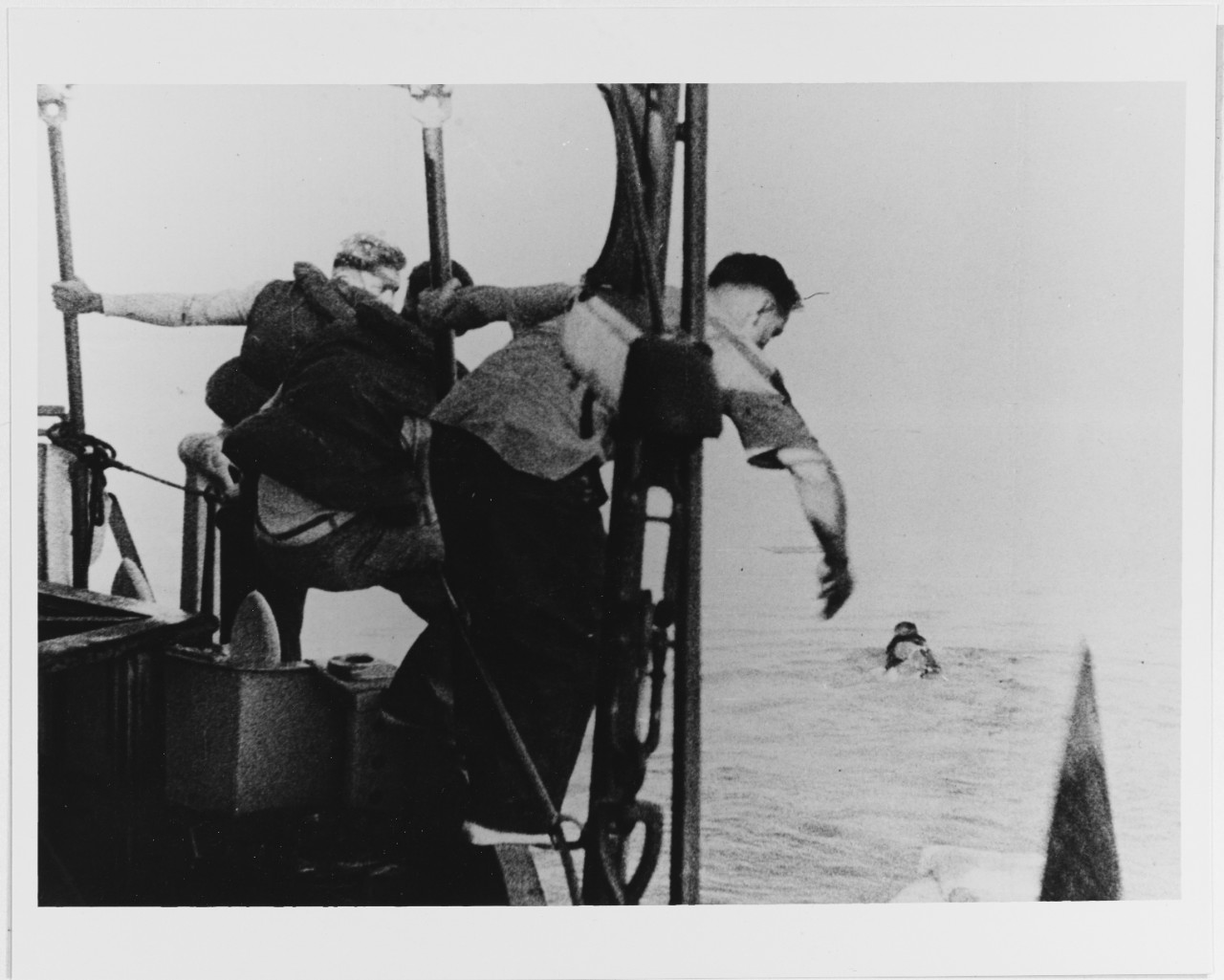
Crew members of the USS Panay abandoning ship after being bombed by Japanese planes on December 12, 1937. Naval History and Heritage Command
Once ashore, American sailors and their passengers treated the wounded and sought shelter. Because of his wounds, Hughes turned to several of his passengers for assistance: diplomat George Atcheson and US Army Captain Frank Roberts, an American military attaché in China. Together, Acheson and Roberts, who both spoke Chinese, sought help from a nearby village and arranged transportation for the Panay’s crew and passengers to and from the village of Hanshan.
On the night of December 14, two days after the attack, the survivors were picked up by the Panay’s sistership, USS Oahu, and a British vessel, HMS Ladybird. In all, the Japanese attack killed two sailors, an Italian journalist, and wounded over 30 American sailors.
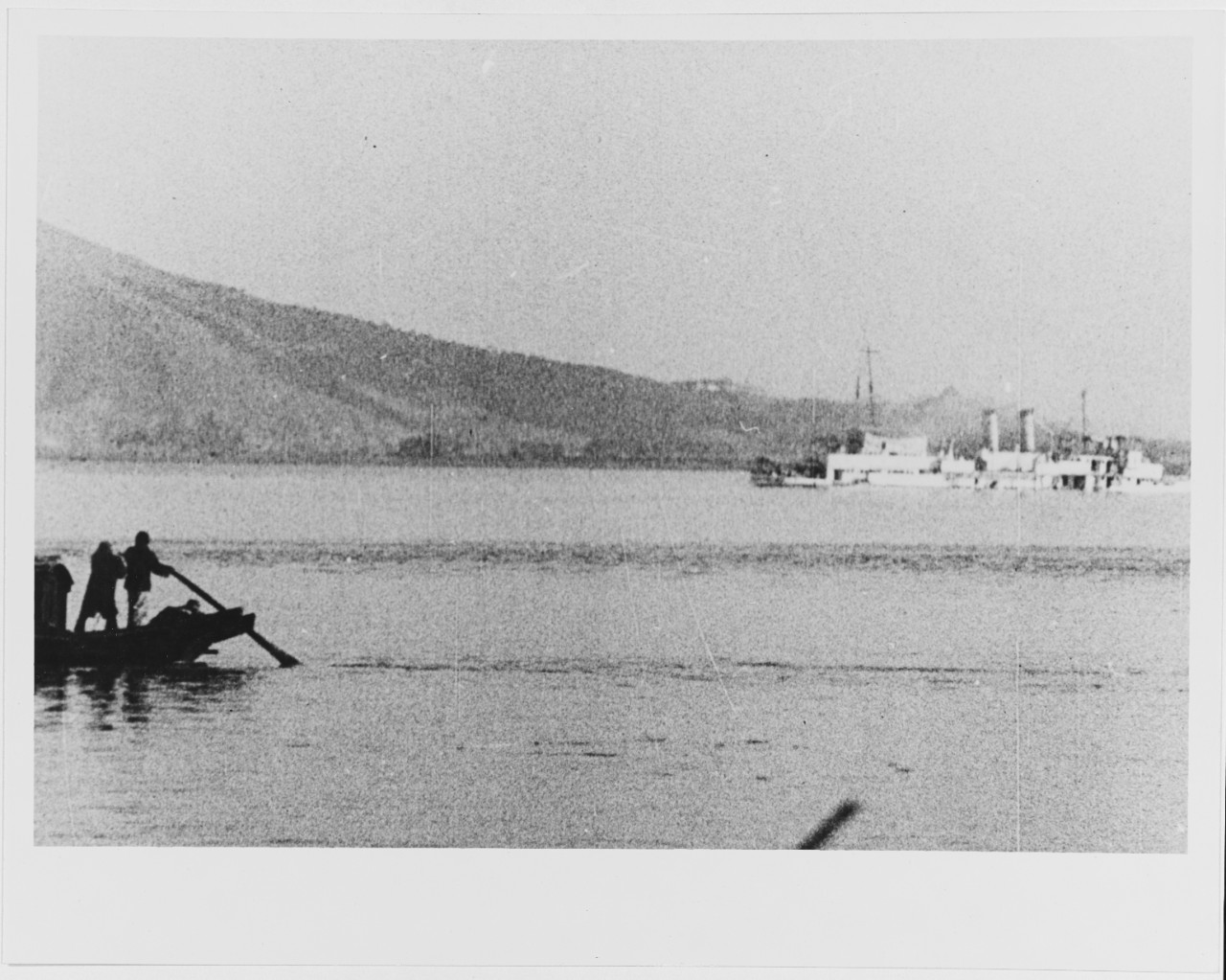
View of the USS Panay sinking in the Yangtze River between Nanking and Wuhu, China, after being bombed by Japanese planes on December 12, 1937. Naval History and Heritage Command
As the survivors of the Panay were being rescued, Japanese violence against Chinese civilians continued in Nanking. On December 18, less a week after the attack on the Panay, reporter F. Tillman Durdin wrote in The New York Times that “wholesale looting, the violation of women, the murder of civilians, the eviction of Chinse from their homes, mass executions of war prisoners and the impressing of able-bodied men turned Nanking into a city of terror.”12 Less than a month later, Life magazine published graphic photographs of Japanese atrocities in Nanking, which the magazine called “quite possibly the worst holocaust in modern history.”13
Consequences and Legacy
Realizing the enormity of what happened, senior Japanese government officials immediately met with their American counterparts to apologize for the attack on the Panay. In Tokyo, Foreign Minister Hirota went personally to Ambassador Grew’s residence to convey the Japanese government’s “profound apology” for what happened to the Panay and tell the American ambassador, “I cannot possibly express how badly we feel about this.”14 Recalling the attack more than 15 years later, Okumiya, the pilot, wrote that the Panay attack was “solely the result of a terrible mistake.”15
American officials received the Japanese apologies before they fully understood what had happened to the Panay. In the US government’s first official response to the Panay attack, Secretary of State Hull said that the United States was “deeply shocked” by the attack, and that it expected Japan to apologize, compensate the US for the loss of the Panay, its crew, and its passengers, and take steps to ensure that such an attack never happened again.16
Officials in President Franklin D. Roosevelt’s administration were not the only ones alarmed by the attack on the Panay. So too were Americans wary of greater US military involvement overseas who sought to limit the president’s authority to conduct foreign policy.
On December 16, 1937, just four days after the attack, more than 200 members of the House of Representatives voted to advance the Ludlow Resolution. Named for Indiana Congressman Louis Ludlow, the proposed Constitutional amendment would require the president to put any proposed declaration of war to a vote by the American electorate, “except in the event of an invasion of the United States or its territorial possessions and attack upon its citizens residing therein.”17 The resolution failed when it came up for a vote in the House in early 1938, but it was a reminder of how strong anti-interventionist sentiment was in the United States in the late 1930s.
Ordinary Japanese citizens also reached out to the Americans to apologize for the attack on the Panay. Some even sent sums of money that they hoped would be sent to the families of the victims aboard the Panay. As Ambassador Grew recorded in his diary on December 20, 1937, “we have been deluged by delegations, visitors, letters, and contributions of money—people from all walks of life, from high officials, doctors, professors, business men down to school children, trying to express their shame, apologies, and regrets for the action of their own Navy.”18 Grew saw these gestures as evidence that there were “two Japans,” one the official government that was increasingly hostile to the United States, and the other the people of Japan, who wanted peace.19
The attack on the Panay sank an American warship and killed or wounded dozens of US sailors, but the incident did not bring the United States and Japan to the brink of war. Since the attack took place deep inside Chinese territory at a time when the US was still dealing with the Great Depression, the Roosevelt administration had few good military options available, and the American people had little appetite for a confrontation with Japan.
With the Japanese apology and promises of restitution in hand, President Roosevelt chose not to take any further steps to punish Japan.20 After months of talks, US officials informed the Japanese that the US was prepared to accept approximately $2.2 million as compensation for Japan’s actions.21 In April 1938, the Japanese government officially delivered a check to the American embassy for that amount.22
Although the attack on the Panay did not ignite a war between the United States and Japan, it marked a turning point in their relationship. In attacking an American-flagged ship during its military operations in China, the Japanese signaled a greater willingness to take risks as they pursued their geopolitical objectives in China. As historian Dorothy Borg wrote, “in most other respects the situation in the Far East grew worse, if anything, after the settlement had been concluded.”23
- 1
Telegram from the Secretary of State (Hull) to the Ambassador in Japan (Grew), August 30, 1937, Foreign Relations of the United States (FRUS), Japan, 1931-1941, Volume I (Washington, D.C.: U.S. Government Printing Office, 1943). (URL: https://history.state.gov/historicaldocuments/frus1931-41v01). Accessed11/7/2025.
- 2
Memorandum by the Ambassador in Japan (Grew), September 1, 1937, FRUS, Japan, 1931-1941, Volume I (Washington, D.C.: U.S. Government Printing Office, 1943). (URL: https://history.state.gov/historicaldocuments/frus1931-41v01/d341). Accessed 11/7/2025.
- 3
Gordon Chang, Fateful Ties: A History of America’s Preoccupation with China (Cambridge, MA: Harvard University Press, 2015), 5.
- 4
Kemp Tolley, Yangtze Patrol: The U.S. Navy in China (Annapolis, MD: Naval Institute Press, 1971), 16, 58, 71, 84, 97, and 180.
- 5
Perry, The Panay Incident: Prelude to Pearl Harbor (The MacMillan Company, 1969), 8.
- 6
Richard B. Frank, Tower of Skulls: A History of the Asia-Pacific War, July 1937-May 1942 (New York: W.W. Norton & Company, 2020), 65.
- 7
Radio Bulletin: Report of Commander J.J. Hughes, US Navy, to the Secretary of the Navy, December 27, 1937. (URL: https://www.ibiblio.org/hyperwar/USN/ships/logs/PR/PR-5_Panay-Radio-Bulletin.htm). Accessed 11/12/2025.
- 8
The Ambassador in China (Johnson) to the Secretary of State, December 12, 1937, FRUS, Diplomatic Papers, 1937, Volume IV: The Far East (Washington, D.C.: U.S. Government Printing Office, 1954). (URL: https://history.state.gov/historicaldocuments/frus1937v04). Accessed 11/13/2025.
- 9
Masatake Okumiya, with Roger Pineay, “How the Panay Was Sunk,” Proceedings, Vol. 79/6/604 (June 1953). (URL: https://www.usni.org/magazines/proceedings/1953/june/how-panay-was-sunk). Accessed 11/14/2025.
- 10
Masatake Okumiya, with Roger Pineay, “How the Panay Was Sunk,” Proceedings, Vol. 79/6/604 (June 1953). (URL: https://www.usni.org/magazines/proceedings/1953/june/how-panay-was-sunk). Accessed 11/14/2025.
- 11
Norman Alley, I Witness (New York: Wilfred Funk, 1941), 267.
- 12
F. Tillman Durdin, “All Captives Slain,” The New York Times, December 18, 1937.
- 13
“The Camera Overseas: The Japanese Conquest Brings ‘A Week of Hell’ to China’s Nationalist Capital of Nanking,” Life, Vol. 4, No. 2 (January 10, 1938), pp. 51.
- 14
The Ambassador in Japan (Grew) to the Secretary of State (Hull), December 13, 1937, FRUS, Japan, 1931-1941, Volume I (Washington, D.C.: U.S. Government Printing Office, 1943). (URL: https://history.state.gov/historicaldocuments/frus1937v04/d637). Accessed 11/14/2025.
- 15
Masatake Okumiya, with Roger Pineay, “How the Panay Was Sunk,” Proceedings, Vol. 79/6/604 (June 1953). (URL: https://www.usni.org/magazines/proceedings/1953/june/how-panay-was-sunk). Accessed 11/14/2025.
- 16
The Secretary of State to the Ambassador in Japan (Grew), December 13, 1937, FRUS, Japan, 1931-1941, Volume I (Washington, D.C.: U.S. Government Printing Office, 1943). (URL: https://history.state.gov/historicaldocuments/frus1931-41v01/d375). Accessed 11/18/2025.
- 17
“The Ludlow Resolution,” The New York Times, December 16, 1937.
- 18
Ten Years in Japan: A Contemporary Record Drawn from the Diaries and Private and Official Papers of Joseph C. Grew, United States Ambassador to Japan 1932-1942 (London: Hamond, Hamond & Company Limited, 1945), 207.
- 19
Trevor K. Plante, “‘Two Japans:’ Japanese Expressions of Sympathy and Regret in the Wake of the Panay Incident,” Prologue. Vol. 33, No. 2 (Summer 2001). (URL: https://www.archives.gov/publications/prologue/2001/summer/two-japans-1). Accessed 11/14/2025.
- 20
Robert Dallek, Franklin D. Roosevelt and American Foreign Policy, 1932-1945 (New York: Oxford University Press, 1979), 154-155.
- 21
The Secretary of State to the Ambassador in Japan (Grew), March 19, 1938, FRUS, Japan, 1931-1941, Volume I (Washington, D.C.: U.S. Government Printing Office, 1943). (URL: https://history.state.gov/historicaldocuments/frus1931-41v01/d401). Accessed 11/18/2025.
- 22
The Ambassador in Japan (Grew) to the Secretary of State, April 22, 1938, FRUS, Japan, 1931-1941, Volume I (Washington, D.C.: U.S. Government Printing Office, 1943). (URL: https://history.state.gov/historicaldocuments/frus1931-41v01/d407). Accessed 11/18/2025.
- 23
Dorothy Borg, The United States and the Far Eastern Crisis of 1933-1938: From the Manchurian Incident Through the Initial Stage of the Undeclared Sino-Japanese War (Cambridge, MA: Harvard University Press, 1964), 504.
Further Reading:
- Dorothy Borg, The United States and the Far Eastern Crisis of 1933-1938: From the Manchurian Incident Through the Initial Stage of the Undeclared Sino-Japanese War (Cambridge, MA: Harvard University Press, 1964)
- Gordon Chang, Fateful Ties: A History of America’s Preoccupation with China (Cambridge, MA: Harvard University Press, 2015)
- Robert Dallek, Franklin D. Roosevelt and American Foreign Policy, 1932-1945 (New York: Oxford University Press, 1979)
- Richard B. Frank, Tower of Skulls: A History of the Asia-Pacific War, July 1937-May 1942 (New York: W.W. Norton & Company, 2020)

Sean Scanlon, PhD
Sean Scanlon is a World War II Military Historian at the Jenny Craig Institute for the Study of War and Democracy.
Cite this article:
MLA Citation:
APA Citation:
Chicago Style Citation: