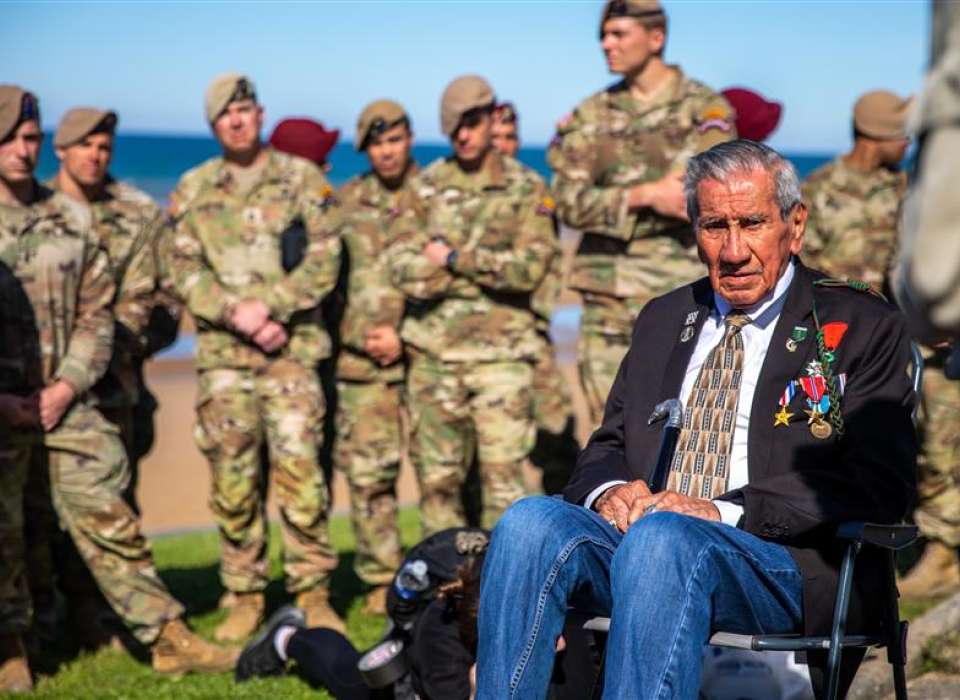
Top Photo: Decorated D-Day veteran Charles Norman Shay.
The National WWII Museum mourns the loss of WWII veteran and dear friend Charles Norman Shay, who passed away on December 3, 2025, at age 101. A US Army medic during the D-Day landings at Normandy, Shay was awarded the Silver Star for his actions on Omaha Beach on June 6, 1944.
Shay was born in Bristol, Connecticut, on June 27, 1924, as one of nine children and a member of the Penobscot Nation. The family moved back to their ancestral reservation in Maine when Shay was just five years old. In 1943, one year after graduating from high school, he was drafted into the Army.
Shay was just 19 years old when he landed on Easy Red sector of Omaha Beach in the first wave of the invasion as a combat medic with F Company, 16th Infantry Regiment, 1st Infantry Division—also known as “the Big Red One.” Shay waded through chest-deep water under intense machine gun fire, later recalling the surf being red with blood from the dead and wounded.
According to the Library of Congress, Shay was one of approximately 500 Native Americans who took part in the Normandy invasion and one of some 175 on Omaha Beach.
Shay wasted no time upon landing on the beach, where he began treating his wounded comrades. Noticing injured men struggling in the high tide, Shay exposed himself to enemy fire and dragged fellow soldiers of the Big Red One out of the water and onto higher ground to administer first aid. For these actions on Omaha Beach, Shay was awarded the Silver Star, the nation’s third-highest award for valor on the battlefield. France would bestow Shay with the Legion of Honor in 2007 for his bravery on D-Day.
After D-Day, Shay continued to serve in the European theater, where he treated the wounded and tended to his injured fellow soldiers in the Battles of Aachen, the Hürtgen Forest, and the Bulge. In March 1945, he was selected for a special mission attached to a reconnaissance squad near the Sieg River to conduct surveillance on a village occupied by German troops. The squad was captured by the Germans and forced to march nearly 60 miles to Stalag 6G, where Shay survived on minimal food and water until he was liberated by American troops in April 1945.
Following World War II, Shay again served as a combat medic during the Korean War, earning a Bronze Star. He retired with the rank of Master Sergeant. Later in life, Shay worked tirelessly to recognize the contributions of Native Americans during World War II.
In 2009, Shay was featured in The National WWII Museum’s General Raymond E. Mason Jr. Distinguished Lecture Series and spoke about his wartime service as a combat medic with the 1st Infantry Division. He joined the Museum again for the 2010 International Conference on World War II, presenting on what his experience was like as a Native American medic with 1st Infantry Division at Omaha Beach. He also published a memoir entitled Project Omaha Beach. Shay moved to France in 2018, where he lived until his death.
We are grateful for Master Sergeant Shay’s service and friendship.