War Clouds
 |
The
generation of Americans who came to
adulthood during the 1930s grew up in
a world shadowed by extraordinary economic
and military threats.
A
financial depression gripped much
of the globe, throwing millions out
of work. In some countries, economic
hardship contributed to the power
and appeal of political extremists.
These leaders offered simple solutions
to their countries' problems, solutions
that included extreme nationalism,
military expansion, and doctrines
of racial superiority.
In Germany, Adolf
Hitler created a fascist state that
threatened the peace of Europe. Hitler
renounced treaty obligations, began
a rapid arms buildup, and made territorial
demands on Germany's neighbors. He
and the Italian dictator Benito Mussolini
joined their nations in a military
union.
In Asia, another
militarized state expanded its borders.
Early in the 1930s Japan, hungry for
land and raw materials, seized Manchuria.
Soon it set its sights on further
expansion in China and Southeast Asia.
Separated by
two oceans from these troubles, Americans
hoped to isolate themselves from war.
Yet at the end of this troubled decade
their lives were profoundly altered
by events that unfolded far from home.
Imbalance of Power
 |
The world of the 1930s was one of extremes.
In Japan, Germany,
and Italy, violently nationalistic
leaders were at work building formidable
war machines. They used their military
power to threaten other countries.
Threats soon gave way to hostilities,
and the people of Europe and Asia
lived increasingly in the shadow of
hatred and oppression.
A far different
attitude towards war existed in the
United States. Situated between Europe
and Asia, America had a small peacetime
army and a deep unwillingness to be
drawn into another global conflict.
Americans were content in their isolation.
Many were coping with the harsh realities
of the Depression. Few wanted to get
involved in troubles overseas.
But it was impossible
to ignore events taking place around
the world. Some Americans harbored
growing concerns that these events
could pose a threat to the United
States. Still, isolationist sentiment
remained strong. Bowing to popular
pressure, President Franklin D. Roosevelt
signed the Neutrality Acts, which
kept the country in a passive position.
Meanwhile,
the German, Japanese, and Italian
armed forces continued to grow. By
1939 it was clear that the United
States was at a grave military disadvantage.
Should it be drawn into war, it
would face a difficult situation.
Germany's Expansion
During the 1930s
Germany and Japan expanded their armed
forces with astonishing speed, through
conscription and massive production
programs. Military expenditures skyrocketed,
especially in Germany. By 1939 the armies
and air forces of both countries dwarfed
those of the United States. Even Italy,
whose army was only a fraction of the
size of Germany's and Japan's, had more
troops than the United States. America's
only strength was its navy, which served,
with the Atlantic and Pacific Oceans,
as the nation's main line of defense.
Japan
At the start of the
1930s Japan was an overcrowded nation
heavily dependent on foreign imports
of food and raw materials. In 1931
ultranationalists pushed the country
to seize the Chinese province of Manchuria.
As the decade progressed, the military
increasingly dominated Japan's economy
and government. The army grew enormously
and the navy boasted aircraft carriers,
powerful battleships, and strong air
and submarine forces. In 1937 Japan
entered a full-scale war with China.
But American and British presence
in the region hindered Japan's ambitions
in Southeast Asia. War production
accelerated in anticipation of future
conflicts.
United
States
After World War I the United States returned
to its traditional policy of isolation from
armed conflicts abroad. America's military
was reduced drastically. During the 1920s
and 1930s its strength remained low. Even
as war loomed in Europe and Asia, America
made little effort to mobilize. In 1939
the United States armed forces ranked 18th
in the world. The nation was far from being
a military superpower. Only the navy, which
had long been America's primary line of
defense, was maintained at a level that
commanded respect.
Germany
After its defeat in World War I, Germany
was forced to demilitarize. The Treaty of
Versailles restricted Germany to an army
of 100,000 men and forbid it to have a navy
or air force. Until the early 1930s Germans
were preoccupied with reviving their crippled
economy. But in 1935 Adolf Hitler, in a
bid to build a new German empire, began
remilitarization--in direct violation of
the Versailles treaty. By 1939 the size
of the German war machine was second only
to that of the Soviet Union.
Italy
During the 1930s Italian dictator Benito
Mussolini began a military campaign to extend
Italy's influence in Europe and Africa.
After invading and annexing Ethiopia in
1936, Mussolini controlled much of East
Africa. During the next two years, Italian
military spending and production increased
dramatically. In 1939 Mussolini signed the
Pact of Steel that aligned Italy's fortunes
with Germany. By that time, Italy possessed
a sizable navy and airforce, and an army
three times as large as the U.S. Army.
The
Course of War

|
"We are ready!... The year 1941 will
bring completion of the greatest victory
in our history." -- Adolf Hitler, December
31, 1940 "For 2,600 years since it was founded,
our Empire has never known a defeat. This
record alone is enough to produce a conviction
in our ability to crush any enemy no matter
how strong."
--Prime Minister
Tojo Hideki, Radio address, December
8, 1941
World War II began in Asia. During the
1930s Japan undertook a campaign of aggressive
military expansion. It occupied Manchuria
in 1931, and in 1937 began a long and brutal
war in China. In 1940 it pushed into French
Indo- China.
On the other side of the globe, two other
nations pursued expansionist policies during
the 1930s. In 1935 Italy invaded Ethiopia.
In Europe, Adolf Hitler began intimidating
neighboring states and expanding Germany's
borders. In 1938 he annexed Austria. He
then demanded German-speaking areas of Czechoslovakia.
The democracies of Europe, anxious to avoid
war, bowed to Hitler's wishes. But this
only led to new demands on Czechoslovakia.
Germany also forged a military union with
Italy.
On September 1, 1939, Germany invaded Poland.
Britain and France, Poland's allies, declared
war on Germany. At first the war went well
for Germany and its Italian ally. Poland
capitulated. France was defeated. British
troops were driven from the Continent. There
were military successes in Scandinavia and
the Balkans. Then Hitler made a strategic
error. In June 1941 he invaded the Soviet
Union. His offensive soon bogged down. Germany
now faced enemies on two fronts.
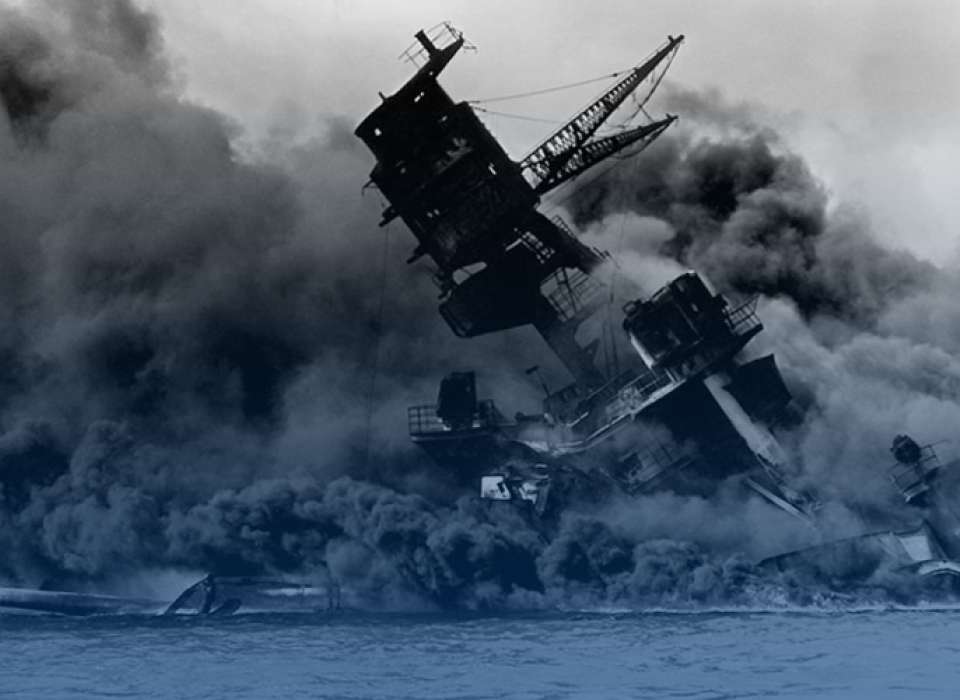
On December 7, 1941, the war took another
dramatic turn. Japan attacked American,
British, and Dutch territories in the Pacific.
On December 11, Germany and Italy declared
war on the United States. America now joined
a conflict that mushroomed into a global
war--the largest in world history.
|
|